Collagen & Consumer Supplements
Marine Collagen vs Bovine Collagen: The Revealing Truth
Jul
Marine Collagen vs Bovine Collagen: Key Differences and Which One You Actually Need (2026)
The marine collagen vs bovine collagen debate is one of the most commonly asked questions in the supplement industry — and the answer most people receive is either a brand-driven opinion masquerading as science or a vague “it depends” that leaves the buyer no clearer than before. This guide delivers the complete, evidence-based marine collagen vs bovine collagen comparison — covering molecular weight, bioavailability, collagen types, benefit categories, sourcing, sustainability, and the specific goal-by-goal decision framework that tells you exactly which option wins for your situation.
The marine collagen vs bovine collagen choice is genuinely consequential. Both are high-quality collagen peptide sources — but they differ meaningfully in their molecular weight profile, their collagen type composition, and consequently the specific benefit categories where each excels. Choosing marine collagen vs bovine collagen incorrectly for your goal does not ruin your health — but it does mean you are leaving a portion of your supplementation investment on the table. This guide ensures that does not happen.
Marine Collagen vs Bovine Collagen: The Fundamental Difference
The marine collagen vs bovine collagen comparison begins at the molecular level — because the physical properties of each source’s collagen peptides determine their absorption, distribution, and biological activity in the body.
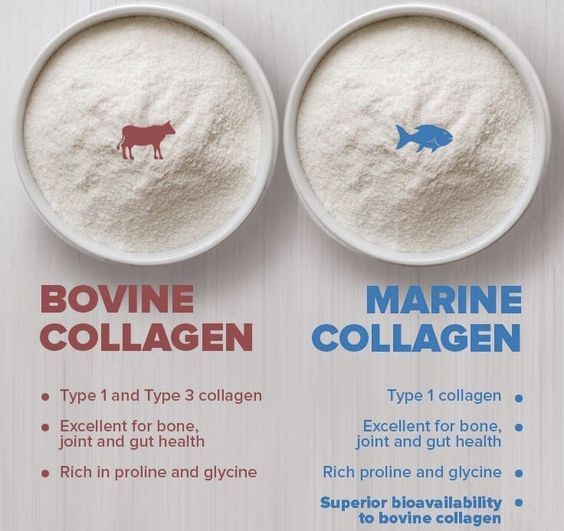
Marine collagen is derived from fish — specifically from fish skin, scales, and bones — primarily from species such as cod, tilapia, snapper, and salmon. Marine collagen is exclusively Type I collagen — the fibrillar collagen found in skin, tendon, bone, and most connective tissues. The defining molecular property of marine collagen in the marine collagen vs bovine collagen comparison is its lower average molecular weight — typically 3,000 to 5,000 daltons after hydrolysis. This lower molecular weight reflects both the naturally smaller collagen fibril structure in fish connective tissue and the efficiency of marine collagen hydrolysis processes.
Bovine collagen is derived from cattle — specifically from cattle hide, bone, and cartilage — and contains a naturally occurring mixture of Type I and Type III collagen reflecting their co-distribution in bovine connective tissue. In the marine collagen vs bovine collagen comparison, bovine collagen peptides have a higher average molecular weight — typically 10,000 to 15,000 daltons after standard hydrolysis — a direct consequence of the larger fibril structure of bovine connective tissue collagen.
This molecular weight difference between marine collagen vs bovine collagen is the most pharmacologically significant distinction between the two sources — and it directly determines the bioavailability comparison.
Marine Collagen vs Bovine Collagen: Bioavailability
Bioavailability — the proportion of consumed collagen peptides that is absorbed as intact di- and tripeptides and delivered to target connective tissues — is the most important practical comparison in the marine collagen vs bovine collagen debate.
Marine collagen wins the marine collagen vs bovine collagen bioavailability comparison. The lower average molecular weight of marine collagen peptides — 3,000 to 5,000 daltons versus 10,000 to 15,000 daltons for bovine — means marine collagen peptides cross the intestinal epithelium more efficiently as intact bioactive fragments. Research published in PubMed examining collagen peptide absorption and molecular weight consistently demonstrates that lower molecular weight collagen peptides produce higher peak plasma hydroxyproline concentrations following oral administration — meaning more of the active collagen peptide fragments reach the connective tissue sites where they stimulate collagen synthesis.
The marine collagen vs bovine collagen bioavailability advantage for marine is estimated at approximately 1.5 to 2 times higher absorption efficiency — a meaningful difference that affects how quickly each source progresses through the collagen peptides timeline and how much substrate is delivered to target tissues per gram consumed.
What this means in practice for the marine collagen vs bovine collagen decision: Marine collagen delivers more bioactive collagen peptide fragments per gram consumed — making it the more dose-efficient choice in the marine collagen vs bovine collagen comparison when bioavailability is the primary selection criterion.
Marine Collagen vs Bovine Collagen: Collagen Types
The collagen type composition difference between marine collagen vs bovine collagen is the second most important distinction after bioavailability — because collagen type determines tissue tropism and benefit category.
Marine collagen — exclusively Type I:
In the marine collagen vs bovine collagen comparison, marine collagen provides only Type I collagen peptides. Type I collagen is the structural collagen of skin, tendon, ligament, bone, and the connective tissue sheaths of muscle — making marine collagen peptides highly targeted for applications where Type I collagen is the specific tissue requirement. For skin anti-aging, tendon support, and bone matrix maintenance, marine collagen’s Type I exclusivity is not a limitation — it is a precision advantage.
Bovine collagen — Types I and III combined:
In the marine collagen vs bovine collagen comparison, bovine collagen naturally provides both Type I and Type III collagen — reflecting the co-distribution of these types in bovine hide and connective tissue. Type III collagen contributes specifically to skin elasticity and softness — the quality of youthful skin that bounces back and feels supple — alongside Type I’s contribution to structural firmness. The Type I and III combination in bovine collagen makes it the more complete skin anti-aging collagen source in the marine collagen vs bovine collagen comparison for users who want both firmness and elasticity covered in a single product.
Our Type I vs Type II vs Type III collagen guide covers the specific biological functions of each collagen type in detail — essential reading for anyone building a comprehensive collagen protocol around the marine collagen vs bovine collagen decision.
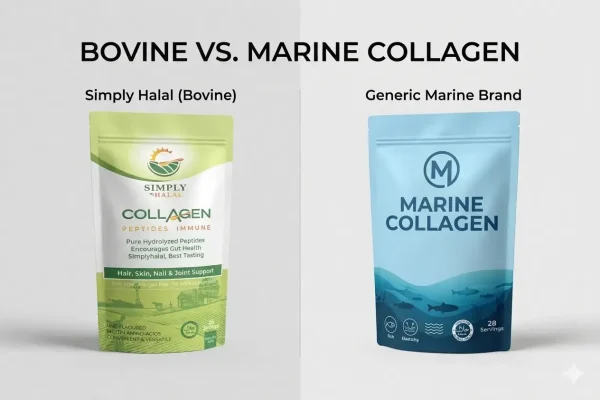
Marine Collagen vs Bovine Collagen: Head-to-Head Comparison Table
| Factor | Marine Collagen | Bovine Collagen |
|---|---|---|
| Source | Fish skin, scales, bones | Cattle hide, bone, cartilage |
| Collagen types | Type I only | Types I and III |
| Average molecular weight | 3,000 to 5,000 daltons | 10,000 to 15,000 daltons |
| Bioavailability | ★★★★★ Superior absorption | ★★★☆☆ Good but lower than marine |
| Skin anti-aging — firmness | ★★★★★ Type I — highest bioavailability | ★★★★☆ Type I — good bioavailability |
| Skin anti-aging — elasticity | ★★★☆☆ Type I only | ★★★★★ Types I and III combined |
| Tendon and ligament support | ★★★★★ High bioavailability Type I | ★★★★☆ Good Type I coverage |
| Joint health (cartilage) | ★★☆☆☆ No Type II — limited joint effect | ★★★☆☆ No Type II but broader coverage |
| Bone density support | ★★★★☆ Type I — good bioavailability | ★★★★☆ Type I — comparable |
| Gut health | ★★★☆☆ Type I provides glycine/proline | ★★★★☆ Types I and III broader gut support |
| Dietary suitability | Halal, pescatarian friendly | Not suitable for vegetarians or pescatarians |
| Taste and odour | Can have mild fish flavour if not deodorised | Generally neutral taste |
| Environmental sustainability | ★★★★☆ Utilises fish processing waste | ★★★☆☆ Cattle farming environmental footprint |
| Cost | Slightly higher per gram | Slightly lower per gram |
Marine Collagen vs Bovine Collagen: Goal-by-Goal Decision Guide
Marine Collagen vs Bovine Collagen for Skin Anti-Aging
Winner: Depends on your primary skin concern
The marine collagen vs bovine collagen decision for skin anti-aging is the most nuanced goal-specific comparison in this guide — because both sources contribute to skin health through overlapping but distinct mechanisms.
For skin firmness and wrinkle reduction — the outcome most commonly associated with collagen peptide supplementation — marine collagen wins the marine collagen vs bovine collagen comparison. Its superior bioavailability means more Type I collagen peptide fragments reach dermal fibroblasts per gram consumed — producing faster and more pronounced stimulation of the Type I collagen synthesis that improves structural skin firmness. The earlier phases of the collagen peptides timeline are reached faster with marine collagen than with bovine for this specific outcome.
For skin elasticity and softness — the quality of youthful skin that goes beyond simple firmness — bovine collagen wins the marine collagen vs bovine collagen comparison. The Type III collagen naturally present in bovine collagen contributes to the reticular fibre network responsible for skin elasticity that marine collagen’s Type I-only profile cannot address.
Best approach: Use marine collagen as the primary supplement for firmness-focused skin outcomes and combine with or alternate with bovine collagen for comprehensive coverage of both skin firmness and elasticity simultaneously. For the most complete skin health protocol, both marine collagen and GHK-Cu serum work synergistically — oral collagen peptides stimulating from the inside while topical GHK-Cu drives fibroblast activity from the outside. Our copper peptide serum guide, glow blend peptide article, and GHK-Cu serum product page cover this combination.
Marine Collagen vs Bovine Collagen for Joint Health
Winner: Neither — Type II collagen is needed
The marine collagen vs bovine collagen comparison for joint health produces a surprising answer — neither source wins decisively because neither provides the Type II collagen that is specifically required for cartilage health and the oral tolerance immune modulation mechanism that produces the most significant joint pain relief outcomes.
Both marine collagen and bovine collagen provide Type I collagen — which contributes to the connective tissue surrounding joints (tendons, ligaments, joint capsule) but not to the articular cartilage itself. For dedicated joint cartilage health, Type II chicken cartilage collagen is the specifically indicated choice — a finding that the marine collagen vs bovine collagen comparison for this application cannot escape.
For athletes whose joint concerns are primarily connective tissue and ligamentous rather than cartilage-specific, both marine and bovine collagen support the surrounding joint structures — with marine collagen’s superior bioavailability giving it a marginal advantage. For maximum joint recovery, combining any collagen peptide source with BPC-157 injectable recovery peptide creates the most effective protocol — BPC-157’s angiogenic and anti-inflammatory mechanisms directly accelerating the connective tissue repair that collagen peptides nutritionally support. Our BPC-157 and TB-500 stack guide, BPC-157 product page, and peptides for healing article cover the complete joint recovery protocol.
Marine Collagen vs Bovine Collagen for Athletic Recovery
Winner: Marine collagen — marginally
For athletes using collagen peptides specifically for tendon health and athletic connective tissue recovery — taken 60 minutes before training with Vitamin C — marine collagen wins the marine collagen vs bovine collagen comparison marginally. Its superior bioavailability delivers more active Type I collagen peptide fragments to tenocytes in the post-exercise collagen synthesis window — producing a slightly faster and more pronounced progression through the athletic phases of the collagen peptides timeline.
However bovine collagen is not significantly inferior for this application — its Type I content provides excellent tendon and ligament collagen precursor substrate, and the inclusion of Type III collagen contributes to the fascial connective tissue health that supports athletic performance alongside tendon function. For athletes who want comprehensive connective tissue coverage across multiple tissue types, bovine collagen’s Type I and III combination is a practical advantage over marine collagen’s Type I only profile.
For athletes running performance peptide protocols — CJC-1295 + Ipamorelin, BPC-157, or IGF-1 LR3 — collagen peptides from either marine or bovine sources integrate as the foundational nutritional support that enhances the connective tissue environment in which injectable peptides operate. Our how to build a peptide stack for muscle growth guide, best peptides for cutting article, and CJC-1295 + Ipamorelin blend product page cover the complete performance protocol context.
Marine Collagen vs Bovine Collagen for Hair Health
Winner: Marine collagen
The marine collagen vs bovine collagen comparison for hair health resolves in marine collagen’s favour — its superior bioavailability ensures maximum delivery of Type I collagen peptide fragments to the scalp dermis where follicle-anchoring collagen is synthesised. Hair follicles are anchored in the dermal connective tissue that depends primarily on Type I collagen — and the faster absorption of marine collagen makes more substrate available during the follicle growth phase where collagen synthesis is most active.
For maximum hair health outcomes from the marine collagen vs bovine collagen comparison, combining oral marine collagen with topical GHK-Cu scalp application addresses hair health from both the nutritional and the topical peptide stimulation angles simultaneously. Our copper peptides for hair growth guide covers this combined approach in complete detail.
Marine Collagen vs Bovine Collagen for Gut Health
Winner: Bovine collagen — marginally
The marine collagen vs bovine collagen comparison for gut health resolves slightly in bovine collagen’s favour — primarily because the combination of Type I and Type III collagen provides broader coverage of the intestinal wall connective tissue where both collagen types are naturally expressed. Bovine collagen’s higher glycine content per serving (due to larger serving sizes required to compensate for lower bioavailability) also contributes to gut mucosal support.
For athletes managing gut health alongside training stress, combining bovine collagen peptides with oral BPC-157 capsules creates the most comprehensive gut health protocol — collagen peptides providing the structural amino acid substrate while BPC-157 activates the mucosal repair and anti-inflammatory mechanisms that protect gut integrity under training-induced stress. Our BPC-157 product page and BPC-157 benefits article cover the complete gut health peptide protocol.
Marine Collagen vs Bovine Collagen: Dietary and Lifestyle Considerations
Beyond the pharmacological marine collagen vs bovine collagen comparison, several practical lifestyle factors should inform the decision:
Dietary restrictions: Marine collagen is suitable for pescatarians and is halal-certified from appropriate sources. Bovine collagen is not suitable for vegetarians, vegans, or those following halal diets without verified certification. The marine collagen vs bovine collagen decision for users with dietary restrictions may be determined by these considerations alone.
Taste: Some marine collagen products carry a mild fish flavour or odour — particularly lower-quality products using less refined hydrolysis processes. Quality marine collagen peptides from TitanForge Peptides are deodorised and flavour-neutral. Bovine collagen is generally tasteless and odourless in hydrolysed form — a practical advantage for users who mix collagen peptides into beverages or smoothies.
Sustainability: Marine collagen primarily utilises fish processing industry byproducts — skin, scales, and bones that would otherwise be discarded — giving it a favourable sustainability profile compared to collagen sources requiring dedicated animal rearing. The marine collagen vs bovine collagen comparison on environmental grounds generally favours marine collagen for this reason.
Can You Use Marine and Bovine Collagen Together?
Yes — and for users seeking the most comprehensive collagen peptides coverage, using both marine and bovine collagen simultaneously in the same daily protocol is the optimal approach to the marine collagen vs bovine collagen question.
The combination of marine and bovine collagen addresses the complete spectrum of collagen peptide benefits more comprehensively than either source alone. Marine collagen’s superior bioavailability maximises the Type I collagen peptide substrate delivery to skin and surface connective tissue. Bovine collagen’s Type III content addresses skin elasticity and gut health dimensions that marine collagen’s Type I-only profile cannot cover. Together they eliminate every gap that the marine collagen vs bovine collagen comparison reveals in each source individually.
Many users in the TitanForge Peptides community who begin the marine collagen vs bovine collagen comparison as an either-or question end up using both — marine collagen as their primary morning dose for skin health and bovine collagen pre-training for the comprehensive connective tissue coverage that athletic recovery demands. Browse our complete collagen peptides range covering both marine and bovine options across all major application categories.
Marine Collagen vs Bovine Collagen: The Definitive Decision Guide
| Your Primary Goal | Marine Collagen vs Bovine Collagen Winner | Recommended Product |
|---|---|---|
| Skin firmness and wrinkle reduction | Marine collagen — superior bioavailability Type I | Marine collagen peptides |
| Skin elasticity and softness | Bovine collagen — Type I and III combined | Bovine collagen peptides |
| Complete skin anti-aging | Both together | Marine + bovine combined protocol |
| Tendon and ligament recovery | Marine collagen — marginally | Marine collagen pre-training |
| Cartilage and joint health | Neither — use Type II | Type II chicken cartilage collagen |
| Gut health | Bovine collagen — broader coverage | Bovine collagen peptides |
| Hair health | Marine collagen — superior bioavailability | Marine collagen peptides |
| Athletic comprehensive recovery | Both together | Marine morning + bovine pre-training |
| Dietary restriction (pescatarian) | Marine collagen only option | Marine collagen peptides |
| Budget-conscious | Bovine collagen — lower cost per gram | Bovine collagen peptides |
Frequently Asked Questions
Q: Is marine collagen better than bovine collagen?
A: In the marine collagen vs bovine collagen comparison — marine collagen has superior bioavailability due to its lower molecular weight, making it more dose-efficient and faster-acting for skin firmness and hair health goals. Bovine collagen has broader collagen type coverage (Types I and III), making it more comprehensive for skin elasticity, gut health, and general connective tissue maintenance. Neither is universally better — the marine collagen vs bovine collagen winner depends entirely on your specific goal.
Q: Which is better for skin — marine or bovine collagen?
A: For skin firmness and wrinkle reduction — marine collagen wins the marine collagen vs bovine collagen comparison due to its superior bioavailability delivering more Type I collagen peptides to dermal fibroblasts per gram consumed. For skin elasticity and softness — bovine collagen wins because its natural Type III content addresses the skin elasticity dimension that marine collagen’s Type I-only profile cannot. For complete skin anti-aging coverage — use both together.
Q: What is the main difference between marine and bovine collagen?
A: The main differences in the marine collagen vs bovine collagen comparison are molecular weight (marine 3,000 to 5,000 daltons versus bovine 10,000 to 15,000 daltons), bioavailability (marine superior), and collagen type composition (marine Type I only versus bovine Types I and III). These differences determine which benefit categories each source excels at and inform the goal-specific decision framework in this guide.
Q: Can I take marine and bovine collagen together?
A: Yes — combining marine collagen and bovine collagen is the most comprehensive collagen peptides protocol available, covering Type I bioavailability for skin firmness and hair health (marine) alongside Type III for skin elasticity and gut health (bovine). The two sources complement rather than compete with each other in the marine collagen vs bovine collagen combination protocol.
Q: Is marine collagen more expensive than bovine collagen?
A: Yes — marine collagen is typically slightly more expensive per gram than bovine collagen, reflecting the more complex processing required to extract and hydrolyse fish skin and scale collagen to the low molecular weight that gives marine collagen its bioavailability advantage. The marine collagen vs bovine collagen cost difference is moderate — and the superior bioavailability of marine collagen means a lower dose achieves equivalent plasma peptide concentrations compared to bovine.
Q: Where can I buy marine and bovine collagen peptides?
A: TitanForge Peptides supplies both marine Type I collagen and bovine Type I and III collagen — independently quality verified with full documentation before every purchase. Browse our complete collagen peptides range here.
