best peptides for weight loss and muscle gain
Tesamorelin Peptide: Benefits, Dosage & How It Works

May
Tesamorelin Peptide: Benefits, Dosage, and How It Works (2026)
Tesamorelin peptide occupies a unique position in the growth hormone peptide landscape — one that sets it apart from every other GHRH analogue available in the research community. While compounds like CJC-1295 and sermorelin are widely used for their GH-stimulating effects and are supported by compelling preclinical evidence, tesamorelin peptide has crossed the threshold that none of its GHRH analogue peers have reached: it has received formal FDA approval as a pharmaceutical treatment for a specific, clinically defined condition.
That distinction matters — not just as a regulatory footnote, but as a signal of the depth and quality of the clinical evidence base supporting tesamorelin peptide’s effects. The randomised controlled trial data generated during tesamorelin peptide’s pharmaceutical development programme provides a level of evidence-based confidence that makes it one of the most credible fat loss and GH-stimulating peptides available to researchers and protocol designers in 2026.
This guide covers everything you need to know about tesamorelin peptide — what it is, exactly how it works at the hypothalamic-pituitary level, its most extensively documented benefits, how it compares to other GHRH analogues, dosage guidance, and where to find genuine tesamorelin peptide at verified purity standards.
What Is Tesamorelin Peptide?
Tesamorelin peptide is a synthetic analogue of endogenous growth hormone releasing hormone (GHRH) — the naturally occurring neuropeptide produced by the hypothalamus that signals the pituitary gland to release growth hormone. Tesamorelin peptide consists of the full 44-amino-acid sequence of human GHRH, modified with the addition of a trans-3-hexenoic acid group at the N-terminus — a modification that dramatically increases tesamorelin peptide’s stability against enzymatic degradation in the bloodstream, extending its functional half-life compared to native GHRH.
Tesamorelin peptide was developed by Theratechnologies and received FDA approval in 2010 under the brand name Egrifta for the treatment of excess abdominal fat in HIV-infected patients with lipodystrophy — an abnormal redistribution of body fat caused by HIV antiretroviral therapy. This approval made tesamorelin peptide the first and only GHRH analogue to receive FDA approval for any indication — establishing a regulatory track record that distinguishes tesamorelin peptide from all other synthetic GHRH analogues in the research market.
The clinical trial programme that supported tesamorelin peptide’s FDA approval generated an unusually robust evidence base — with multiple large-scale randomised controlled trials demonstrating statistically significant, reproducible reductions in visceral adipose tissue (VAT) that have been validated across diverse patient populations. As documented in PubMed’s tesamorelin clinical trial index, this clinical data positions tesamorelin peptide as the most evidence-backed GHRH analogue for visceral fat reduction currently available.
How Tesamorelin Peptide Works
Tesamorelin peptide exerts its effects through a well-defined, physiologically appropriate mechanism that distinguishes it meaningfully from direct GH administration and from shorter-acting GHRH analogues:
GHRH Receptor Activation and Pulsatile GH Release
Tesamorelin peptide binds to and activates GHRH receptors on somatotroph cells in the anterior pituitary gland — stimulating the release of endogenous growth hormone in a pulsatile pattern that closely mirrors the body’s natural GH secretion rhythm. This pulsatile GH release from tesamorelin peptide stimulation is physiologically important — it preserves the natural feedback regulation of the GH axis rather than producing the constant, supraphysiological GH elevation associated with exogenous HGH administration.
The preservation of pulsatile GH release by tesamorelin peptide means the body’s own regulatory systems — including IGF-1 feedback and somatostatin inhibition — remain functional throughout the protocol, producing a self-limiting GH elevation that is inherently safer than approaches that bypass natural regulation entirely.
IGF-1 Elevation and Downstream Anabolic Activity
Tesamorelin peptide-stimulated GH release drives downstream elevation of IGF-1 — Insulin-like Growth Factor 1 — in the liver and peripheral tissues. IGF-1 mediates the majority of GH’s metabolic and anabolic effects, including fat oxidation, muscle protein synthesis, and connective tissue support. As reviewed in Examine.com’s GHRH analogue research overview, the IGF-1 elevation produced by GHRH analogues like tesamorelin peptide is central to the body composition changes observed in clinical trials.
Visceral Fat Reduction Through GH-Driven Lipolysis
The most clinically significant mechanism of tesamorelin peptide is its ability to reduce visceral adipose tissue — the metabolically active fat depot surrounding the abdominal organs. GH is a potent stimulator of lipolysis — the breakdown of stored fat for energy — with visceral adipose tissue being particularly responsive to GH-driven fat mobilisation. Tesamorelin peptide’s GH stimulation drives preferential lipolysis in visceral fat depots, producing the selective reduction in abdominal fat that is the compound’s most distinctive and clinically validated effect.
Tesamorelin Peptide Key Benefits
Based on the clinical trial data and preclinical research supporting tesamorelin peptide, the following benefits are the most extensively documented:
Clinically proven visceral fat reduction — Tesamorelin peptide’s most robustly evidenced benefit is its ability to reduce visceral adipose tissue — the deep abdominal fat that surrounds organs and is directly associated with cardiometabolic risk. Multiple FDA-approval-enabling clinical trials demonstrated average VAT reductions of 15 to 18 percent from baseline with tesamorelin peptide versus placebo — a clinically meaningful reduction that has been validated across multiple independent study populations.
For individuals dealing with stubborn abdominal fat that is resistant to diet and exercise — particularly older individuals experiencing age-related accumulation of visceral fat driven by natural GH decline — tesamorelin peptide’s visceral fat-specific lipolytic effect is one of the most compelling targeted interventions available.
Growth hormone axis restoration — Natural GH production declines significantly with age — a process called somatopause — producing the characteristic body composition changes of middle age: increased visceral fat, reduced lean muscle mass, reduced bone density, and declining metabolic rate. Tesamorelin peptide’s GHRH receptor activation stimulates the pituitary to restore more youthful GH secretion patterns, addressing the upstream hormonal driver of these age-related changes rather than simply treating their symptoms.
Improved body composition — Beyond visceral fat reduction, tesamorelin peptide’s GH and IGF-1 elevation supports lean mass preservation and modest lean mass improvement alongside fat reduction — producing genuine body recomposition rather than simple weight loss. Clinical trial participants using tesamorelin peptide showed improvements in trunk-to-limb fat ratio alongside VAT reduction, reflecting a broader body composition benefit beyond the primary abdominal fat endpoint.
Cardiometabolic marker improvement — Visceral fat is not just aesthetically undesirable — it is metabolically active, secreting inflammatory cytokines and contributing to insulin resistance, dyslipidaemia, and cardiovascular risk. Tesamorelin peptide’s reduction of visceral fat in clinical trials was accompanied by improvements in triglycerides, visceral adiposity index, and other cardiometabolic markers — suggesting benefits that extend beyond the visible body composition changes.
Improved physical performance in GH-deficient individuals — GH plays a fundamental role in exercise capacity, recovery, and physical performance. Tesamorelin peptide’s restoration of more physiological GH levels in individuals with age-related or pathological GH deficiency supports improved exercise tolerance, faster post-exercise recovery, and enhanced training adaptations over sustained use.
These statements reflect current clinical and preclinical research findings. Tesamorelin peptide outside of the pharmaceutical Egrifta formulation is supplied as a research compound. Always consult a qualified healthcare professional before beginning any tesamorelin peptide protocol.
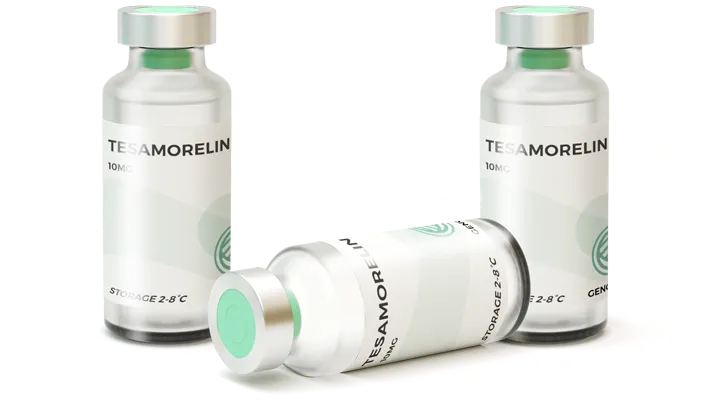
Tesamorelin Peptide vs CJC-1295: Which GHRH Analogue Should You Choose?
Tesamorelin peptide and CJC-1295 are the two most widely researched GHRH analogues available — and the comparison between them is one of the most frequently asked questions among performance and longevity-focused researchers. Here is a direct, evidence-based breakdown:
| Factor | Tesamorelin Peptide | CJC-1295 (without DAC) |
|---|---|---|
| Structure | Full 44-aa GHRH sequence + N-terminal modification | Modified GHRH 1-29 fragment |
| Regulatory status | FDA-approved (Egrifta) for lipodystrophy | Research compound — no approval |
| Evidence base | Large-scale human RCTs — highest clinical evidence | Preclinical + smaller human studies |
| Primary application | Visceral fat reduction, GH restoration | GH stimulation, performance, anti-aging |
| Half-life | Approximately 25 to 38 minutes | Approximately 30 minutes |
| Dosing frequency | Once daily | 2 to 3 times daily |
| Visceral fat evidence | ★★★★★ Strongest available — clinical RCT data | ★★★☆☆ Inferred through GH mechanism |
| Performance focus | ★★★☆☆ Secondary benefit | ★★★★★ Primary application |
| Stack with GHRP? | Yes — enhances GH pulse | Yes — standard combination |
| Cost | Higher — more complex synthesis | Moderate |
The key distinction is clinical evidence specificity — tesamorelin peptide has the strongest clinical evidence for visceral fat reduction of any GHRH analogue, supported by the FDA-approval-enabling RCT programme. CJC-1295 has a broader application profile for performance, recovery, and general GH optimisation with a more accessible price point.
For individuals whose primary goal is visceral abdominal fat reduction — particularly older individuals, those with metabolic syndrome, or anyone with significant centrally accumulated fat that has proven resistant to conventional approaches — tesamorelin peptide’s clinical evidence makes it the more targeted and more evidence-backed choice. For athletes and performance-focused users seeking broad GH optimisation across muscle, recovery, fat, and sleep — CJC-1295 combined with Ipamorelin remains the most practical and cost-effective approach. Explore our CJC-1295 product page and CJC-1295 + Ipamorelin blend for the standard GH secretagogue stack.
Tesamorelin Peptide vs AOD-9604
Both tesamorelin peptide and AOD-9604 target fat loss — but through completely different mechanisms that make them complementary rather than competing options:
Tesamorelin peptide works upstream — stimulating GH release from the pituitary, which then drives systemic fat mobilisation with a preference for visceral depots. Tesamorelin peptide’s fat loss effect is mediated through the entire GH-IGF-1 axis and produces broader metabolic and body composition benefits alongside visceral fat reduction.
AOD-9604 works downstream — it is a fragment of the HGH molecule specifically engineered to reproduce HGH’s fat-burning properties through direct lipolytic activity in adipose tissue without activating the growth hormone receptor. AOD-9604 produces direct, targeted lipolysis without the upstream hormonal cascade of tesamorelin peptide.
The most comprehensive approach for individuals focused specifically on visceral and abdominal fat reduction is combining tesamorelin peptide’s upstream GH stimulation with AOD-9604’s direct lipolytic activity — covering both the hormonal and the direct adipose tissue mechanisms simultaneously. Explore our AOD-9604 product page for full AOD-9604 specifications and dosage guidance.
Tesamorelin Peptide Dosage Guide
The following tesamorelin peptide dosage information is provided for reference based on published clinical research. It does not constitute medical advice.
Clinical and research tesamorelin peptide dosage:
- Dose: 1 mg to 2 mg per day subcutaneously
- Frequency: Once daily — tesamorelin peptide’s once-daily dosing is one of its practical advantages over shorter-acting GHRH analogues requiring multiple daily injections
- Timing: Morning administration before breakfast in a fasted state — this aligns tesamorelin peptide’s GH stimulation with the natural morning GH pulse and maximises the lipolytic window before the first meal
- Cycle length: 3 to 6 months for meaningful visceral fat reduction — the FDA approval trials ran for 26 weeks, and the most significant VAT reductions were observed at the 26-week endpoint
- Break period: Minimum 4-week break between cycles
Tesamorelin peptide reconstitution: Tesamorelin peptide is supplied as a lyophilized powder requiring reconstitution with bacteriostatic water. The standard reconstitution ratio is 1ml to 2ml bac water per 2mg vial. Use our peptide reconstitution calculator for exact draw volumes based on your reconstitution ratio.
Stacking tesamorelin peptide: Tesamorelin peptide is commonly combined with a GHRP such as Ipamorelin or GHRP-6 to produce a synergistic GH pulse — tesamorelin peptide activating the GHRH receptor while the GHRP activates the complementary ghrelin receptor pathway simultaneously. This combination produces a stronger GH response than tesamorelin peptide alone and is the standard approach for users seeking maximum GH axis stimulation alongside the visceral fat-specific benefits of tesamorelin peptide.
Tesamorelin Peptide: Side Effect Profile
Tesamorelin peptide’s clinical trial data provides the most comprehensive side effect profile of any synthetic GHRH analogue — a meaningful advantage of its pharmaceutical development history. The most commonly reported adverse events from the FDA approval trials include:
Injection site reactions — The most frequently reported side effect of tesamorelin peptide in clinical trials — redness, swelling, and tenderness at the subcutaneous injection site. These are typically mild and resolve within 24 to 48 hours. Rotating injection sites minimises localised tissue irritation from tesamorelin peptide injections.
Water retention — GH-related fluid retention is a common effect of tesamorelin peptide — particularly during the first 4 to 8 weeks of use. This typically resolves as the body adapts to the new GH level. Mild oedema in the extremities is the most common presentation of tesamorelin peptide-related water retention.
Joint and muscle discomfort — Arthralgia and myalgia are reported with tesamorelin peptide at higher doses — consistent with the known joint and muscle effects of GH elevation across the GHRH analogue class. These effects are typically mild and dose-dependent.
Glucose metabolism effects — GH has insulin-antagonising properties — meaning tesamorelin peptide can produce mild increases in fasting blood glucose, particularly at higher doses or in individuals with pre-existing insulin resistance. Individuals with diabetes or impaired glucose metabolism should exercise particular caution with tesamorelin peptide and monitor glucose levels during protocols. As reviewed in Rupa Health’s GHRH analogue clinical overview, glucose monitoring is a standard recommendation for any GH-stimulating peptide protocol.
Frequently Asked Questions
Q: What is tesamorelin peptide used for? A: Tesamorelin peptide is used in research and clinical contexts primarily for visceral fat reduction through GH-axis stimulation. It is the only FDA-approved GHRH analogue — approved as Egrifta for HIV-associated lipodystrophy. In research contexts, tesamorelin peptide is studied for visceral fat reduction, GH restoration in age-related GH decline, body composition improvement, and cardiometabolic marker optimisation.
Q: How does tesamorelin peptide differ from other GHRH analogues? A: Tesamorelin peptide uses the full 44-amino-acid GHRH sequence with an N-terminal modification for enhanced stability — making it structurally more complete than the Modified GRF 1-29 fragment used in CJC-1295. Tesamorelin peptide also has the strongest clinical evidence base of any GHRH analogue, supported by large-scale FDA-approval-enabling randomised controlled trials specifically demonstrating visceral fat reduction.
Q: How long does tesamorelin peptide take to reduce belly fat? A: The FDA approval clinical trials for tesamorelin peptide ran for 26 weeks — with significant VAT reductions observed across the full trial period. Meaningful visceral fat reduction from tesamorelin peptide is typically observed from week 12 onwards, with peak results at 6 months of consistent daily tesamorelin peptide administration. Short-term protocols of less than 12 weeks are unlikely to produce the level of VAT reduction demonstrated in clinical research.
Q: Can tesamorelin peptide be stacked with Ipamorelin? A: Yes — tesamorelin peptide and Ipamorelin are a highly effective combination. Tesamorelin peptide activates the GHRH receptor pathway while Ipamorelin activates the complementary ghrelin receptor — the two pathways working synergistically to produce a stronger GH pulse than either compound alone. This combination is the most common tesamorelin peptide stack for users seeking maximum GH axis stimulation. Explore our Ipamorelin product page for full Ipamorelin dosage details.
Q: Is tesamorelin peptide the same as CJC-1295? A: No — tesamorelin peptide and CJC-1295 are different GHRH analogues with different structures, evidence bases, and primary applications. Tesamorelin peptide uses the full 44-amino-acid GHRH sequence and has FDA-approval-enabling RCT data for visceral fat reduction. CJC-1295 uses the modified 29-amino-acid GHRH fragment and is primarily used for performance, recovery, and general GH optimisation. Both are GHRH analogues that stimulate pituitary GH release — but they are distinct compounds.
Q: Where can I buy tesamorelin peptide? A: TitanForge Peptides supplies research-grade tesamorelin peptide at independently verified 99%+ purity with a full Certificate of Analysis on every batch. Shop tesamorelin peptide here.
