peptide comparison and alternatives
CJC-1295 vs Ipamorelin — The Answer Will Surprise You
May
CJC-1295 vs Ipamorelin: Which GH Peptide Is Right for You? (2026)
If you are researching CJC-1295 vs Ipamorelin trying to decide which one to use — you are asking a question that most peptide vendors will answer incorrectly. They will give you a comparison table, declare one compound the winner for your goal, and steer you toward a single purchase. This guide is going to give you a fundamentally different answer — one that is supported by the pharmacology, consistent with the research evidence, and will almost certainly change how you think about the CJC-1295 vs Ipamorelin decision entirely.
The real answer to the CJC-1295 vs Ipamorelin question is not which one is better. It is that the comparison itself is based on a false premise — the idea that CJC-1295 and Ipamorelin are alternatives competing for the same role in your protocol. They are not. CJC-1295 and Ipamorelin work through completely different biological mechanisms targeting entirely separate GH-releasing pathways — which means they are not two answers to the same question, they are two complementary answers to two different questions that together produce a result neither can achieve alone.
Understanding why changes everything about your GH protocol. But to understand why, you first need to understand exactly how each compound works — and why the mechanisms matter more than any surface-level comparison ever could.
CJC-1295 Explained: The GHRH Pathway
CJC-1295 is a synthetic analogue of growth hormone releasing hormone — the endogenous neuropeptide produced by the hypothalamus that signals the pituitary gland to release growth hormone. Specifically CJC-1295 is a modified version of the GHRH 1-29 fragment — the biologically active N-terminal portion of GHRH that carries the full receptor-binding and GH-releasing activity of the complete 44-amino-acid molecule.
When CJC-1295 is administered subcutaneously, it travels to the anterior pituitary where it binds to and activates the GHRH receptor (GHRHR) on somatotroph cells — the specialised pituitary cells responsible for producing and releasing growth hormone. This GHRHR activation triggers a cascade of intracellular signalling events that results in GH synthesis and secretion — producing a GH pulse that is proportional to the CJC-1295 dosage and the existing pituitary GH reserve.
The defining characteristic of CJC-1295 in the CJC-1295 vs Ipamorelin comparison is that it works exclusively through the GHRH receptor pathway. This is the same pathway that the hypothalamus uses to signal natural GH release — meaning CJC-1295 amplifies an existing biological signal rather than introducing an entirely new one. The result is a GH pulse that is physiologically consistent, receptor-selective, and governed by the same natural feedback mechanisms that regulate the body’s endogenous GH axis.
As documented in PubMed’s CJC-1295 pharmacokinetics research, CJC-1295 produces dose-dependent GH release that maintains the pulsatile character of natural GH secretion — making it one of the most physiologically appropriate tools available for GH axis optimisation.
Ipamorelin Explained: The Ghrelin Receptor Pathway
Ipamorelin is a synthetic pentapeptide — a five-amino-acid chain — belonging to the growth hormone releasing peptide (GHRP) family. Unlike CJC-1295, Ipamorelin does not work through the GHRH receptor at all. Instead Ipamorelin activates the growth hormone secretagogue receptor type 1a (GHSR-1a) — the ghrelin receptor — on somatotroph cells in the anterior pituitary.
This is a completely separate receptor from the GHRH receptor that CJC-1295 targets. The ghrelin receptor is activated by the endogenous hormone ghrelin — a peptide primarily produced in the stomach that plays roles in appetite regulation, GH secretion, and energy metabolism. When Ipamorelin activates GHSR-1a it triggers a GH pulse through an intracellular signalling cascade that is distinct from the GHRHR pathway — producing GH release through a mechanism that is entirely independent of and parallel to the CJC-1295 mechanism.
The defining characteristic of Ipamorelin in the CJC-1295 vs Ipamorelin comparison is its exceptional receptor selectivity. While earlier GHRPs like GHRP-6 and GHRP-2 activate multiple receptor subtypes alongside GHSR-1a — producing GH release but also elevating cortisol, prolactin, and other hormones — Ipamorelin is highly selective for GHSR-1a. This means Ipamorelin produces a clean, strong GH pulse without the cortisol and prolactin elevation that makes less selective GHRPs problematic for extended use.
As reviewed in Examine.com’s growth hormone secretagogue analysis, Ipamorelin’s combination of strong GH release and minimal off-target hormonal effects makes it the most practically useful GHRP for the widest range of users and protocol durations.
CJC-1295 vs Ipamorelin: The Head-to-Head Comparison
Now that both mechanisms are clear, here is how CJC-1295 and Ipamorelin compare across the factors that matter most in a GH peptide protocol:
| Factor | CJC-1295 | Ipamorelin |
|---|---|---|
| Receptor target | GHRH receptor (GHRHR) | Ghrelin receptor (GHSR-1a) |
| Mechanism | GHRH pathway amplification | Ghrelin receptor activation |
| GH release potency | Strong — moderate to high pulse | Strong — clean, sharp pulse |
| Cortisol elevation | Minimal | Minimal — best-in-class selectivity |
| Prolactin elevation | Minimal | Minimal |
| Appetite stimulation | None | None — unlike GHRP-6 |
| Half-life (non-DAC) | ~30 minutes | ~2 hours |
| Injection frequency | 2 to 3 times daily | 2 to 3 times daily |
| Beginner suitability | ★★★★★ | ★★★★★ |
| Long-cycle suitability | ★★★★★ | ★★★★★ |
| Solo use effectiveness | Good | Good |
| Combined effectiveness | ★★★★★ Synergistic | ★★★★★ Synergistic |
The most important row in the entire CJC-1295 vs Ipamorelin comparison is the last two. Solo use effectiveness for both compounds is good — meaningful GH release, meaningful body composition benefits, meaningful recovery improvement. But combined effectiveness is exceptional — and this is where the CJC-1295 vs Ipamorelin comparison fundamentally changes.
Why the CJC-1295 vs Ipamorelin Question Has the Wrong Premise
Here is the insight that transforms the CJC-1295 vs Ipamorelin comparison from a binary either-or decision into a protocol design decision:
CJC-1295 and Ipamorelin activate two completely separate GH-releasing pathways in the pituitary simultaneously — and the two pathways are synergistic.
When CJC-1295 is administered alongside Ipamorelin, CJC-1295 activates GHRHR on somatotroph cells while Ipamorelin simultaneously activates GHSR-1a on the same cells. Both signals converge on the same output — GH secretion — through different intracellular mechanisms. The result is a GH pulse that is substantially greater than the additive sum of the two individual pulses — a genuine pharmacological synergy rather than simply double the effect.
This is not theoretical — it is the documented pharmacological basis for why the CJC-1295 and Ipamorelin combination became the most widely used GH peptide protocol globally. Research consistently demonstrates that GHRH analogues and GHRPs produce synergistic rather than merely additive GH release when administered together — as documented in PubMed’s GHRH and GHRP combination research.
This synergy means that the real answer to CJC-1295 vs Ipamorelin is not to choose one. It is to use both — and to use them together in the same injection for maximum synergistic effect.
CJC-1295 vs Ipamorelin: When You Might Use One Without the Other
Despite the synergistic argument for combining both compounds, there are specific circumstances where using CJC-1295 or Ipamorelin individually makes sense:
CJC-1295 solo — appropriate when:
- Budget constraints require starting with a single compound — CJC-1295 alone provides the GHRH pathway activation that forms the backbone of any GH protocol
- Running CJC-1295 with DAC on a once-weekly protocol where daily GHRP dosing is impractical — the DAC version’s extended half-life makes continuous GHRHR activation without daily injection possible
- Researching the individual effects of each compound before combining — starting solo allows clean assessment of individual response before adding the second pathway
Ipamorelin solo — appropriate when:
- Investigating the specific ghrelin receptor pathway effects independently
- Adding a GHRP to an existing protocol that already includes a different GHRH component such as sermorelin or tesamorelin
- Users who specifically want the GHSR-1a activation benefits — including the sleep quality and appetite-neutral GH release that characterise Ipamorelin — without the GHRH component
For the vast majority of users however the CJC-1295 vs Ipamorelin question resolves to the same answer — use both together.
CJC-1295 + Ipamorelin: The Combined Protocol
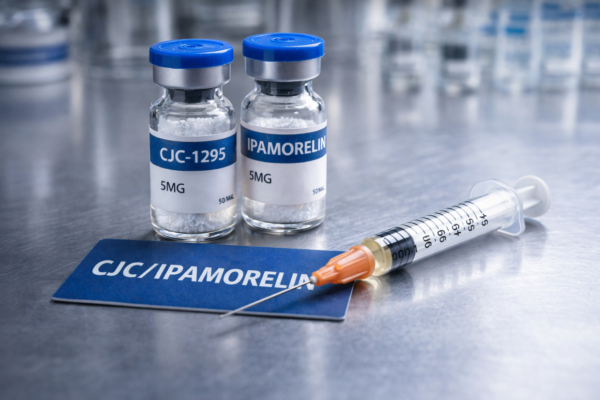
When CJC-1295 and Ipamorelin are used together — which is the standard recommendation for almost all bodybuilding and performance protocols — both compounds are drawn into the same insulin syringe and administered as a single subcutaneous injection. This combined injection approach is both pharmacologically sound and practically convenient — one injection rather than two covers both GH-releasing pathways simultaneously.
Standard CJC-1295 + Ipamorelin Combined Protocol:
- CJC-1295 dose: 100 mcg to 200 mcg per injection
- Ipamorelin dose: 200 mcg to 300 mcg per injection
- Administration: Both drawn into the same insulin syringe, single subcutaneous injection
- Frequency: Twice daily — upon waking fasted and 30 to 60 minutes before sleep
- Cycle length: 8 to 16 weeks followed by a minimum 4-week break
- Timing: Always in a fasted or near-fasted state — insulin elevation from a recent meal significantly blunts the GH pulse from both compounds
For detailed dosage guidance across all experience levels see our CJC-1295 dosage guide and our CJC-1295 Ipamorelin shelf life and storage guide.
The Pre-Blended Solution: CJC-1295 + Ipamorelin Combination Vial
For users who want the maximum convenience of the CJC-1295 and Ipamorelin combination without the need to reconstitute two separate vials and draw from both per injection — TitanForge Peptides supplies the CJC-1295 + Ipamorelin pre-blended combination vial.
This pre-blended vial combines both compounds in a single lyophilized vial at the ideal ratio — one reconstitution, one vial, one draw per injection. The same synergistic two-pathway GH protocol in a format that eliminates every additional step involved in running the two compounds separately. Both compounds are independently verified to minimum 99% purity by HPLC and Mass Spectrometry — with full batch-specific COA documentation on our Lab Results page.
CJC-1295 vs Ipamorelin vs GHRP-6: Where Does GHRP-6 Fit?
The CJC-1295 vs Ipamorelin comparison frequently leads to a follow-up question — where does GHRP-6 fit, and should you consider GHRP-6 instead of Ipamorelin?
GHRP-6 activates the same GHSR-1a receptor as Ipamorelin — meaning it operates through the same ghrelin receptor pathway and is equally synergistic with CJC-1295. The key difference between Ipamorelin and GHRP-6 is receptor selectivity and side effects:
- Ipamorelin — highly selective for GHSR-1a, minimal cortisol or prolactin elevation, no appetite stimulation. Best for most users at most goals across extended protocols.
- GHRP-6 — activates GHSR-1a plus additional receptor subtypes, produces moderate cortisol and prolactin elevation, significant appetite stimulation. Best for deliberate bulking phases where the appetite enhancement is a genuine benefit.
For users specifically in a mass-gaining phase who need both GH stimulation and appetite support to maintain the caloric surplus required for maximum muscle growth — replacing Ipamorelin with GHRP-6 in the CJC-1295 + GHRP stack is the standard bulking protocol adjustment. For all other goals and all other phases Ipamorelin is the more appropriate and more versatile GHRP choice. Our GHRP-6 product page covers full GHRP-6 specifications for users considering the bulking stack variation.
Frequently Asked Questions
Q: Should I take CJC-1295 or Ipamorelin? A: Both — and together. CJC-1295 and Ipamorelin activate completely separate GH-releasing pathways and produce synergistic GH release when combined in the same injection. The CJC-1295 vs Ipamorelin comparison is based on a false premise — they are not alternatives but complements. The standard recommendation for almost all performance and bodybuilding protocols is to use CJC-1295 and Ipamorelin together as a combined injection twice daily.
Q: What is the difference between CJC-1295 and Ipamorelin? A: CJC-1295 is a GHRH analogue that activates the GHRH receptor pathway to produce GH release. Ipamorelin is a GHRP that activates the ghrelin receptor pathway to produce GH release. They use completely different receptors and completely different intracellular mechanisms — which is precisely why they are synergistic when combined rather than redundant.
Q: Is CJC-1295 stronger than Ipamorelin? A: Comparing strength between CJC-1295 and Ipamorelin individually is not the most useful framing — they produce GH release through different mechanisms and the question of which is “stronger” is less meaningful than understanding that their combined use produces substantially greater GH release than either compound alone. Together they cover both primary GH-releasing pathways simultaneously for a synergistic outcome that neither achieves independently.
Q: Can CJC-1295 and Ipamorelin be mixed in the same syringe? A: Yes — drawing CJC-1295 and Ipamorelin from their respective vials into the same insulin syringe for a single combined injection is standard practice and pharmacologically sound. Alternatively our CJC-1295 + Ipamorelin pre-blended combination vial combines both compounds in a single vial — eliminating the need to draw from two separate vials per injection.
Q: How long before CJC-1295 and Ipamorelin show results? A: Most users of the CJC-1295 and Ipamorelin combination report improved sleep quality and recovery within the first 2 to 3 weeks. Meaningful body composition changes — improved lean mass and reduced body fat — are typically noticeable from weeks 6 to 8 of consistent use, with more significant outcomes developing over 12 to 16 week protocols.
Q: Which is better for fat loss — CJC-1295 or Ipamorelin? A: Neither is primarily a fat loss compound — both produce GH elevation which drives fat oxidation as a downstream effect. For dedicated fat loss the CJC-1295 and Ipamorelin combination is most effectively paired with AOD-9604 for direct lipolytic activity alongside the GH-driven fat oxidation. Our best peptide stack guide covers the complete fat loss peptide stack in detail.
Q: Where can I buy CJC-1295 and Ipamorelin? A: TitanForge Peptides supplies both CJC-1295 and Ipamorelin individually and as a pre-blended combination vial at independently verified 99%+ purity with full COA documentation. Shop CJC-1295 here, shop Ipamorelin here, and shop the pre-blended combination here.
