ghk copper peptide (ghk-cu) for skin & anti-aging
Copper Peptides for Hair Growth: Does GHK-Cu Work?
May
Copper Peptides for Hair Growth: Does GHK-Cu Actually Work? (2026)
Hair loss is one of the most emotionally significant physical changes a person can experience — affecting an estimated 50% of men and 25% of women by the age of 50, with many experiencing meaningful hair thinning significantly earlier. The hair loss treatment market is saturated with products making bold promises and delivering underwhelming results, which is why the growing scientific interest in copper peptides for hair growth has attracted so much attention from people who have exhausted conventional options or are simply looking for a more evidence-based approach.
Copper peptides for hair growth — specifically the GHK-Cu compound — represent one of the most biologically compelling hair loss interventions currently under investigation. Unlike many hair growth products that work superficially or through mechanisms that are poorly understood, copper peptides for hair growth operate through specific, well-documented biological pathways that directly address the cellular environment in which hair follicles either thrive or deteriorate. The evidence is not conclusive by pharmaceutical trial standards — but it is significantly more compelling than most people realise.
This guide covers everything you need to know about copper peptides for hair growth — how GHK-Cu interacts with hair follicle biology, what the research actually shows, how copper peptides for hair growth compare to conventional treatments, how to use GHK-Cu for hair growth correctly, and what realistic results to expect from a copper peptide hair growth protocol.
Understanding Hair Loss: Why the Follicle Environment Matters
Before examining copper peptides for hair growth specifically, understanding what drives hair loss at the biological level gives important context to why GHK-Cu’s mechanisms are so relevant to the problem.
Hair follicles are miniature organs embedded in the scalp that cycle through active growth (anagen), regression (catagen), and resting (telogen) phases throughout life. Healthy hair growth depends on the follicle spending the majority of its time in the active anagen phase — producing a full, thick hair shaft. Hair thinning and loss occur when this cycle is disrupted — follicles spend less time in anagen, produce progressively thinner hair shafts, and eventually miniaturise to the point where they can no longer produce visible hair.
The most common driver of this follicle miniaturisation is androgenetic alopecia — the genetically influenced sensitivity of follicles to dihydrotestosterone (DHT), which shortens the anagen phase and progressively reduces hair shaft diameter. But DHT sensitivity is not the only factor — scalp inflammation, reduced blood supply to follicles, oxidative stress, reduced growth factor signalling, and declining stem cell activity in the follicle bulge all contribute to the deteriorating follicle environment that precedes and accompanies hair loss.
Copper peptides for hair growth are particularly relevant because GHK-Cu addresses multiple aspects of this deteriorating follicle environment simultaneously — not just one isolated pathway — which is why the early research on copper peptides for hair growth is so encouraging.
How Copper Peptides for Hair Growth Work: The Biology
GHK-Cu exerts its effects on hair follicles through several complementary biological mechanisms — each contributing to the overall copper peptide hair growth effect:
Angiogenesis and Scalp Blood Supply
One of the most significant mechanisms through which copper peptides for hair growth operate is angiogenesis — the formation of new blood vessels. Hair follicles are metabolically demanding structures that require a rich blood supply to support the active cell division occurring during the anagen growth phase. Reduced scalp vascularity — compromised blood flow to the follicle — is a consistent feature of areas affected by hair thinning and loss.
GHK-Cu is a potent stimulator of VEGF — Vascular Endothelial Growth Factor — the primary driver of new blood vessel formation. As documented in PubMed’s GHK-Cu vascular research, copper peptides for hair growth stimulate the formation of new capillaries in the scalp tissue surrounding hair follicles — improving the nutrient and oxygen delivery that supports active follicle function and anagen phase duration.
This angiogenic mechanism of copper peptides for hair growth is one the compound shares with minoxidil — believed to be a primary reason minoxidil works — which is why the comparison between copper peptides for hair growth and minoxidil is so frequently made in hair loss research discussions.
Growth Factor Stimulation
Copper peptides for hair growth stimulate the production of several growth factors that directly regulate hair follicle activity — including KGF (Keratinocyte Growth Factor), HGF (Hepatocyte Growth Factor), and VEGF. These growth factors signal follicle keratinocytes to proliferate, extend the anagen growth phase, and produce thicker, stronger hair shafts. The growth factor stimulation of copper peptides for hair growth directly counteracts the growth factor decline associated with androgenetic alopecia and the ageing scalp environment.
Anti-Inflammatory Scalp Environment
Scalp inflammation — chronic, low-grade inflammatory activity around hair follicles — is increasingly recognised as a significant contributor to follicle miniaturisation and hair loss. Copper peptides for hair growth demonstrate potent anti-inflammatory activity through multiple pathways — reducing the production of pro-inflammatory cytokines that damage follicle tissue and disrupt the anagen growth cycle. As reviewed in Rupa Health’s copper peptide hair research overview, the anti-inflammatory properties of copper peptides for hair growth are directly relevant to the inflammatory component of androgenetic alopecia that conventional DHT-blocking treatments do not address.
DHT Inhibition Research
Perhaps the most surprising finding in copper peptides for hair growth research is evidence suggesting GHK-Cu may have some capacity to inhibit 5-alpha reductase — the enzyme that converts testosterone to DHT. While this DHT-inhibiting effect of copper peptides for hair growth is less potent and less well-established than finasteride’s mechanism, it represents an additional layer of relevance for the most common form of pattern hair loss — and one that topical copper peptides for hair growth can address without the systemic hormonal consequences of oral finasteride.
Stem Cell Activation in the Hair Follicle Bulge
The follicle bulge — the stem cell reservoir of the hair follicle — is responsible for producing the new follicle cells required for each anagen growth cycle. Copper peptides for hair growth have been studied for their potential to activate these bulge stem cells — supporting the follicle’s capacity to generate new growth cycles and maintain the hair shaft production that visible hair density depends on.
What Does the Research Show on Copper Peptides for Hair Growth?
The research on copper peptides for hair growth is encouraging but should be presented honestly — the evidence base is not yet at the level of large-scale randomised controlled trials that pharmaceutical treatments require for regulatory approval.
Dr Loren Pickart — the scientist who first identified GHK-Cu in human plasma — conducted early research on copper peptides for hair growth demonstrating that GHK-Cu stimulated hair follicle enlargement and extended anagen phase duration in mouse models. Pickart’s work, documented in his published research and reviewed on PubMed’s GHK hair follicle research index, showed follicle size increases of up to 100% in some models — a remarkable finding that established copper peptides for hair growth as a genuine area of scientific interest.
A comparative study examining copper peptides for hair growth against minoxidil found that topical GHK-Cu produced hair growth stimulation comparable to 5% minoxidil solution in relevant models — a finding that has driven significant interest in copper peptides for hair growth among those seeking alternatives to conventional treatments.
The mechanistic evidence for copper peptides for hair growth — angiogenesis, growth factor stimulation, anti-inflammatory activity, and potential DHT modulation — is consistent with what we would expect to produce meaningful hair growth support, even in the absence of large-scale human clinical trials. Examine.com’s analysis of copper peptide evidence, available on their GHK-Cu research page, places the copper peptides for hair growth evidence as preliminary but mechanistically sound — warranting serious consideration rather than dismissal.
Copper Peptides for Hair Growth vs Minoxidil vs Finasteride
Understanding where copper peptides for hair growth fit in relation to the established pharmaceutical treatments for hair loss helps set appropriate expectations.
| Factor | Copper Peptides (GHK-Cu) | Minoxidil | Finasteride |
|---|---|---|---|
| Primary mechanism | Angiogenesis, growth factors, anti-inflammatory, potential DHT inhibition | Vasodilation, angiogenesis | 5-alpha reductase inhibition — DHT reduction |
| Evidence level | Preliminary — strong mechanistic, limited large human trials | Established — FDA approved | Established — FDA approved |
| Application | Topical scalp serum | Topical solution or foam | Oral tablet |
| Systemic effects | None — topical only | Minimal systemic absorption | Significant hormonal effects |
| Sexual side effects | None reported | Rare | Documented — erectile dysfunction, libido reduction |
| Skin and scalp benefits | Yes — collagen, barrier, anti-inflammatory | Limited | None |
| Suitable for women | Yes | Yes (lower concentration) | Not recommended |
| Prescription required | No | No (OTC) | Yes |
| Cost | Moderate | Low to moderate | Low to moderate |
| Best used | Solo or combined with minoxidil | Solo or combined with GHK-Cu | Solo or combined with topical agents |
The most important insight from this comparison is that copper peptides for hair growth and minoxidil work through complementary rather than identical mechanisms — making them potentially more effective in combination than either used alone. Copper peptides for hair growth address the growth factor, inflammatory, and potentially androgenic dimensions of hair loss while minoxidil addresses vasodilation and angiogenesis. Used together they cover more of the biological territory relevant to hair follicle health than either compound alone.
How to Use Copper Peptides for Hair Growth
The following copper peptides for hair growth application guidance is based on published research and established use protocols.
Choosing Your Copper Peptide Hair Growth Product
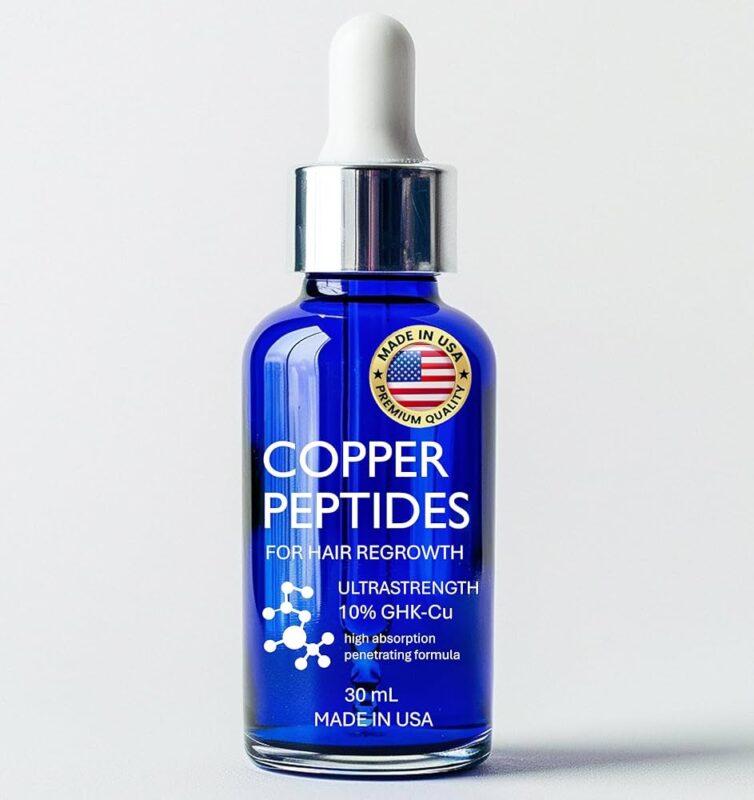
For hair growth applications, copper peptides need to be delivered directly to the scalp — not just the hair shaft. A dedicated copper peptide scalp serum or a copper peptide serum formulated for both face and scalp application is the appropriate product format. TitanForge Peptides GHK-Cu serum is suitable for scalp application — its lightweight formulation absorbs readily into scalp tissue without leaving residue. Shop GHK-Cu serum here.
Application Protocol for Copper Peptides for Hair Growth
Frequency: Apply copper peptides for hair growth once to twice daily — morning and evening for maximum effect, or evening only as a minimum protocol
Application technique: Part the hair to expose the scalp in thinning areas. Apply 3 to 5 drops of copper peptide serum directly to the scalp — not the hair — in the areas of concern. Using fingertips, gently massage the copper peptides for hair growth into the scalp using small circular motions for 1 to 2 minutes. This massage technique serves two purposes — it distributes the copper peptides for hair growth evenly across the scalp surface and stimulates blood flow to the follicle area independently.
Timing: Apply copper peptides for hair growth to a clean scalp — after washing and before any styling products. If combining with minoxidil, apply copper peptides for hair growth first and allow to dry completely before applying minoxidil solution.
Cycle: Copper peptides for hair growth can be used continuously — GHK-Cu does not produce the receptor desensitisation that some pharmaceutical treatments are associated with. Consistent daily use over a minimum of 3 to 6 months is required to assess the full copper peptides for hair growth response.
Stacking Copper Peptides for Hair Growth
For a comprehensive hair growth protocol, copper peptides for hair growth are most effective when combined with:
Oral collagen peptides — Providing the amino acid building blocks for hair shaft protein synthesis alongside the follicle environment support of copper peptides for hair growth. Hair is primarily composed of keratin — a protein whose synthesis depends on the same amino acid pool that collagen peptides provide. Our collagen peptide range provides the oral foundation for this inside-out hair health protocol.
Biotin-rich diet or supplementation — Biotin (Vitamin B7) is a critical cofactor for keratin synthesis. Copper peptides for hair growth optimise the follicle environment while biotin ensures the metabolic machinery for hair protein production is adequately supported.
Scalp massage — As mentioned above, manual scalp massage for 4 to 5 minutes daily has been shown in published research to increase hair shaft thickness by stimulating dermal papilla cells through mechanical stretch — a complementary, zero-cost addition to any copper peptides for hair growth protocol.
Copper Peptides for Hair Growth: Timeline and Realistic Expectations
Setting honest, realistic expectations is essential for any hair growth protocol — including copper peptides for hair growth.
Months 1 to 2: Reduced scalp inflammation and improved scalp texture from copper peptides for hair growth anti-inflammatory activity. Some users report reduced hair shedding during this period as the follicle environment stabilises.
Months 2 to 4: Initial signs of new hair growth in treated areas — fine, short new hairs emerging from previously dormant or miniaturised follicles responding to copper peptides for hair growth stimulation. Existing hair may appear thicker and stronger as improved follicle nutrition and growth factor activity improves hair shaft quality.
Months 4 to 6: More visible improvement in hair density as new growth cycles mature. The copper peptides for hair growth response is cumulative — results continue improving with consistent use beyond the initial protocol period.
Months 6 to 12: Peak copper peptides for hair growth response — maximum density improvement achievable with topical GHK-Cu use. Maintenance of the copper peptide hair growth protocol is required to sustain results.
Important note: Copper peptides for hair growth cannot reverse follicles that have fully miniaturised and become non-functional — they are most effective when used before follicle miniaturisation is complete, in the earlier stages of hair thinning when follicles are still active but deteriorating. Earlier intervention with copper peptides for hair growth produces better outcomes than later treatment.
Frequently Asked Questions
Q: Do copper peptides for hair growth actually work? A: The research on copper peptides for hair growth is promising — with mechanistic evidence showing GHK-Cu stimulates angiogenesis, growth factors, and anti-inflammatory activity in the scalp environment that directly supports follicle health. Early comparative research suggested copper peptides for hair growth produce results comparable to 5% minoxidil in relevant models. Large-scale human clinical trials are limited — but the mechanistic and preliminary evidence positions copper peptides for hair growth as one of the most biologically compelling topical hair loss interventions available without a prescription.
Q: How long do copper peptides for hair growth take to work? A: Meaningful copper peptides for hair growth results typically require 3 to 6 months of consistent daily application. Initial improvements in scalp health and reduced shedding may be noticeable within 4 to 8 weeks, but visible new hair growth from copper peptides for hair growth requires the completion of at least one full follicle cycle — which takes approximately 3 months minimum.
Q: Can copper peptides for hair growth be used with minoxidil? A: Yes — copper peptides for hair growth and minoxidil are considered complementary treatments that work through overlapping but distinct mechanisms. Apply copper peptide serum first and allow to dry before applying minoxidil. The combination of copper peptides for hair growth with minoxidil addresses more of the biological drivers of hair loss than either treatment alone.
Q: Are copper peptides for hair growth safe for women? A: Yes — copper peptides for hair growth are safe for women and are particularly relevant for female pattern hair loss, postpartum hair shedding, and diffuse hair thinning. Unlike finasteride — which is not recommended for women — copper peptides for hair growth carry no hormonal effects and no reproductive safety concerns.
Q: How do copper peptides for hair growth compare to finasteride? A: Finasteride works by blocking the conversion of testosterone to DHT — the primary androgen involved in follicle miniaturisation. Copper peptides for hair growth work through angiogenesis, growth factor stimulation, and anti-inflammatory activity — with some evidence of mild DHT modulation. Finasteride has a stronger evidence base for androgenetic alopecia but carries documented sexual side effects and is not suitable for women. Copper peptides for hair growth have no systemic hormonal effects and are suitable for both men and women.
Q: Where can I buy copper peptide serum for hair growth? A: TitanForge Peptides supplies GHK-Cu copper peptide serum formulated with independently verified pharmaceutical-grade GHK-Cu — suitable for both scalp and facial application. Shop copper peptide serum here.
