peptide comparison and alternatives
Peptides vs Steroids: Key Differences Explained
Apr
Peptides vs Steroids: Key Differences Every Athlete Should Know
If you have been researching ways to improve your performance, speed up recovery, or build a better physique, you have almost certainly encountered both peptides and steroids in the same conversation. They are often lumped together, frequently confused, and — depending on who you ask — either celebrated or condemned as a pair.
The reality is that peptides and steroids are fundamentally different compounds with entirely different mechanisms, risk profiles, legal statuses, and applications. Understanding that difference is not just academically interesting — it is practically essential for anyone making decisions about what they put in their body.
This guide gives you the complete, honest breakdown. No hype on either side. Just the science, the facts, and the information you need to make an informed decision.
What Are Steroids?
When most people say “steroids” in the context of fitness and sport, they are referring to anabolic-androgenic steroids (AAS) — synthetic derivatives of testosterone. These are not to be confused with corticosteroids, which are anti-inflammatory drugs used medically for conditions like asthma and arthritis and have an entirely different profile.
Anabolic steroids were first developed in the 1930s and were initially used medically to treat conditions such as delayed puberty and muscle-wasting diseases. Their ability to dramatically increase muscle protein synthesis and nitrogen retention quickly made them attractive to competitive athletes, and their use spread rapidly through professional sport and bodybuilding from the 1950s onwards.
Common anabolic steroids include testosterone (and its esters), nandrolone, stanozolol, oxandrolone, and trenbolone. They are Schedule III controlled substances in the United States, Class C drugs in the United Kingdom, and are banned by the World Anti-Doping Agency (WADA) in competitive sport globally.
How Do Steroids Work?
Anabolic steroids work by binding directly to androgen receptors inside muscle cells, where they activate the genes responsible for protein synthesis. The result is a dramatically increased rate of muscle protein production — the body literally builds muscle tissue faster than it otherwise could.
At the same time, steroids reduce recovery time by inhibiting the action of cortisol (the catabolic hormone that breaks down muscle tissue), allowing athletes to train harder and more frequently with less recovery required between sessions.
The effects are powerful and relatively rapid. This is precisely what makes anabolic steroids both appealing and dangerous.
What Are Peptides?
Peptides are short chains of amino acids — the same building blocks that make up all proteins in the body. Your body naturally produces thousands of different peptides, each serving a specific biological function. Insulin is a peptide. Growth hormone is a peptide. So are many of the signalling molecules that regulate your immune system, your hunger, your sleep, and your tissue repair processes.
In the context of sports performance and wellness, peptide supplementation refers to the use of specific synthetic peptide sequences that mimic, stimulate, or support naturally occurring biological processes. Rather than introducing a foreign hormone directly — as steroids do — most performance peptides work by signalling the body’s own systems to produce more of what it already makes naturally.
The most commonly used performance peptides include growth hormone secretagogues like CJC-1295 and Ipamorelin (which stimulate the pituitary gland to release more growth hormone), recovery peptides like BPC-157 and TB-500 (which accelerate tissue repair), and metabolic peptides like AOD-9604 (which promotes fat breakdown).
How Do Peptides Work?
Most performance peptides work through one of three primary mechanisms:
- Receptor stimulation — Binding to specific receptors on cell surfaces to trigger a biological response, such as growth hormone secretagogues binding to ghrelin receptors to stimulate GH release
- Growth factor modulation — Upregulating or downregulating specific growth factors involved in tissue repair, muscle development, or fat metabolism
- Signalling pathway activation — Interacting with intracellular signalling cascades to promote healing, regeneration, or metabolic changes
The key distinction from steroids is that peptides typically work with the body’s existing regulatory systems rather than overriding them.
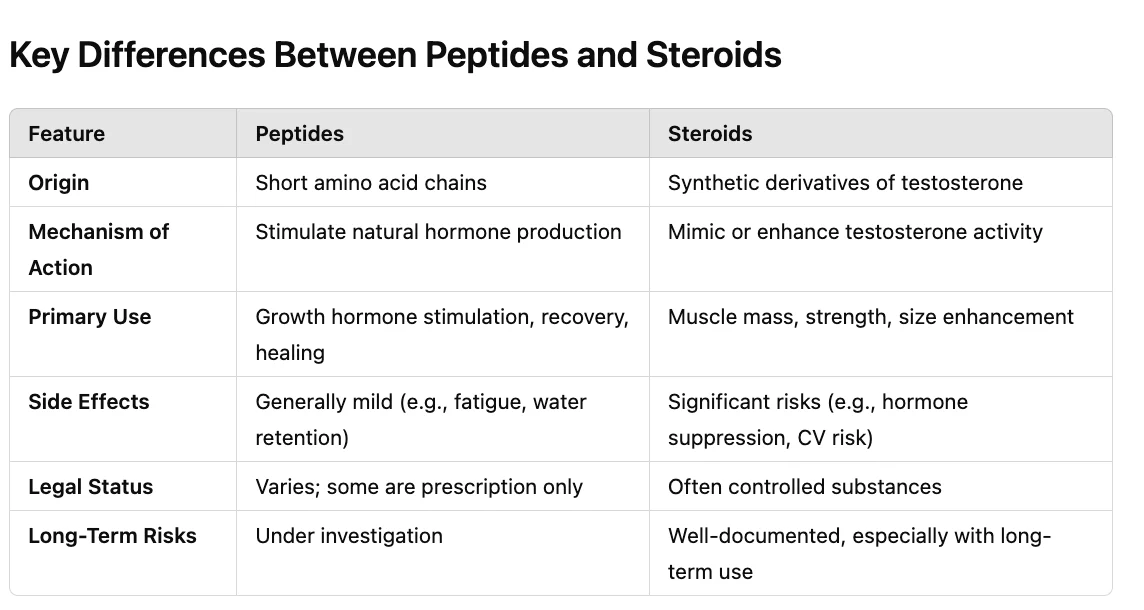
Peptides vs Steroids: A Direct Comparison
Mechanism of Action
This is the most fundamental difference between the two.
Steroids act as direct hormonal agents. When you use anabolic steroids, you are introducing synthetic testosterone derivatives that bind directly to androgen receptors and force an anabolic response. The body’s own hormonal production responds by shutting down — the hypothalamic-pituitary-gonadal (HPG) axis detects the excess androgen and reduces or stops natural testosterone production. This is why post-cycle therapy (PCT) is required after steroid use — to restart the body’s own hormonal function.
Peptides — particularly growth hormone secretagogues — work indirectly. Rather than introducing growth hormone directly, they signal the pituitary gland to release more of its own GH. The body retains its own regulatory feedback mechanisms, which means natural hormone production is generally not suppressed in the same way. When you stop taking a GH secretagogue, your GH axis continues to function normally.
This distinction is clinically significant. The hormonal suppression caused by steroids is one of the most serious medium and long-term health concerns associated with their use.
Effects on Muscle and Performance
Steroids produce faster and more dramatic muscle gains than any peptide currently available. A well-designed steroid cycle can produce 10 to 20 pounds of lean muscle mass in 8 to 16 weeks — results that would take years to achieve naturally. They also dramatically increase strength, training capacity, and recovery speed.
Peptides produce more gradual, sustainable changes. GH secretagogues like CJC-1295 and Ipamorelin improve body composition over time — supporting lean muscle retention, fat reduction, and recovery — but they do not produce the acute, dramatic muscle-building effect of anabolic steroids. Their strength lies in recovery, longevity, and body composition optimisation rather than rapid mass gain.
For athletes looking for explosive muscle gains in a short window, steroids are more effective. For athletes looking for sustainable performance improvement, better recovery, reduced injury risk, and long-term health — peptides present a compelling alternative without the associated risk profile.
Safety Profile
This is where the two diverge most dramatically.
Anabolic steroids carry a well-documented range of serious side effects, particularly with long-term or high-dose use:
- Cardiovascular — Left ventricular hypertrophy, increased LDL cholesterol, decreased HDL cholesterol, elevated blood pressure, and significantly increased risk of heart attack and stroke. This is the most dangerous long-term consequence of steroid use and has been directly implicated in premature deaths among steroid-using athletes
- Hormonal suppression — Shutdown of natural testosterone production, testicular atrophy, and infertility (which may be permanent in long-term users)
- Liver toxicity — Particularly with oral (17-alpha-alkylated) steroids, which must pass through the liver and can cause hepatotoxicity, peliosis hepatis, and in rare cases liver failure
- Psychological effects — Mood swings, aggression (“roid rage”), dependency, and depression — particularly during post-cycle periods when natural testosterone is suppressed and artificial testosterone is withdrawn
- Androgenic effects — Acne, male pattern baldness (accelerated), and in women: virilisation including voice deepening, clitoral enlargement, and menstrual disruption
- Gynecomastia — Breast tissue development in men, caused by aromatisation of excess androgens to oestrogen
Peptides, by comparison, demonstrate a significantly cleaner safety profile across the research literature:
- Growth hormone secretagogues like Ipamorelin are specifically selected for their minimal effect on cortisol and prolactin — the hormones associated with the negative side effects of less selective compounds
- BPC-157 has demonstrated no identifiable lethal dose in animal research and no significant toxic effects across a broad dosage range
- Collagen peptides have decades of consumer safety data and are considered safe for long-term daily use
- The most commonly reported side effects of performance peptides are mild: temporary water retention with GH secretagogues, minor injection site reactions, and occasional nausea
It is important to be honest: comprehensive long-term human clinical safety data for many research peptides is still limited. But the available evidence suggests a fundamentally different risk category compared to anabolic steroids.
Legal Status
Anabolic steroids are controlled substances in most developed countries. In the United States they are Schedule III controlled substances. In the United Kingdom they are Class C drugs. Possession without a prescription is illegal. They are completely banned in competitive sport under WADA regulations.
Peptides occupy a more nuanced legal space. Many peptide supplements — collagen peptides, for example — are entirely unregulated consumer products available in health food stores. Research peptides like BPC-157 and CJC-1295 are generally legal to possess for research purposes in most countries but are not approved for human therapeutic use by the FDA or equivalent agencies. Some peptides have been banned by WADA for use in competitive sport, including growth hormone secretagogues and IGF-1 analogues.
The legal status of specific peptides varies by compound and by country. Always verify the regulations applicable in your jurisdiction before purchasing.
Detection in Drug Testing
Steroids are detectable in urine and blood tests. Sports organisations test extensively for them, and detection windows can range from days to months depending on the compound and test methodology.
Peptides are generally more difficult to detect than steroids and historically presented significant challenges to anti-doping authorities. However, testing methodologies have improved substantially and WADA now has validated detection methods for an expanding range of peptide compounds. Any competitive athlete subject to drug testing should treat peptides with the same caution as any other prohibited substance.
Cost and Accessibility
Steroids require a prescription for legal purchase in most countries and are typically acquired through grey-market or black-market channels by non-medical users, introducing significant quality and safety risks beyond those inherent to the compounds themselves.
Peptides are more broadly accessible through licensed supplement retailers and research compound suppliers. When purchased from a reputable, independently tested source like TitanForge Peptides, the quality and purity risks associated with black-market steroid procurement do not apply.
Who Should Consider Peptides Instead of Steroids?
Peptides are not steroids. They will not replicate the acute muscle-building effects of a testosterone cycle. Anyone telling you otherwise is misleading you.
What peptides offer is a fundamentally different value proposition — one that is genuinely compelling for a broad range of athletes and wellness-focused individuals:
- Athletes who compete under drug testing — Growth hormone secretagogues and recovery peptides carry lower detection risk than steroids, though competitive athletes should always verify their specific compounds against the current WADA prohibited list
- Athletes focused on recovery and injury prevention — BPC-157, TB-500, and collagen peptides address the aspects of training that anabolic steroids do not: connective tissue health, joint integrity, and gut function
- People over 35 experiencing natural hormonal decline — GH secretagogues support the body’s own GH production, which declines with age, in a way that does not suppress the HPG axis
- Anyone who values long-term health alongside performance — The cardiovascular, hormonal, and psychological risk profile of steroids is not compatible with long-term health optimisation. Peptides offer performance support without that trade-off
- Beginners exploring performance supplementation — Starting with peptides rather than steroids represents a significantly lower-risk entry point for anyone new to performance supplementation
Can Peptides and Steroids Be Used Together?
Many advanced users do combine peptides with anabolic steroids — particularly growth hormone secretagogues alongside testosterone protocols. This is outside the scope of this article and involves risk considerations beyond those of either compound used alone. We do not recommend or advocate this approach and strongly advise medical supervision for anyone using anabolic steroids under any circumstances.
Frequently Asked Questions
Q: Are peptides safer than steroids? A: Based on available research, yes — the risk profile of performance peptides is significantly lower than that of anabolic steroids. Peptides do not suppress natural testosterone production, do not carry the cardiovascular risks associated with long-term steroid use, and do not produce androgenic side effects. However, peptides are not risk-free, and long-term human clinical data is still limited for many research compounds.
Q: Do peptides build muscle like steroids? A: No — not to the same degree or speed. Anabolic steroids produce faster and more dramatic muscle gains by directly stimulating androgen receptors. Peptides support muscle development more gradually, primarily through GH stimulation, improved recovery, and reduced catabolism. They are better thought of as performance optimisation tools rather than mass-building agents.
Q: Are peptides legal where steroids are not? A: In most countries, yes — many peptides are legal to purchase for research or supplementation purposes where anabolic steroids require a prescription or are entirely controlled substances. However, the legal status of specific peptides varies by compound and country. Always verify before purchasing.
Q: Are peptides detectable in sport drug tests? A: WADA has banned several peptides including growth hormone secretagogues and IGF-1 analogues, and detection methods are improving. Competitive athletes subject to drug testing should not assume any peptide is undetectable and should consult the current WADA prohibited list before use.
Q: What are the best peptides for performance without the risks of steroids? A: For performance and body composition, CJC-1295 and Ipamorelin are the most widely used. For recovery, BPC-157 and TB-500 are the most researched. For fat loss, AOD-9604 is a strong option. You can explore all of these in our Performance Peptides range.
Q: Where can I buy quality peptides? A: TitanForge Peptides supplies independently tested, COA-verified peptides with a minimum 99% purity standard. Browse our full range here.
