Collagen & Consumer Supplements
Type I vs Type II vs Type III Collagen: Proven Differences
Jul
Type I vs Type II vs Type III Collagen: Which Do You Actually Need? (2026)
Type I vs Type II vs Type III collagen is one of the most commonly misunderstood distinctions in the supplement industry — and the confusion costs people real money. Most collagen buyers select products based on marketing claims, price, or brand familiarity rather than on the specific biological role of each collagen type and whether that role matches their actual recovery or health goal. The result is a market full of people taking the wrong type of collagen for their objective — and wondering why they are not seeing the results they expected.
The Type I vs Type II vs Type III collagen distinction is not a minor technical detail. These three collagen types have fundamentally different amino acid sequences, different tissue distributions, different biological functions, and different mechanisms of action as supplemental peptides. Taking Type II collagen when you need Type I collagen for skin health is not going to produce meaningful skin results. Taking Type I and III collagen when you need Type II for joint cartilage is not going to resolve cartilage-related joint pain. The Type I vs Type II vs Type III collagen question has a specific, actionable answer — and this guide delivers it.
Why Collagen Types Matter: The Biological Foundation
Before examining the Type I vs Type II vs Type III collagen differences specifically, understanding why collagen exists in multiple types at all gives essential context for why the type distinction matters so much in practice.
Collagen is a structural protein family — all collagen types share the fundamental triple-helix architecture of three polypeptide chains wound together, but each type differs in the specific amino acid sequence that forms this triple helix, the post-translational modifications applied to that sequence, and the supramolecular arrangement the collagen forms in its target tissue. These structural differences are what determine tissue distribution — each collagen type self-assembles into the specific physical structure required by the tissue it serves.
When collagen peptides are consumed as supplements, the hydrolysed fragments are absorbed as bioavailable di- and tripeptides and delivered via the bloodstream throughout the body. Research suggests that collagen peptide fragments from specific collagen types show preferential accumulation in the tissues where that collagen type is naturally expressed — meaning Type II collagen peptides accumulate preferentially in cartilage while Type I collagen peptides accumulate preferentially in skin, tendon, and bone. As documented in PubMed’s collagen peptide tissue distribution research, this tissue tropism of different collagen types is the fundamental biological rationale for selecting the correct collagen type for your specific goal in the Type I vs Type II vs Type III collagen comparison.
This tissue-specific accumulation is why the Type I vs Type II vs Type III collagen distinction is not just marketing differentiation — it reflects genuine biological specificity that determines which supplement delivers the outcomes you are purchasing it for.
Type I Collagen: The Most Abundant and Most Versatile
Type I collagen is the most abundant protein in the human body — accounting for approximately 90 percent of all collagen and present in virtually every connective tissue that provides structural strength and tensile integrity. Understanding Type I collagen in the Type I vs Type II vs Type III collagen comparison begins with understanding where it lives and what physical role it performs.
Where Type I collagen is found:
Type I collagen forms dense, parallel-arranged fibril bundles that provide exceptional tensile strength — the structural architecture of skin, bone, tendon, ligament, fascia, cornea, and the connective tissue sheaths surrounding muscle. In skin it forms the fibrous dermis that gives skin its structural firmness and resilience. In tendon and ligament it provides the tensile strength that transmits and resists mechanical forces. In bone it forms the organic matrix around which hydroxyapatite mineral is deposited.
What Type I collagen supplementation does:
In the Type I vs Type II vs Type III collagen comparison, supplemental Type I collagen peptides deliver glycine, proline, and hydroxyproline to dermal fibroblasts — stimulating Type I collagen synthesis in the dermis and producing the clinically documented improvements in skin elasticity, hydration, and wrinkle depth that are the most extensively studied outcome in the collagen peptide literature. Type I collagen peptides also provide the connective tissue collagen precursor substrate for tendon and ligament repair — the application most relevant to athletes managing the connective tissue demands of progressive overload training.
Best sources of Type I collagen:
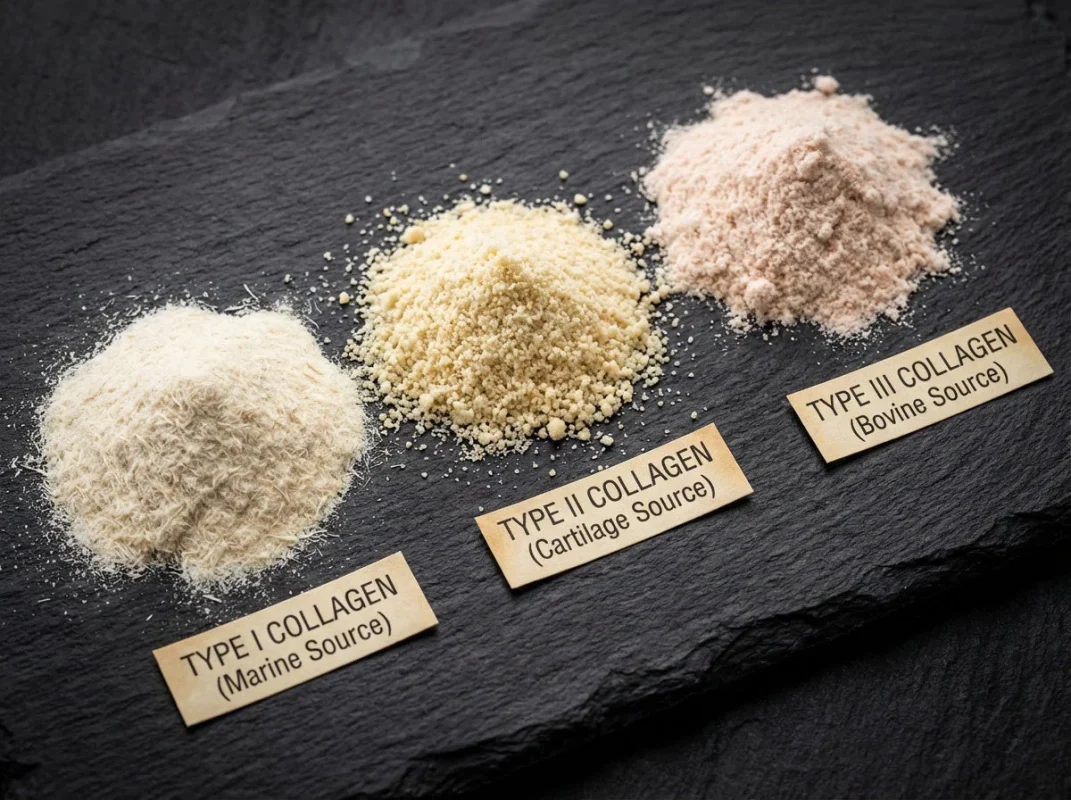
- Marine collagen — exclusively Type I, derived from fish skin and scale. Lowest average molecular weight (3,000 to 5,000 daltons) and highest bioavailability in the Type I vs Type II vs Type III collagen comparison. Best choice for skin health, anti-aging, and surface connective tissue applications. Our copper peptide serum guide and glow blend peptide article cover how marine Type I collagen peptides integrate with topical peptide protocols for comprehensive skin health
- Bovine hide collagen — primarily Type I with some Type III, derived from cattle hide. Higher molecular weight than marine but excellent for tendon, ligament, bone, and general connective tissue applications
Who needs Type I collagen in the Type I vs Type II vs Type III collagen comparison:
- Anyone focused on skin health, anti-aging, or wrinkle reduction
- Athletes managing tendon and ligament health under training load
- Anyone supporting bone density maintenance
- Bodybuilders using collagen peptides alongside BPC-157 for connective tissue protection during performance protocols
Explore our collagen peptides range for marine and bovine Type I collagen options and our collagen peptides vs whey protein article for how Type I collagen peptides integrate with a complete recovery protocol.
Type II Collagen: The Joint and Cartilage Specialist
Type II collagen is cartilage’s primary structural protein — accounting for approximately 90 percent of the collagen in articular cartilage, the smooth tissue covering joint surfaces that absorbs compressive force and enables frictionless movement. In the Type I vs Type II vs Type III collagen comparison, Type II collagen is the most distinct — both in its structural role and in its mechanism of action as a supplement.
Where Type II collagen is found:
Unlike the fibrillar arrangement of Type I collagen, Type II collagen forms a mesh-like network in cartilage tissue that provides simultaneous compressive resistance and elastic rebound under mechanical load. Type II collagen is also found in the nucleus pulposus of intervertebral discs and in the vitreous humour of the eye — tissues that require the same combination of compressive resistance and flexible compliance that defines Type II collagen’s structural role throughout the body.
What Type II collagen supplementation does — the unique mechanism:
The mechanism by which Type II collagen peptides work in the Type I vs Type II vs Type III collagen comparison is fundamentally different from both Type I and Type III collagen. While Type I and III collagen peptides work primarily by providing amino acid substrate for collagen synthesis in their target tissues, Type II collagen peptides — particularly in their undenatured (native) or partially hydrolysed form — appear to work through an additional oral tolerance mechanism.
Orally consumed Type II collagen peptide fragments are recognised by gut-associated immune cells, triggering a regulatory immune response that reduces the inflammatory activity directed at cartilage tissue — a mechanism that is particularly relevant for osteoarthritis and inflammatory joint conditions where immune-mediated cartilage degradation is a primary driver of joint deterioration. As reviewed in Examine.com’s Type II collagen joint research analysis, this oral tolerance mechanism is distinct from the amino acid substrate mechanism and adds a meaningful anti-inflammatory dimension to Type II collagen supplementation that Type I collagen peptides do not provide.
This dual mechanism — both amino acid substrate provision and immune-mediated anti-inflammatory activity — makes Type II collagen uniquely effective for joint health applications in the Type I vs Type II vs Type III collagen comparison.
Best sources of Type II collagen:
- Chicken sternum cartilage — the most common and most researched source of supplemental Type II collagen. Provides both hydrolysed Type II collagen peptides for amino acid substrate delivery and native Type II collagen fragments for the oral tolerance mechanism
- Bovine tracheal cartilage — an alternative Type II collagen source with similar amino acid profile and mechanism
Who needs Type II collagen in the Type I vs Type II vs Type III collagen comparison:
- Anyone with osteoarthritis, cartilage degradation, or activity-limiting joint pain
- Athletes over 35 experiencing joint discomfort under training load — particularly the knees, hips, and shoulders
- Bodybuilders whose progressive overload training creates significant compressive joint stress
- Anyone with a history of joint injury or cartilage damage
- Individuals concerned about long-term joint health maintenance as a longevity priority
Type II collagen integrates powerfully with injectable recovery peptides — particularly BPC-157 for its angiogenic and anti-inflammatory properties that complement Type II collagen’s oral tolerance mechanism. Our BPC-157 and TB-500 stack guide, BPC-157 product page, and peptides for healing article cover the complete connective tissue repair protocol that Type II collagen supplements within.
Type III Collagen: The Elasticity and Softness Partner
Type III collagen is the most frequently overlooked collagen type in consumer discussions — despite being one of the most important for the skin health and anti-aging outcomes that drive the majority of collagen peptide purchasing decisions. In the Type I vs Type II vs Type III collagen comparison, Type III collagen is the complement to Type I — both are found in skin, but they serve different structural functions within it.
Where Type III collagen is found:
Type III collagen co-distributes with Type I in skin, blood vessel walls, intestinal walls, and reticular fibres throughout soft tissue. In skin, Type III collagen is found alongside Type I collagen in the dermis — where it contributes specifically to skin elasticity and softness rather than the structural firmness that Type I collagen provides. Type III collagen forms a fine fibrillar network that gives young skin its characteristic plumpness and spring — the quality of skin that “bounces back” when touched or stretched.
What Type III collagen supplementation does:
In the Type I vs Type II vs Type III collagen comparison, supplemental Type III collagen peptides support skin elasticity restoration and skin softness — the anti-aging outcomes most associated with the visible quality of youthful skin that goes beyond simple firmness. Type III collagen peptides also support vascular wall integrity and intestinal connective tissue — making them relevant for cardiovascular health and gut barrier function alongside their skin benefits.
Type III collagen naturally declines with age at a faster rate than Type I in many individuals — contributing to the loss of skin softness and elasticity that begins to appear from the mid-30s onwards even before the more dramatic skin structural changes associated with later-stage collagen loss occur. Supplementing Type III collagen peptides addresses this specific early anti-aging dimension of collagen decline.
Best sources of Type III collagen:
- Bovine hide collagen — naturally contains both Type I and Type III collagen in a ratio that reflects the natural co-distribution of these collagen types in bovine connective tissue. This is why bovine collagen peptide products are typically labelled as “Type I and III” — they naturally provide both types rather than just one. This Type I and III combination makes bovine collagen peptides the most versatile choice in the Type I vs Type II vs Type III collagen comparison for skin health goals
Who needs Type III collagen in the Type I vs Type II vs Type III collagen comparison:
- Anyone focused on skin softness, elasticity, and the youthful quality that goes beyond simple firmness
- Individuals in their 30s to 50s experiencing the early stages of skin quality decline — reduced bounce, softness, and elasticity
- Anyone combining collagen peptides with topical peptide protocols for comprehensive skin health
- Individuals concerned with vascular and gut connective tissue health alongside skin outcomes
Our copper peptide serum guide, glow blend peptide article, and GHK-Cu serum product page cover the comprehensive skin health protocol that Type I and III collagen peptides integrate with topically.
Type I vs Type II vs Type III Collagen: The Decision Framework
| Goal | Best Collagen Type | Best Source | Key Mechanism |
|---|---|---|---|
| Skin firmness and wrinkle reduction | Type I | Marine collagen | Dermal fibroblast Type I collagen synthesis stimulation |
| Skin elasticity and softness | Type III | Bovine hide (Type I + III) | Reticular fibre elasticity restoration |
| Complete skin anti-aging | Types I + III combined | Bovine hide or marine + bovine blend | Covers both firmness and elasticity dimensions simultaneously |
| Joint health and cartilage | Type II | Chicken sternum cartilage | Amino acid substrate + oral tolerance immune modulation |
| Tendon and ligament repair | Type I | Bovine or marine | Glycine/proline substrate for tendon collagen synthesis |
| Bone density maintenance | Type I | Bovine bone | Organic bone matrix collagen precursor provision |
| Gut health and intestinal barrier | Types I and III | Bovine | Intestinal wall collagen substrate support |
| General connective tissue maintenance | Types I and III | Bovine hide | Broadest connective tissue coverage in one product |
| Athletes — comprehensive recovery | Types I, II, and III | Bovine hide + chicken collagen | Covers skin, tendon, joint, and bone simultaneously |
| Hair health | Type I | Marine or bovine | Hair follicle connective tissue and scalp dermis support |
Can You Take All Three Types Together?
A natural question arising from the Type I vs Type II vs Type III collagen comparison is whether you can — and should — supplement all three collagen types simultaneously. The answer is yes — and for athletes and comprehensive protocol users, taking all three types is often the most appropriate strategy.
Type I, II, and III collagen peptides do not compete with each other — they distribute preferentially to different target tissues and serve different biological functions. Running all three simultaneously covers the complete spectrum of connective tissue health — skin, tendon, ligament, cartilage, bone, and gut — without any redundancy or interference between the collagen types.
The most practical approach to taking all three types in the Type I vs Type II vs Type III collagen comparison is to use a bovine hide collagen peptide (providing Types I and III) alongside a separate Type II chicken cartilage collagen — covering all three types across two products that are both widely available, cost-effective, and well-studied.
For bodybuilders and performance athletes running BPC-157 and TB-500 recovery protocols alongside collagen peptides — all three collagen types contribute to the comprehensive connective tissue support framework that these injectable peptides operate within. Our BPC-157 and TB-500 stack guide, BPC-157 muscle recovery guide, and how to build a peptide stack for muscle growth article cover the complete performance recovery context that collagen peptides supplement within.
Type I vs Type II vs Type III Collagen: Dosage by Type
| Collagen Type | Application | Daily Dose | Timing | Co-factor |
|---|---|---|---|---|
| Type I (marine) | Skin anti-aging | 2.5 g to 10 g | Any time daily | Vitamin C |
| Type I (bovine) | Tendon/ligament | 15 g | 60 min pre-training | Vitamin C |
| Type II (chicken) | Joint health | 40 mg to 10 g | Any time daily | Vitamin C |
| Types I + III (bovine) | General connective tissue | 10 g to 15 g | 60 min pre-training or AM | Vitamin C |
| Types I + II + III | Comprehensive | 10–15 g Type I+III + 40mg–2.5g Type II | Pre-training + any | Vitamin C |
Note the significant dose difference in the Type I vs Type II vs Type III collagen comparison between Type II and Types I and III — Type II collagen peptides, particularly in undenatured or low-hydrolysis form, are effective at much lower doses (40 mg for the oral tolerance mechanism) than hydrolysed Type I and III collagen peptides that require gram-level dosing for amino acid substrate provision.
Use our peptide reconstitution calculator for any protocol involving injectable peptides alongside your collagen peptide supplementation, and visit our Lab Results page to verify quality documentation on every collagen product before purchasing.
Frequently Asked Questions
Q: What is the difference between Type I, Type II, and Type III collagen?
A: In the Type I vs Type II vs Type III collagen comparison — Type I is the most abundant, found in skin, bone, tendon, and ligament — providing structural firmness and tensile strength. Type II is cartilage-specific — found in joint surfaces and intervertebral discs, working through both amino acid substrate provision and immune tolerance mechanisms to support joint health. Type III co-distributes with Type I in skin and blood vessel walls — contributing specifically to skin elasticity and softness rather than the firmness that Type I provides. Each type serves a distinct biological function in a different tissue.
Q: Which type of collagen is best for skin?
A: In the Type I vs Type II vs Type III collagen comparison for skin health — both Type I and Type III are relevant. Type I collagen peptides — particularly marine collagen with its superior bioavailability — stimulate dermal fibroblast collagen synthesis for improved skin firmness and wrinkle reduction. Type III collagen peptides support skin elasticity and softness. Bovine collagen peptides naturally provide both Type I and III — making them the most comprehensive single-product skin health collagen choice. Our copper peptide serum guide covers the topical peptide companion protocol for maximum skin collagen support.
Q: Which type of collagen is best for joints?
A: Type II collagen wins the Type I vs Type II vs Type III collagen comparison for joint health — it is the only collagen type that directly targets cartilage tissue and provides the oral tolerance immune modulation mechanism that reduces inflammatory cartilage degradation. For dedicated joint health applications, Type II chicken sternum collagen is specifically indicated rather than the Type I and III bovine collagen that serves skin and general connective tissue goals.
Q: Should I take Type I or Type II collagen?
A: The Type I vs Type II collagen decision depends entirely on your primary goal. For skin, tendon, ligament, bone, or general connective tissue health — choose Type I (and ideally Type I + III). For cartilage and joint health — choose Type II. For comprehensive coverage — use both in the same protocol. They do not compete and using both simultaneously covers more connective tissue recovery territory than either alone.
Q: Is marine collagen better than bovine collagen?
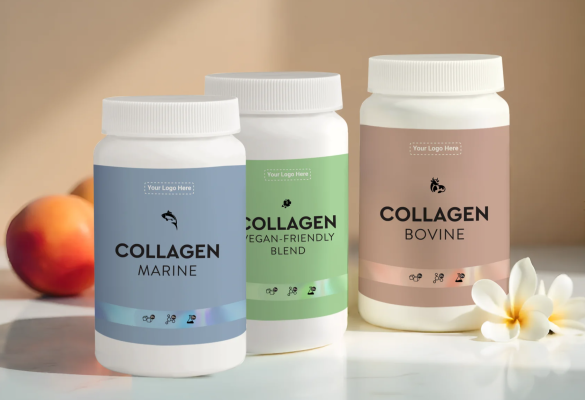
A: In the Type I vs Type II vs Type III collagen comparison between sources — marine collagen (Type I only) has superior bioavailability due to its smaller molecular weight, making it the preferred choice for skin health applications where rapid delivery to dermal tissue is the priority. Bovine collagen (Types I and III) has broader connective tissue coverage — including tendon, ligament, bone, and gut — making it more versatile for athletic and general connective tissue applications. Many comprehensive protocols use both for complete coverage.
Q: Where can I buy all three types of collagen?
A: TitanForge Peptides supplies marine Type I collagen, bovine Type I and III collagen, and Type II cartilage collagen across all major application categories — all independently quality verified. Browse our complete collagen peptides range here.
