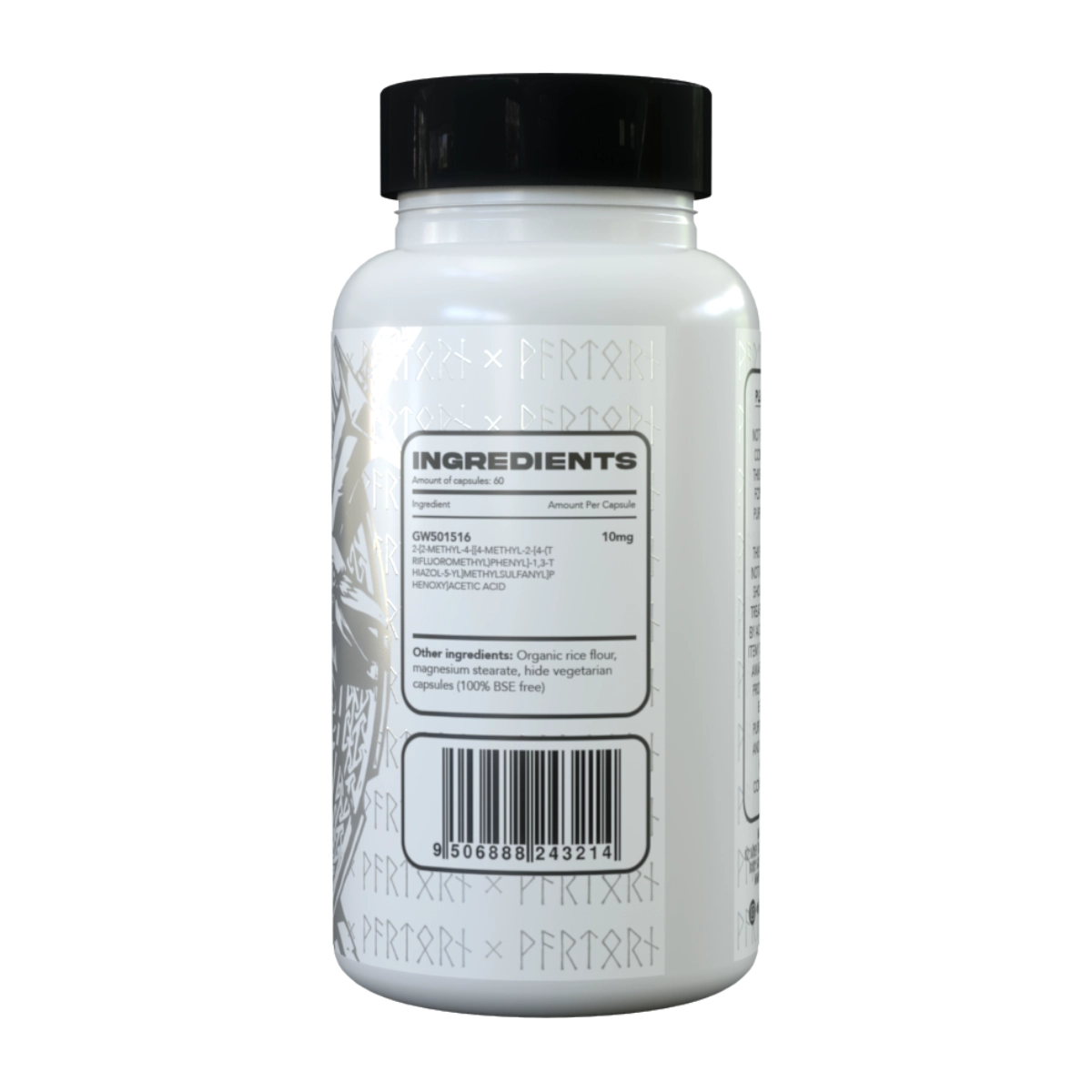
Cardarine (GW-501516) | PPAR$\delta$ Receptor

Original price was: $77.00.$56.00Current price is: $56.00.
Cardarine (GW-501516) is a high-affinity Peroxisome Proliferator-Activated Receptor delta (PPAR$\delta$) agonist. Initially developed in the 1990s to investigate metabolic and cardiovascular health, Cardarine is widely utilized in laboratory research to study the regulation of fatty acid metabolism, glucose uptake in skeletal muscle, and the enhancement of physical endurance. By shifting the body’s primary energy source from glucose to lipids, it provides a unique model for researching metabolic efficiency and obesity countermeasures.
Cardarine (GW-501516): The Science of PPARδ Signaling
The Biochemistry of Cardarine
Cardarine is not a selective androgen receptor modulator (SARM) or a hormone; rather, it is a metabolic modulator that functions as a selective agonist for the PPAR$\delta$ receptor. These receptors are found predominantly in tissues with high energy demands, such as skeletal muscle and the liver. Activation of PPAR$\delta$ by Cardarine triggers the transcription of genes involved in energy expenditure and lipid catabolism.
Mechanism of Action: Metabolic Reprogramming
In advanced metabolic and exercise physiology research, Cardarine functions through several coordinated physiological pathways:
-
Upregulation of Fatty Acid Oxidation: The compound stimulates the expression of genes like CPT1, which facilitates the transport of fatty acids into the mitochondria for beta-oxidation.
-
Glucose-to-Lipid Fuel Shift: Research focuses on the peptide’s ability to “switch” the metabolic preference of skeletal muscle, preserving glycogen stores by increasing the rate of fat burning.
-
Mitochondrial Biogenesis: Cardarine is investigated for its capacity to increase mitochondrial density in Type I (slow-twitch) muscle fibers, mimicking the cellular adaptations seen in aerobic endurance training.
-
Lipid Profile Stabilization: Studies observe that PPAR$\delta$ activation can improve HDL levels and reduce triglycerides by modulating VLDL production in the liver.
Primary Research Applications
-
Endurance and Physical Performance: Analyzing the extension of time-to-exhaustion and oxygen utilization in laboratory aerobic models.
-
Obesity and Metabolic Syndrome: Investigating the reduction of adipose tissue and the improvement of insulin sensitivity in high-fat diet models.
-
Cardiovascular Health Research: Studying the impact of PPAR$\delta$ signaling on arterial plaque formation and systemic inflammation markers.
-
Muscle Fiber Type Transformation: Observing the potential for shifting muscle fibers from Type II (fast-twitch) to more oxidative Type I configurations.
4. Technical Specifications (E-E-A-T Data)
| Feature | Scientific Specification |
| Chemical Name | {4-[({4-methyl-2-[4-(trifluoromethyl)phenyl]-1,3-thiazol-5-yl}methyl)sulfanyl]-2-methylphenoxy}acetic acid |
| Molecular Formula | $C_{21}H_{18}F_{3}NO_{3}S_{2}$ |
| Molecular Weight | 453.50 g/mol |
| CAS Number | 317318-73-0 |
| Purity Grade | $\geq$99% (HPLC Verified) |
| Form | Research Grade Capsules (Standardized Concentration) |
| Solubility | Soluble in DMSO and Ethanol |
5. Product FAQ
Q: Is Cardarine a steroid?
A: No. Cardarine is a PPAR$\delta$ receptor agonist. It does not interact with the androgen receptor and does not influence testosterone levels, making it structurally and functionally distinct from anabolic steroids or SARMs.
Q: Why was research on Cardarine historically controversial?
A: Early pharmaceutical research on Cardarine was discontinued after high-dose, long-term studies in specific rodent models showed an increase in neoplastic growth. Modern research continues to investigate its metabolic benefits while strictly adhering to safety and dosage protocols in various laboratory environments.
Related products

GLP-1 & METABOLIC RESEARCH COMPOUNDS


NEUROPEPTIDE RESEARCH COMPOUNDS

GLP-1 & METABOLIC RESEARCH COMPOUNDS


EMERGING & SPECIALIST RESEARCH PEPTIDES
Follistatin 344 | Advanced Myostatin Inhibition Research Data

NEUROPEPTIDE RESEARCH COMPOUNDS

RESEARCH-GRADE COMPOUNDS


RESEARCH-GRADE COMPOUNDS
BPC-157 | Advanced Tissue Repair & Gastric Research Compound


EMERGING & SPECIALIST RESEARCH PEPTIDES
ARA-290 | Advanced Innate Repair & Neuropathic Research Data
