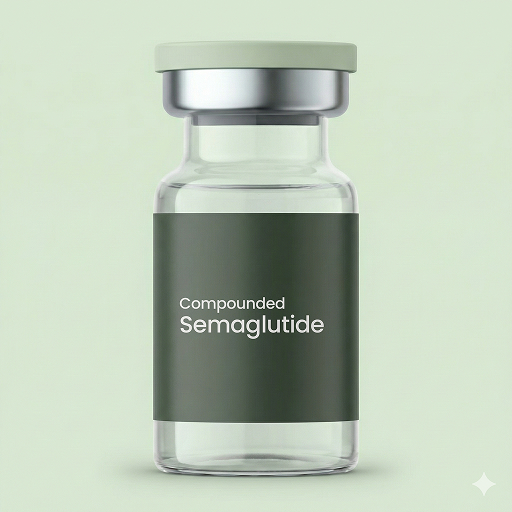
Semaglutide | Advanced GLP-1 Receptor Agonist Research Data
Original price was: $300.00.$288.00Current price is: $288.00.
Semaglutide is a potent, synthetic GLP-1 receptor agonist designed for high metabolic stability and extended biological activity. As a 31-amino acid peptide, it acts as a long-acting analog of the incretin hormone glucagon-like peptide-1 (GLP-1). In advanced research settings, Semaglutide is investigated for its profound ability to stimulate glucose-dependent insulin secretion, suppress postprandial glucagon, and regulate appetite through central nervous system signaling.
Semaglutide: The Science of Sustained Incretin Agonism
The Biochemistry of Semaglutide
The structure of Semaglutide ($C_{187}H_{291}N_{45}O_{59}$) is engineered for maximum durability against enzymatic degradation. The modification includes the substitution of Alanine with alpha-aminoisobutyric acid (Aib) at position 8 to resist dipeptidyl peptidase-IV (DPP-IV). Additionally, the attachment of a C-18 fatty diacid chain via a spacer at Lysine 26 facilitates high-affinity albumin binding, extending its half-life to approximately 165 hours in research models.
Mechanism of Action: GLP-1R Activation and Metabolic Control
In advanced endocrinology and metabolism research, Semaglutide functions through several coordinated physiological pathways:
-
Enhanced Insulinotropic Response: The peptide binds to the GLP-1 receptor on pancreatic beta cells, amplifying insulin secretion in a glucose-dependent manner.
-
Hepatic Glucose Modulation: Research focuses on the peptide’s capacity to inhibit glucagon release from alpha cells, effectively lowering hepatic glucose production.
-
Gastric Motility Regulation: Semaglutide is investigated for its role in slowing gastric emptying, which contributes to a more gradual absorption of nutrients.
-
Hypothalamic Signaling: The peptide penetrates specific brain regions to influence satiety and reward pathways, making it a focal point for studies involving energy intake and obesity.
Primary Research Applications
-
Chronic Weight Management Research: Investigating the impact of sustained GLP-1R signaling on body composition and total energy expenditure.
-
Metabolic Syndrome & T2D Modeling: Analyzing the restoration of glycemic stability and beta-cell responsiveness in dysfunctional metabolic states.
-
Cardiovascular Integrity Studies: Observing the peptide’s impact on markers of atherosclerosis, systemic inflammation, and endothelial health.
-
Neuroprotective Research: Studying the potential of GLP-1 analogs to mitigate neuro-inflammatory processes and preserve cognitive function.
4. Technical Specifications (E-E-A-T Data)
| Feature | Scientific Specification |
| Peptide Type | GLP-1 Receptor Agonist (Incretin Mimetic) |
| Amino Acid Count | 31 Amino Acids |
| Molecular Formula | $C_{187}H_{291}N_{45}O_{59}$ |
| Molecular Weight | 4113.58 g/mol |
| CAS Number | 910463-68-2 |
| Purity Grade | $\geq$99% (HPLC & Mass Spec Verified) |
| Modification | Aib substitution (Pos 8) & C-18 fatty diacid acylation |
| Solubility | Soluble in Water and Saline |
5. Product FAQ
Q: How does Semaglutide differ from Liraglutide in research?
A: While both are GLP-1 agonists, Semaglutide features a C-18 fatty diacid and specific amino acid substitutions that provide a significantly longer half-life (~7 days) compared to Liraglutide (~13 hours). This allows for different observation intervals in research protocols.
Q: Why is the albumin binding significant for Semaglutide?
A: The acylation allows Semaglutide to bind reversibly to albumin. This protection prevents rapid renal filtration and protects the peptide from enzymatic cleavage, ensuring a sustained concentration of the research compound in the subject.
Only logged in customers who have purchased this product may leave a review.
Related products


NEUROPEPTIDE RESEARCH COMPOUNDS

RESEARCH-GRADE COMPOUNDS

WEIGHT MANAGEMENT & METABOLIC WELLNESS
Semaglutide (GLP-1 Analogue) | GLP-1 Agonist for Weight Loss

RESEARCH-GRADE COMPOUNDS

GROWTH HORMONE RESEARCH PEPTIDES
Hexarelin | Advanced GHRP & Growth Hormone Research Compound


RESEARCH-GRADE COMPOUNDS
BPC-157 | Advanced Tissue Repair & Gastric Research Compound

GROWTH HORMONE RESEARCH PEPTIDES


NEUROPEPTIDE RESEARCH COMPOUNDS

Reviews
There are no reviews yet.