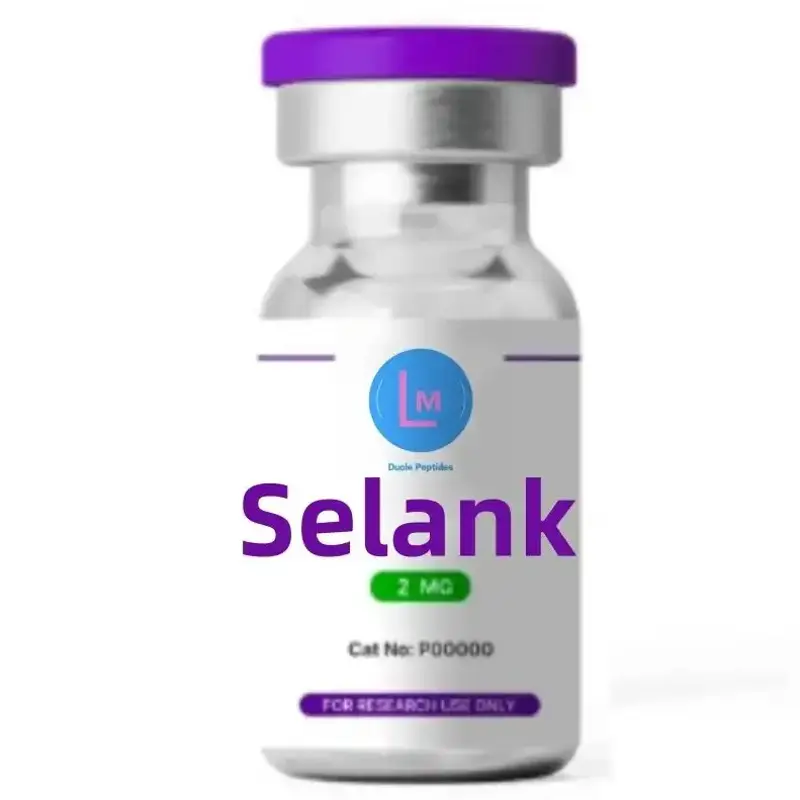
Selank | Advanced Anxiolytic & Nootropic Research Compound

Original price was: $85.00.$79.00Current price is: $79.00.
Selank is a synthetic heptapeptide ($Thr-Lys-Pro-Arg-Pro-Gly-Pro$) modeled after the naturally occurring immunomodulatory peptide Tuftsin. Unlike conventional anxiolytics, Selank operates without sedative or amnesic side effects, making it a premier subject for studying the intersection of stress reduction and cognitive enhancement. In laboratory research, it is investigated for its ability to stabilize the serotonergic and dopaminergic systems while upregulating critical neurotrophic factors.
Selank: The Science of Neuro-Chemical Stability
The Biochemistry of Selank
The structure of Selank is an elongated version of Tuftsin, designed to enhance metabolic stability and prolong its activity within the central nervous system. By mimicking the body’s endogenous signaling molecules, it achieves a high degree of biocompatibility. It is often studied in its N-Acetyl form to further increase its resistance to enzymatic degradation and improve its penetration of the blood-brain barrier.
Mechanism of Action: GABAergic and Monoamine Modulation
In advanced neuroscience and psychology research, Selank functions through several coordinated pathways:
-
GABAergic Signaling Facilitation: The peptide is studied for its ability to modulate GABA receptors, enhancing the inhibitory neurotransmission that buffers the brain against anxiety and hyper-excitability without the typical “crash” of benzodiazepines.
-
Enkephalin Degradation Inhibition: Selank is observed to inhibit the enzymes that break down enkephalins (natural opioids), effectively extending the duration of the body’s internal stress-reducing response.
-
BDNF Upregulation: Research focuses on the peptide’s capacity to stimulate the expression of Brain-Derived Neurotrophic Factor (BDNF) in the hippocampus, which is essential for synaptic plasticity and emotional resilience.
-
Monoamine Stabilization: In models of stress, Selank helps normalize levels of serotonin and dopamine, preventing the neurochemical imbalances associated with chronic environmental pressure.
Primary Research Applications
-
Generalized Anxiety Disorder (GAD) Models: Analyzing the reduction of anxiety-like behaviors and the stabilization of the HPA axis.
-
Cognitive Enhancement Under Stress: Investigating the peptide’s ability to maintain focus, memory retention, and learning capacity during high-cortisol events.
-
Neuroprotective Studies: Observing the preservation of neuronal integrity against oxidative stress and inflammatory signaling.
-
Antidepressant Synergy Research: Studying the potential of Selank to act as a co-regulator in serotonergic research models.
4. Technical Specifications (E-E-A-T Data)
| Feature | Scientific Specification |
| Peptide Sequence | Thr-Lys-Pro-Arg-Pro-Gly-Pro |
| Molecular Formula | $C_{33}H_{57}N_{11}O_{9}$ |
| Molecular Weight | 751.9 g/mol |
| CAS Number | 129954-34-3 |
| Purity Grade | $\geq$99% (HPLC & Mass Spec Verified) |
| Physical State | Lyophilized White Powder |
| Solubility | Highly Soluble in Water and Saline |
5. Product FAQ
Q: How does Selank differ from traditional anxiolytics?
A: Traditional agents often act as heavy sedatives. Research into Selank indicates that it provides an anxiolytic effect while actually enhancing cognitive functions like focus and memory, likely due to its role in upregulating BDNF.
Q: Is Selank considered a stimulant?
A: No. It does not exert a traditional stimulant effect on the central nervous system. Instead, it is researched as a “regulatory” peptide that brings neurochemical levels into homeostasis, which often results in improved mental clarity and reduced fatigue.
Only logged in customers who have purchased this product may leave a review.
Related products

GROWTH HORMONE RESEARCH PEPTIDES

RESEARCH-GRADE COMPOUNDS

GLP-1 & METABOLIC RESEARCH COMPOUNDS
GIP Peptide | Gastric Inhibitory Polypeptide Research Analysis

RESEARCH-GRADE COMPOUNDS

ENDURANCE & ENERGY PEPTIDES
Selank Peptide | 10mg High-Purity Tuftsin Analog | Neuro-Research Grade


NEUROPEPTIDE RESEARCH COMPOUNDS


EMERGING & SPECIALIST RESEARCH PEPTIDES

GLP-1 & METABOLIC RESEARCH COMPOUNDS

Reviews
There are no reviews yet.