
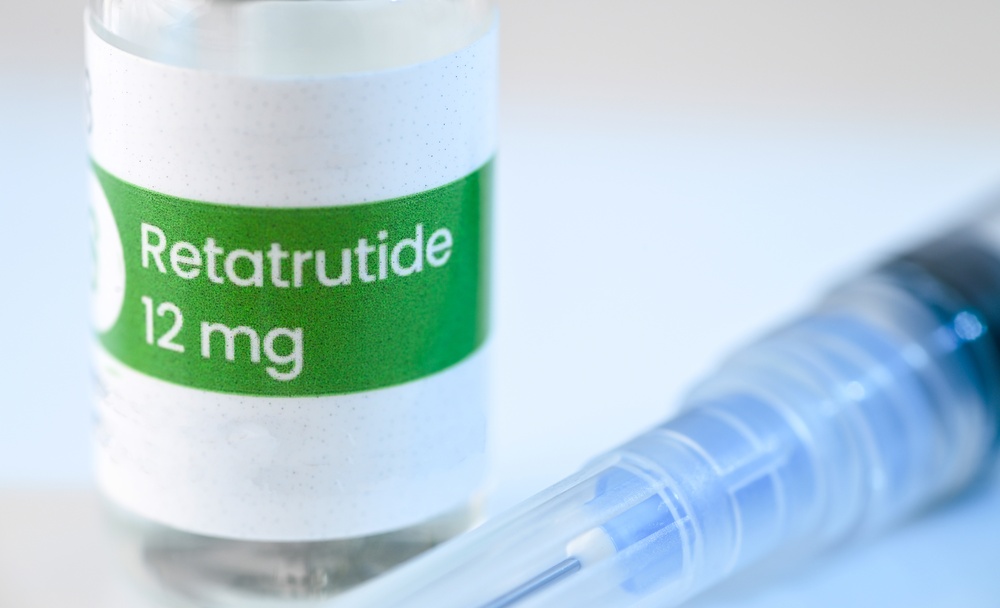

Retatrutide | Advanced Triple Agonist Research & Analysis


Original price was: $380.00.$367.00Current price is: $367.00.
Retatrutide (LY3437943) is an emerging, first-in-class Triple Agonist peptide investigated for its simultaneous activity at the glucagon-like peptide-1 (GLP-1), glucose-dependent insulinotropic polypeptide (GIP), and glucagon (GCG) receptors. By integrating three distinct incretin and metabolic pathways into a single 39-amino acid sequence, Retatrutide is studied for its potential to achieve unprecedented levels of weight regulation and glycemic control in advanced metabolic research models.
Retatrutide: The Science of Triple-Receptor Synergy
The Biochemistry of Retatrutide
Retatrutide is a synthetic peptide based on the GIP backbone, modified to include agonism for both GLP-1 and Glucagon receptors. Its structure features a $C20$ fatty diacid moiety that enables reversible albumin binding, extending its half-life to approximately 6 days in research subjects. This acylation allows for sustained signaling across all three metabolic pathways, providing a comprehensive “triple-threat” approach to investigating energy balance.
Mechanism of Action: The Triple Agonist Pathway
In emerging pharmacological research, Retatrutide functions through three integrated physiological mechanisms:
-
GIP Receptor Agonism: Research focuses on how GIP signaling enhances insulin secretion and potentially improves adipose tissue health, buffering the metabolic impact of nutrient intake.
-
GLP-1 Receptor Agonism: The peptide mimics native GLP-1 to suppress glucagon (in a glucose-dependent manner), delay gastric emptying, and signal satiety within the hypothalamus.
-
Glucagon Receptor Agonism: Unlike single or dual agonists, the addition of glucagon signaling is investigated for its ability to increase energy expenditure (thermogenesis) and directly modulate hepatic lipid metabolism.
-
Synergistic Weight Regulation: Laboratory models suggest that the glucagon component may accelerate adipose tissue loss by increasing the metabolic rate, while the GLP-1 and GIP components manage glycemic stability and appetite.
Primary Research Applications
-
Advanced Obesity Research: Analyzing the impact of triple-pathway signaling on total body fat mass and resting energy expenditure.
-
Metabolic Homeostasis: Investigating the restoration of insulin sensitivity and the stabilization of blood glucose in high-fat diet models.
-
NASH and MASH Studies: Observing the effects of glucagon agonism on hepatic fat content and markers of liver inflammation.
-
Chronic Disease Modeling: Studying the long-term impact of multi-receptor engagement on cardiovascular markers and systemic metabolic flexibility.
4. Technical Specifications (E-E-A-T Data)
| Feature | Scientific Specification |
| Peptide Type | Triple GIP/GLP-1/Glucagon Receptor Agonist |
| Amino Acid Count | 39 Amino Acids |
| Molecular Formula | $C_{221}H_{342}N_{46}O_{68}$ |
| Molecular Weight | 4731.33 g/mol |
| CAS Number | 2381089-83-2 |
| Purity Grade | $\geq$99% (HPLC & Mass Spec Verified) |
| Modification | $C20$ fatty diacid acylation |
| Solubility | Soluble in Water and Saline |
5. Product FAQ
Q: What makes Retatrutide different from Tirzepatide?
A: While Tirzepatide is a dual agonist (GIP and GLP-1), Retatrutide is a Triple Agonist that adds a third pathway: Glucagon. Research indicates that the glucagon component may provide an additional boost to energy expenditure that dual agonists lack.
Q: Why is Glucagon included in the research?
A: Glucagon is traditionally associated with raising blood sugar; however, in the context of this Triple Agonist, it is being researched for its ability to increase caloric burn and improve liver fat metabolism when balanced by GLP-1 and GIP signaling.
Only logged in customers who have purchased this product may leave a review.
Related products

NEUROPEPTIDE RESEARCH COMPOUNDS

FAT LOSS & METABOLIC PEPTIDES
MOTS-c Peptide 10mg | Mitochondrial Exercise Mimetic | $\geq$99% Purity


NEUROPEPTIDE RESEARCH COMPOUNDS

GROWTH HORMONE RESEARCH PEPTIDES

FAT LOSS & METABOLIC PEPTIDES
Tesamorelin 2mg | High-Purity GHRH Analog | Visceral Fat Research


RESEARCH-GRADE COMPOUNDS
BPC-157 | Advanced Tissue Repair & Gastric Research Compound

WEIGHT MANAGEMENT & METABOLIC WELLNESS
Liraglutide (GLP-1 Analogue) | GLP-1 Agonist for Weight Management

GROWTH HORMONE RESEARCH PEPTIDES
Hexarelin | Advanced GHRP & Growth Hormone Research Compound

Reviews
There are no reviews yet.