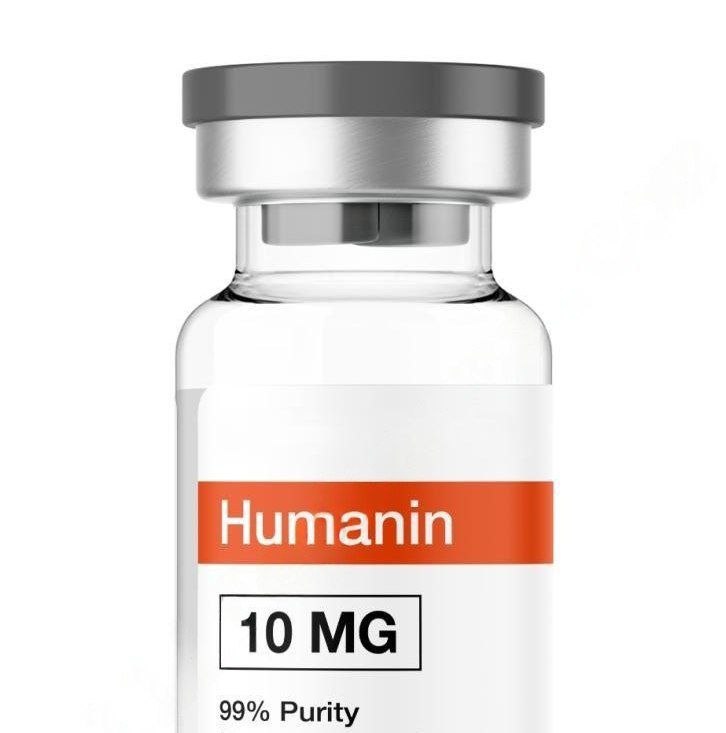
Humanin (HN) 10mg | High-Purity Mitochondrial-Derived Peptide | $\geq$99% Purity


Original price was: $110.00.$88.00Current price is: $88.00.
Humanin is a revolutionary 24-amino acid mitochondrial-derived peptide (MDP) encoded within the 16S ribosomal RNA gene of the mitochondrial genome. Recognized as a master “cytoprotective” agent, Humanin acts as a retrograde signaling molecule, traveling from the mitochondria to the nucleus and extracellular space to shield cells from oxidative stress, hypoxia, and glucose deprivation. In research models, it is the primary subject for investigating the prevention of neuronal cell death and the modulation of systemic insulin sensitivity.
Humanin: The Mitochondrial Sentinel for Cellular Longevity and Protection
The Discovery of the 16S rRNA Encoded Peptide
Humanin was originally discovered in the quest to identify survival factors in the brains of Alzheimer’s patients. Unlike most peptides encoded in the cell nucleus, Humanin is synthesized within the mitochondria, making it a critical component of the “mitohormetic” response. Its unique structure—Met-Ala-Pro-Arg-Gly-Phe-Ser-Cys-Leu-Leu-Leu-Leu-Thr-Ser-Glu-Ile-Asp-Leu-Pro-Val-Lys-Arg-Arg-Ala—allows it to function both as an intracellular signaling molecule and a secreted hormone.
Mechanism of Action: Multi-Targeted Cytoprotection
In advanced molecular research, Humanin functions through both cell-surface receptors and direct protein interactions:
-
STAT3 Pathway Activation: Humanin binds to a tripartite receptor complex (CNTFR/gp130/WSX-1), triggering the JAK2/STAT3 signaling pathway. This leads to the upregulation of survival genes and a significant reduction in pro-inflammatory cytokines.
-
IGFBP-3 Antagonism: It interacts directly with Insulin-like Growth Factor Binding Protein-3 (IGFBP-3). By sequestering IGFBP-3, Humanin prevents it from inducing apoptosis and allows for improved IGF-1 receptor signaling.
-
Bax Inhibition: Within the cytoplasm, Humanin has been observed to bind to the pro-apoptotic protein Bax, preventing its translocation to the mitochondria and thereby blocking the initiation of the programmed cell death cascade.
-
Metabolic Regulation: Research indicates that Humanin acts as a “Sene-metabolic” regulator, improving glucose uptake and mitochondrial respiration in peripheral tissues.
Primary Research Applications of Humanin
-
Neurodegenerative Research: Studying the protection of neurons against amyloid-beta ($A\beta$) toxicity and tau hyperphosphorylation.
-
Cardiovascular Protection: Investigating the reduction of atherosclerotic plaque formation and the protection of vascular endothelial cells.
-
Metabolic Syndrome: Analyzing the peptide’s ability to improve insulin sensitivity and reduce visceral adiposity.
-
Retinal Health: Observing the impact of Humanin on oxidative stress markers in age-related macular degeneration (AMD) models.
4. Technical Specifications (E-E-A-T Data)
| Feature | Scientific Specification |
| Sequence | MAPRGFSCLLLLTSEIDLPVKRRA |
| Molecular Formula | $C_{119}H_{204}N_{34}O_{32}S_{2}$ |
| Molecular Weight | 2687.3 g/mol |
| CAS Number | 330936-93-9 |
| Purity Grade | $\geq$99% (HPLC & Mass Spec Verified) |
| Formulation | Lyophilized White Powder |
5. Product FAQ
Q: What makes Humanin different from other mitochondrial peptides?
A: Humanin was the first MDP discovered. While others like MOTS-c focus primarily on exercise mimetics and metabolic regulation, Humanin is unique for its potent anti-apoptotic properties across almost all tissue types, especially in the CNS and cardiovascular system.
Q: How does Humanin interact with the IGF-1 system?
A: Humanin acts as a partner to the IGF-1 system by neutralizing IGFBP-3. This prevents IGFBP-3 from triggering cell death and ensures that IGF-1 can effectively bind to its receptors to promote cell growth and repair.
Only logged in customers who have purchased this product may leave a review.
Related products

GROWTH HORMONE SECRETAGOGUES

PERFORMANCE PEPTIDES
Thymalin (Thymus Peptide) 10mg | High-Purity Immunomodulatory

FAT LOSS & METABOLIC PEPTIDES
MOTS-c Peptide 10mg | Mitochondrial Exercise Mimetic | $\geq$99% Purity

PERFORMANCE PEPTIDES
Kisspeptin-10 (Kiss-1) 10mg | High-Purity GPR54 Agonist | $\geq$99% Purity

GROWTH HORMONE SECRETAGOGUES

MUSCLE GROWTH & ANABOLIC PEPTIDES

GROWTH HORMONE SECRETAGOGUES

MUSCLE GROWTH & ANABOLIC PEPTIDES
Follistatin 344 (FST-344) 1mg | High-Purity Myostatin Inhibitor | $\geq$98% Purity

Reviews
There are no reviews yet.