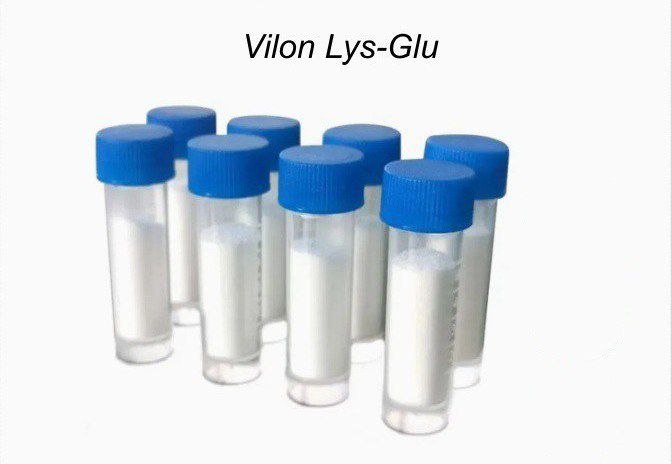
Vilon (Lys-Glu) | 10mg Bioregulatory Dipeptide | $\geq$98% Purity


Original price was: $65.00.$47.00Current price is: $47.00.
Vilon is a synthetic bioregulatory dipeptide consisting of the amino acids L-Lysine and L-Glutamic Acid. Identified as a primary signaling molecule within the thymus gland, Vilon acts as a potent epigenetic modulator. Unlike complex gland extracts, this ultra-pure dipeptide penetrates cellular membranes with high efficiency to interact directly with chromatin, triggering the expression of genes involved in immune surveillance and cellular regeneration.
Vilon (Lys-Glu): The Science of Thymic Bioregulation
Understanding the Lys-Glu Dipeptide Structure
Vilon belongs to a class of “Short Peptides” developed to mimic the biological activity of larger, naturally occurring proteins. By isolating the active Lys-Glu sequence, researchers have created a stable, highly bioavailable analog that retains the full therapeutic potential of the thymus-derived peptide Thymalin. Because of its simple dipeptide structure, Vilon is remarkably resistant to enzymatic breakdown, allowing for sustained interaction with target DNA sequences.
Mechanism of Action: Epigenetic Gene Activation
In advanced molecular biology research, Vilon is studied for its ability to regulate the “Health Span” of cells through several pathways:
-
Chromatin Remodeling: Vilon interacts with the histone proteins in the cell nucleus, “unfolding” specific sections of DNA to allow for the transcription of proteins that typically decline with age.
-
Thymic Rejuvenation: It signals the thymus gland to increase the production of T-cells, enhancing the body’s ability to recognize and neutralize pathogens and senescent cells.
-
Cytokine Modulation: Research indicates that Vilon helps balance the production of pro-inflammatory and anti-inflammatory cytokines, promoting a state of “Immunological Homeostasis.”
-
Telomere Maintenance: Some longitudinal studies explore Vilon’s role in reducing the rate of telomere attrition in blood lymphocytes, a key marker of biological aging.
Vilon vs. Thymalin: The Research Advantage
While both peptides target thymic health, Vilon offers distinct advantages for laboratory study:
-
Purity: Being a synthetic dipeptide, Vilon lacks the impurities or biological variances found in bovine-derived Thymalin extracts.
-
Potency: Due to its small size, Vilon can reach the cell nucleus more rapidly, often requiring lower concentrations to achieve the same gene-regulatory effects.
-
Selectivity: Vilon focuses specifically on protein synthesis and immune modulation without the broad-spectrum hormonal signaling associated with whole-gland extracts.
4. Technical Specifications (E-E-A-T Data)
| Feature | Scientific Specification |
| Chemical Name | L-Lysyl-L-Glutamic Acid |
| Molecular Formula | $C_{11}H_{21}N_{3}O_{5}$ |
| Molecular Weight | 275.3 g/mol |
| Purity Grade | $\geq$98% (HPLC & Mass Spec Verified) |
| CAS Number | 83271-50-5 |
| Physical Form | Lyophilized White Powder |
| Solubility | Highly soluble in sterile water and saline |
5. Product FAQ
Q: What is the primary role of Vilon in bioregulation?
A: Vilon serves as a short-chain signaling molecule that tells the cell to increase the synthesis of structural and functional proteins. Its primary research application is in reversing age-related immune decline (immunosenescence).
Q: Can Vilon be used alongside other bioregulators?
A: Yes. In “Peptide Bioregulator” research, Vilon is frequently studied in conjunction with Epitalon (pineal gland) and Thymogen to observe synergistic effects on the systemic neuroendocrine-immune axis.
Related products

GROWTH HORMONE SECRETAGOGUES
Sermorelin (GHRH 1-29) 2mg | High-Purity Research Peptide | $\geq$99% Purity

MUSCLE GROWTH & ANABOLIC PEPTIDES
TB-500 (Thymosin Beta-4) 5mg | High-Purity Regenerative Peptide | $\geq$99% Purity

ENDURANCE & ENERGY PEPTIDES
SS-31 (Elamipretide) 50mg | Mitochondrial Stabilizing Peptide | $\geq$99% Purity

ENDURANCE & ENERGY PEPTIDES
Epitalon (Epithalamin) 10mg | Telomerase Activator | $\geq$99% Purity

FAT LOSS & METABOLIC PEPTIDES
MOTS-c Peptide 10mg | Mitochondrial Exercise Mimetic | $\geq$99% Purity

MUSCLE GROWTH & ANABOLIC PEPTIDES

GROWTH HORMONE SECRETAGOGUES
CJC-1295 + Ipamorelin Blend (5mg/5mg) | Synergistic GHS Research
FAT LOSS & METABOLIC PEPTIDES
HGH Fragment 176-191 | 5mg High-Purity Lipolytic Peptide | $\geq$99% Purity
