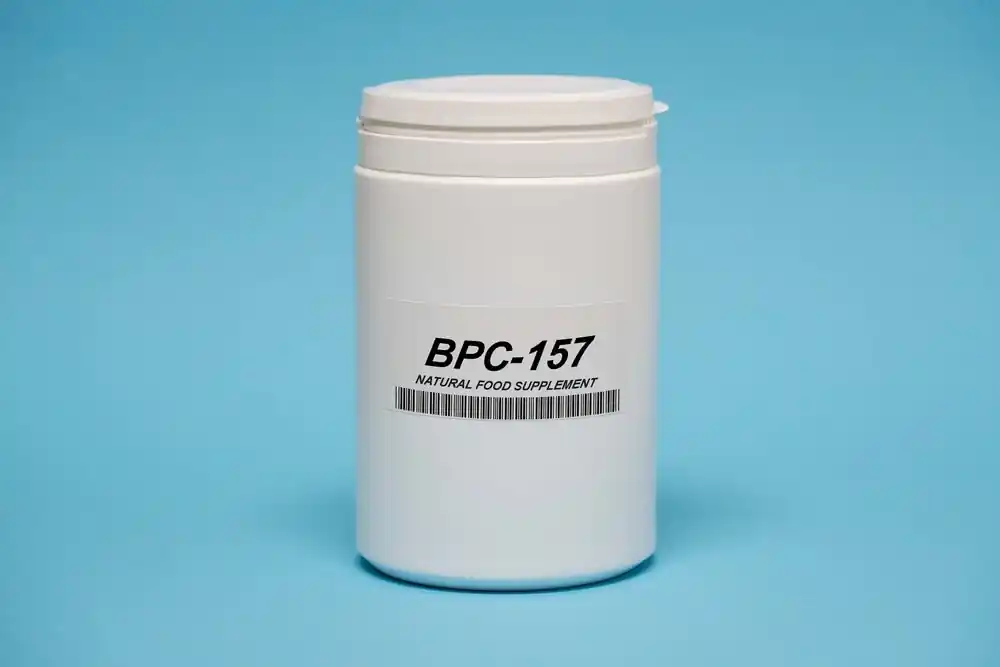
BPC-157 (Body Protection Compound) | 99% Purity Gastric & Tissue Repair

Original price was: $90.00.$75.00Current price is: $75.00.
BPC-157 (Body Protection Compound) is a synthetic 15-amino acid pentadecapeptide modeled after a naturally occurring protective protein found in human gastric juice. Renowned for its broad-spectrum regenerative potential, BPC-157 (Body Protection Compound) is a “cytoprotective” agent that accelerates the healing of various tissues, including tendons, ligaments, and the intestinal mucosa. In laboratory studies, it is investigated for its ability to trigger rapid blood vessel formation and stabilize the cellular response to oxidative stress and mechanical trauma.
BPC-157 (Body Protection Compound): The Science of Endogenous Repair
The Biochemistry of BPC-157 (Body Protection Compound)
BPC-157 (Body Protection Compound) is a fragment of the larger Body Protection Compound protein. Unlike many other growth factors, it is exceptionally stable and resistant to enzymatic degradation, which allows it to remain bioactive in the harsh environment of the gastrointestinal tract. The peptide sequence (Gly-Pro-Pro-Leu-Glu-Pro-Pro-Pro-Gly-Lys-Pro-Ala-Asp-Asp-Ala) is specifically investigated for its high affinity for various receptor sites involved in the repair of the extracellular matrix.
Mechanism of Action: Angiogenesis and Soft Tissue Healing
In advanced physiological research, BPC-157 (Body Protection Compound) functions through a multi-modal regenerative pathway:
-
Upregulation of VEGFR2: BPC-157 (Body Protection Compound) is studied for its ability to increase the expression of Vascular Endothelial Growth Factor receptor 2. This process promotes angiogenesis, creating a new vascular network that delivers essential nutrients to hypoxic, damaged tissues.
-
Activation of the FAK-paxillin Pathway: The peptide is observed to stimulate the recruitment of fibroblasts, which are the primary cells responsible for synthesizing collagen and repairing tendons and ligaments.
-
Nitric Oxide (NO) Modulation: Research suggests that BPC-157 (Body Protection Compound) regulates the NO system, providing both blood pressure-lowering effects and protection for the endothelial lining of the vascular system.
-
Gastrointestinal Cytoprotection: In enteric research, it is analyzed for its ability to heal stomach ulcers and reverse the damage caused by NSAIDs, effectively reinforcing the “gastric mucosal barrier.”
Primary Research Applications of BPC-157 (Body Protection Compound)
-
Tendon and Ligament Recovery: Analyzing the tensile strength and physical restoration of ruptured connective tissues in orthopedic models.
-
Inflammatory Bowel Disease (IBD): Investigating the peptide’s ability to reduce colonic inflammation and promote the healing of intestinal fistulas.
-
Muscle Tear Rehabilitation: Studying the acceleration of myoblast proliferation following acute muscle strain or crush injuries.
-
Neuroprotective Studies: Observing the role of BPC-157 (Body Protection Compound) in protecting brain tissue and stabilizing the gut-brain axis following toxic or traumatic insults.
4. Technical Specifications (E-E-A-T Data)
| Feature | Scientific Specification |
| Peptide Sequence | Gly-Pro-Pro-Leu-Glu-Pro-Pro-Pro-Gly-Lys-Pro-Ala-Asp-Asp-Ala |
| Molecular Formula | $C_{62}H_{98}N_{16}O_{22}$ |
| Molecular Weight | 1419.5 g/mol |
| CAS Number | 137525-51-0 |
| Purity Grade | $\geq$99% (HPLC & Mass Spec Verified) |
| Physical State | Lyophilized White Powder |
| Solubility | Highly Soluble in Water and Saline |
5. Product FAQ
Q: Why is BPC-157 (Body Protection Compound) derived from gastric juice?
A: Evolutionarily, the stomach must survive a highly corrosive environment (pH 1-2). The discovery of BPC-157 (Body Protection Compound) within this environment led researchers to investigate its inherent ability to protect and repair cells against extreme chemical and physical stress.
Q: How does BPC-157 (Body Protection Compound) impact the growth of blood vessels?
A: Research indicates it does not just “add” vessels randomly; rather, it upregulates the VEGFR2 pathway, which organizes the formation of functional capillaries specifically at the site of injury, a process known as “collateralization.”
Only logged in customers who have purchased this product may leave a review.
Related products

COLLAGEN & RECOVERY PEPTIDES
Larazotide Acetate (AT-1001) | Tight Junction Regulator Peptide

COLLAGEN & RECOVERY PEPTIDES
Vegan Collagen Peptides | Plant-Based Biomimetic Booster | 98% Bioavailability


RESEARCH-GRADE COMPOUNDS
BPC-157 | Advanced Tissue Repair & Gastric Research Compound

LONGEVITY & CELLULAR REPAIR PEPTIDES

COLLAGEN & RECOVERY PEPTIDES
Type II Collagen + Boswellia Complex | Advanced Cartilage Signaling

COLLAGEN & RECOVERY PEPTIDES
L-Glutamine Peptide Complex | High-Purity Bioavailable Nitrogen

PERFORMANCE PEPTIDES
Hydrolysed Collagen Peptides (Type I & III) | Grass-Fed | Multi-Tissue Support
COLLAGEN & RECOVERY PEPTIDES
TB-500 (Thymosin Beta-4) | Advanced Cellular Migration & Recovery
Reviews
There are no reviews yet.