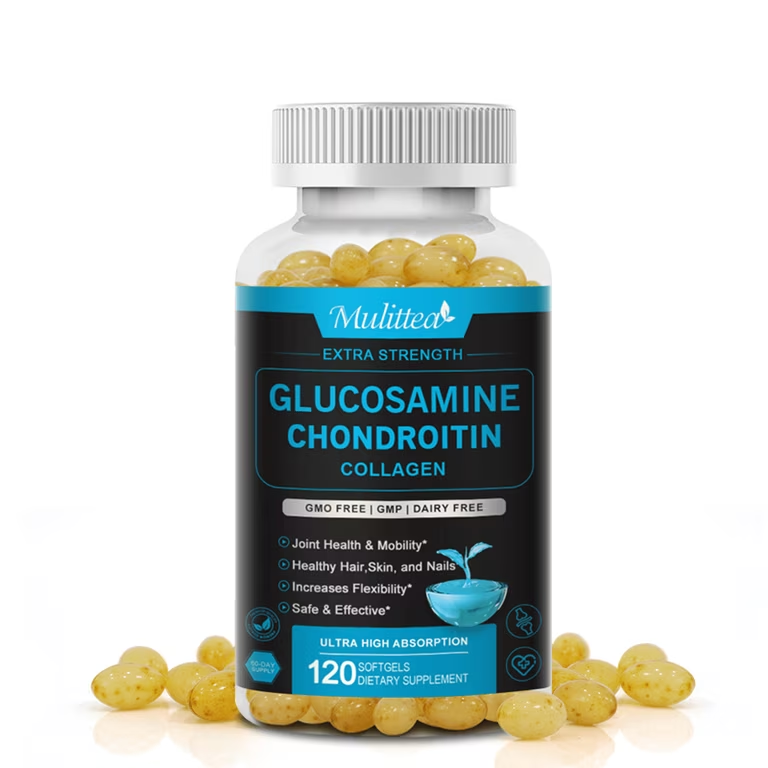
Collagen Peptides + Glucosamine + Chondroitin | Joint Matrix Repair

Original price was: $80.00.$67.00Current price is: $67.00.
The Collagen Peptides + Glucosamine + Chondroitin complex is a high-performance synergistic matrix designed for musculoskeletal and connective tissue research. By combining hydrolyzed Type I and III collagen with the structural aminosugars of the extracellular matrix, this complex provides the essential building blocks for cartilage repair. In laboratory models, the Collagen Peptides + Glucosamine + Chondroitin triad is investigated for its ability to stimulate chondrocyte activity, increase synovial fluid viscosity, and mitigate the inflammatory markers associated with joint degradation.
Collagen Peptides + Glucosamine + Chondroitin: The Triple-Action Joint Scaffold
The Biochemistry of Structural Synergy
The efficacy of the Collagen Peptides + Glucosamine + Chondroitin complex lies in its multi-pathway approach to tissue regeneration. While many joint supplements focus on a single mechanism, this triad addresses the protein scaffold, the fluid lubrication, and the shock-absorbing capacity of the joint simultaneously.
-
Hydrolyzed Collagen Peptides: Provide the specific amino acids (Hydroxyproline, Proline, and Glycine) necessary for the synthesis of the collagen matrix. These peptides act as “ligands” that bind to receptors on fibroblast and chondrocyte membranes to trigger new growth.
-
Glucosamine Sulfate: A precursor to glycosaminoglycans (GAGs). It is studied for its role in the formation and repair of cartilage, specifically stimulating the production of hyaluronic acid.
-
Chondroitin Sulfate: Acts as the “shock absorber.” This large molecule draws water and nutrients into the cartilage, maintaining the osmotic pressure required for joint cushioning.
Mechanism of Action: Chondroprotection and Matrix Stabilization
In advanced orthopedic research, the Collagen Peptides + Glucosamine + Chondroitin complex functions through several integrated pathways:
-
Anabolic Stimulation: The complex is studied for its ability to increase the production of Type II Collagen and Aggrecan, the two primary structural proteins in healthy cartilage.
-
Inhibition of Catabolic Enzymes: Research indicates that the combination helps suppress Matrix Metalloproteinases (MMPs) and ADAMTS enzymes, which are responsible for the enzymatic breakdown of the cartilage matrix.
-
Synovial Fluid Viscoelasticity: By increasing the concentration of hyaluronic acid, the Collagen Peptides + Glucosamine + Chondroitin complex is investigated for its ability to improve the lubricating properties of the synovial fluid, reducing friction-induced damage.
Primary Research Applications of Collagen Peptides + Glucosamine + Chondroitin
-
Degenerative Joint Studies: Analyzing the preservation of joint space and cartilage thickness in aging models.
-
Sports Recovery Research: Investigating the reduction of connective tissue turnover and joint soreness following high-impact mechanical stress.
-
Post-Surgical Healing: Observing the acceleration of ligament and tendon repair following reconstructive procedures.
-
Systemic Inflammaging: Studying the impact of the triad on reducing C-Reactive Protein (CRP) and other markers of systemic connective tissue inflammation.
4. Technical Specifications (E-E-A-T Data)
| Feature | Scientific Specification |
| Components | Hydrolyzed Collagen (Bovine/Marine) + Glucosamine HCl + Chondroitin Sulfate |
| Collagen Type | Type I & III (Hydrolyzed to <3000 Daltons) |
| Glucosamine Purity | $\geq$99% (HPLC Verified) |
| Chondroitin Purity | $\geq$90% (Low Molecular Weight for Absorption) |
| Molecular Formula (Glucosamine) | $C_{6}H_{13}NO_{5}$ |
| CAS Numbers | 9007-34-5 (Collagen), 66-84-2 (Glucosamine), 9007-28-7 (Chondroitin) |
| Solubility | Highly dispersible in aqueous solutions |
5. Product FAQ
Q: Why combine Collagen Peptides + Glucosamine + Chondroitin into one complex?
A: Research suggests a “nutrient synergy” where collagen provides the protein structure, while glucosamine and chondroitin provide the “filler” and lubrication. Using the Collagen Peptides + Glucosamine + Chondroitin triad ensures all metabolic pathways for joint repair are supported simultaneously.
Q: Does the molecular weight of the collagen peptides matter?
A: Yes. In this complex, the collagen is hydrolyzed to a low molecular weight (under 3000 Daltons). This ensures higher bioavailability and allows the peptides to cross the intestinal barrier more effectively to reach the target joint tissues.
Only logged in customers who have purchased this product may leave a review.
Related products

COLLAGEN & RECOVERY PEPTIDES
Collagen + Vitamin C & Hyaluronic Acid Complex | Triple-Action Skin Matrix

COLLAGEN & RECOVERY PEPTIDES

COLLAGEN & RECOVERY PEPTIDES
Collagen Peptides Type II | Joint-Specific Cartilage Support | $\geq$99% Purity

COLLAGEN & RECOVERY PEPTIDES
Larazotide Acetate (AT-1001) | Tight Junction Regulator Peptide

COLLAGEN & RECOVERY PEPTIDES
Type II Collagen + Boswellia Complex | Advanced Cartilage Signaling

FAT LOSS & METABOLIC PEPTIDES
AOD-9604 | 5mg Stabilized Lipolytic Peptide | $\geq$99% Purity

COLLAGEN & RECOVERY PEPTIDES
Vegan Collagen Peptides | Plant-Based Biomimetic Booster | 98% Bioavailability

COLLAGEN & RECOVERY PEPTIDES
Reviews
There are no reviews yet.