
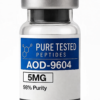
AOD-9604 | 5mg Stabilized Lipolytic Peptide | $\geq$99% Purity


Original price was: $70.00.$55.00Current price is: $55.00.
AOD-9604 (Anti-Obesity Drug 9604) is a cyclic peptide analog of the C-terminal fragment of human Growth Hormone (hGH). Specifically derived from the 176-191 domain, AOD-9604 features an added disulfide bridge that enhances its structural stability and metabolic half-life compared to the standard HGH Fragment. In research models, this peptide is highly regarded for its ability to stimulate fat oxidation and inhibit lipogenesis without the growth-promoting or diabetogenic risks associated with full-length HGH.
AOD-9604: The Evolution of Stabilized Lipolytic Research
Structural Superiority: The Disulfide Advantage
While standard HGH Fragment 176-191 is a linear peptide, AOD-9604 is engineered for durability. The inclusion of a disulfide bond between the cysteine residues creates a cyclic structure that mimics the natural folding of the GH molecule. This modification makes AOD-9604 significantly more resistant to proteolytic enzymes, allowing for more consistent pharmacokinetic data during laboratory observations.
Mechanism of Action: Non-Invasive Metabolic Optimization
In sophisticated metabolic research, AOD-9604 functions through highly specific physiological pathways:
-
Selective Lipolysis: It triggers the release of fat from obese adipose cells by mimicking the body’s natural response to growth hormone, specifically activating the breakdown of triglycerides into glycerol and free fatty acids.
-
Anti-Lipogenic Properties: Research indicates that AOD-9604 suppresses the activity of enzymes that convert non-fatty food materials into fat, effectively inhibiting the formation of new adipocytes.
-
IGF-1 and Insulin Independence: One of the most critical aspects of AOD-9604 is its failure to interact with the IGF-1 receptor or the insulin receptor. This allows researchers to observe fat loss without the risk of cellular proliferation or impaired glucose tolerance.
-
Chondrogenic Effects: Emerging research is investigating AOD-9604 for its regenerative properties. Studies have shown its potential to stimulate chondrocyte proliferation, suggesting applications in cartilage repair and osteoarthritis research.
Primary Research Applications of AOD-9604
-
Chronic Obesity Models: Analyzing the reduction of fat mass in subjects with long-term metabolic dysfunction.
-
Glucose Stability Studies: Studying lipolytic agents that do not induce hyperglycemia or insulin resistance.
-
Regenerative Medicine: Observing the impact of the peptide on the regeneration of hyaline cartilage in joint injury models.
-
Thermogenic Research: Investigating the peptide’s ability to increase metabolic rate and core energy expenditure.
4. Technical Specifications (E-E-A-T Data)
| Feature | Scientific Specification |
| Sequence | Tyr-Leu-Arg-Ile-Val-Gln-Cys-Arg-Ser-Val-Glu-Gly-Ser-Cys-Gly-Phe (Cyclic) |
| Molecular Formula | $C_{78}H_{123}N_{23}O_{23}S_{2}$ |
| Molecular Weight | 1815.1 g/mol |
| CAS Number | 221231-10-3 |
| Purity Grade | $\geq$99% (HPLC & Mass Spec Verified) |
| Stability | Enhanced metabolic stability via disulfide bridge |
5. Product FAQ
Q: Is AOD-9604 the same as HGH Fragment 176-191?
A: They are functionally similar, as both target the lipolytic domain of GH. However, AOD-9604 is the stabilized, cyclic version. This makes it more robust for research purposes, as it persists longer in biological systems before being broken down.
Q: Does AOD-9604 cause joint pain?
A: On the contrary, AOD-9604 is frequently studied for its joint-healing properties. Research into its chondrogenic potential suggests it may assist in the repair of cartilage and connective tissues, a stark contrast to the joint discomfort sometimes associated with high-dose full-length HGH.
Only logged in customers who have purchased this product may leave a review.
Related products

RESEARCH-GRADE COMPOUNDS

GROWTH HORMONE SECRETAGOGUES
Sermorelin (GHRH 1-29) 2mg | High-Purity Research Peptide | $\geq$99% Purity

PERFORMANCE PEPTIDES
Vilon (Lys-Glu) | 10mg Bioregulatory Dipeptide | $\geq$98% Purity

GROWTH HORMONE SECRETAGOGUES

ENDURANCE & ENERGY PEPTIDES
Humanin (HN) 10mg | High-Purity Mitochondrial-Derived Peptide | $\geq$99% Purity

PERFORMANCE PEPTIDES
Hydrolysed Collagen Peptides (Type I & III) | Grass-Fed | Multi-Tissue Support

ENDURANCE & ENERGY PEPTIDES
Epitalon (Epithalamin) 10mg | Telomerase Activator | $\geq$99% Purity

MUSCLE GROWTH & ANABOLIC PEPTIDES
Reviews
There are no reviews yet.