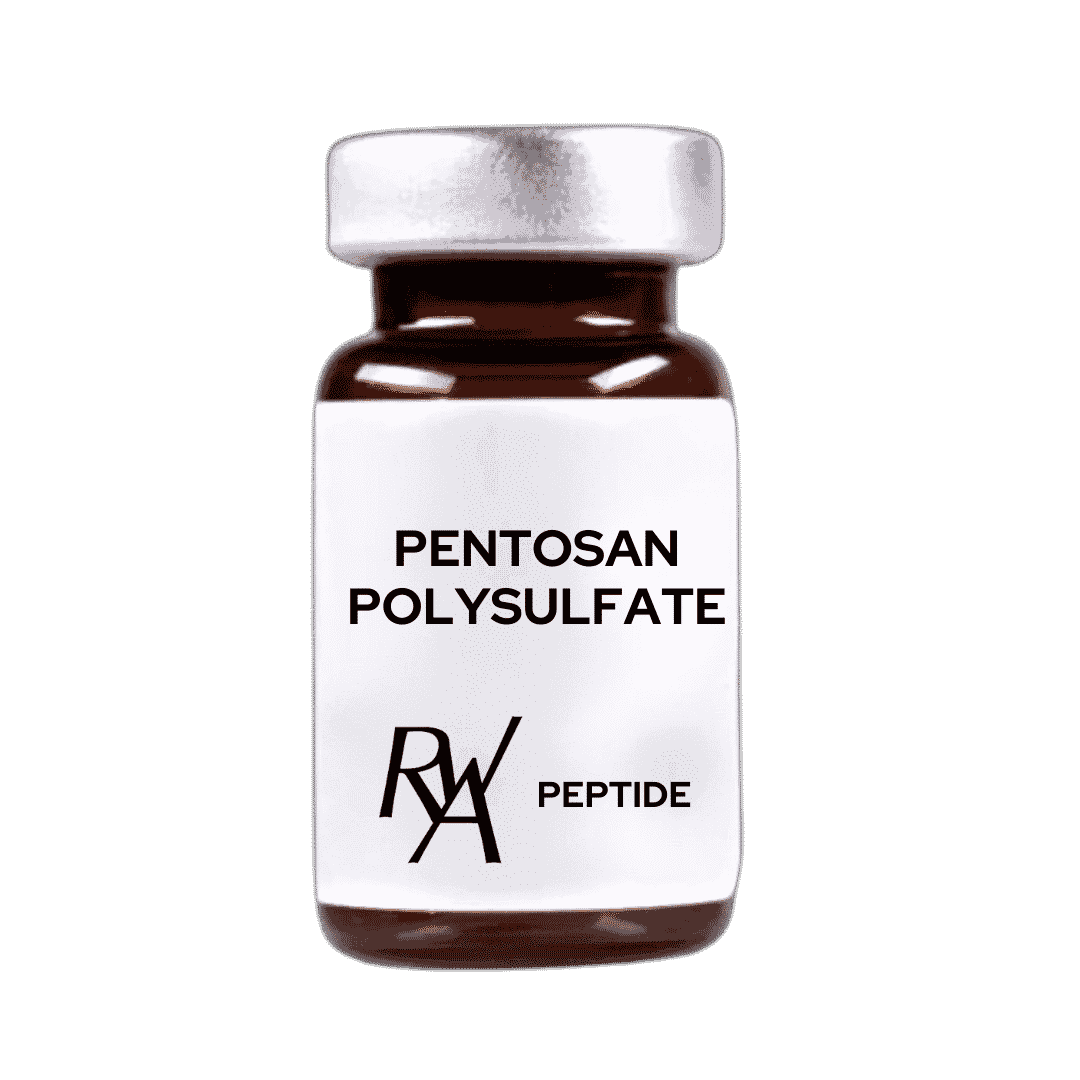
Pentosan Polysulphate Peptide Analogue | Advanced GAG Mimetic Research

Original price was: $120.00.$106.00Current price is: $106.00.
The Pentosan Polysulphate Peptide Analogue is a semi-synthetic, heparin-like macromolecule derived from the hemicellulose of European beech wood. Functioning as a potent glycosaminoglycan (GAG) mimetic, this Pentosan Polysulphate Peptide Analogue is primarily studied for its ability to reinforce deficient mucosal barriers. In advanced research models, it is investigated for its high affinity for damaged urothelial and synovial surfaces, providing a protective “chemical shield” against irritants and inflammatory cytokines.
Pentosan Polysulphate Peptide Analogue: The Science of Barrier Mimicry
The Biochemistry of Polysulphated Xylans
The Pentosan Polysulphate Peptide Analogue is unique due to its high density of sulphate groups, which gives it a strong negative charge. This polyanionic nature allows it to bind specifically to basic fibroblast growth factors and other proteins involved in tissue repair. Unlike standard heparin, the Pentosan Polysulphate Peptide Analogue exhibits low anticoagulant activity while maintaining powerful anti-inflammatory and tissue-protective properties, making it an ideal subject for studying chronic inflammatory conditions without the risk of systemic hemorrhage.
Mechanism of Action: Restoring the Protective Coating
In clinical and laboratory research, the Pentosan Polysulphate Peptide Analogue functions through several specialized pathways:
-
GAG Layer Restoration: In models of the bladder and joints, the Pentosan Polysulphate Peptide Analogue adheres to the luminal surface of the epithelium, effectively replacing lost or damaged glycosaminoglycans. This restores the “barrier function,” preventing toxins or abrasive salts from reaching the underlying sensitive tissue.
-
Inhibition of Mast Cell Activation: Research indicates that the analogue can stabilize mast cells, reducing the release of histamine and other inflammatory mediators that drive chronic pain cycles.
-
Metalloproteinase Modulation: The Pentosan Polysulphate Peptide Analogue is studied for its ability to inhibit MMP-3 and other enzymes that degrade the extracellular matrix in cartilage and connective tissues.
-
Micro-Circulatory Improvement: It is investigated for its ability to mobilize fibrin thrombi and improve the micro-vasculature of the sub-mucosal layers, enhancing nutrient delivery to healing tissues.
Primary Research Applications of Pentosan Polysulphate Peptide Analogue
-
Urothelial Integrity Studies: Analyzing the reduction of permeability in models of interstitial cystitis and painful bladder syndrome.
-
Osteoarthritis Research: Investigating the preservation of the proteoglycan matrix in articular cartilage under mechanical stress.
-
Thromboembolism Prevention: Studying the anti-thrombotic effects in research environments requiring low-anticoagulant heparinoids.
-
Viral Entry Inhibition: Analyzing the ability of the polyanionic chains to bind to viral envelopes, potentially preventing cell entry in infectious disease models.
4. Technical Specifications (E-E-A-T Data)
| Feature | Scientific Specification |
| Full Chemical Name | $\beta$-D-Xylan, (1-4), 2,3-bis(hydrogen sulfate), sodium salt |
| Component Type | Semi-Synthetic Polysulphated Polysaccharide |
| Molecular Formula | $[C_{5}H_{6}Na_{2}O_{10}S_{2}]n$ |
| Molecular Weight | 4,000 – 6,000 Daltons (Low Molecular Weight Fraction) |
| CAS Number | 37319-17-8 |
| Purity Grade | $\geq$98% (HPLC & Electrophoresis Verified) |
| Physical State | White to Off-White Lyophilized Powder |
| Solubility | Highly Soluble in Water ($>$50 mg/mL) |
5. Product FAQ
Q: How does the Pentosan Polysulphate Peptide Analogue differ from standard Heparin?
A: While both are polysulphated molecules, the Pentosan Polysulphate Peptide Analogue has roughly 1/10th the anticoagulant potency of heparin. This allows researchers to focus on its anti-inflammatory and GAG-mimetic properties without significantly altering blood clotting parameters in research models.
Q: Why is the molecular weight of this analogue significant?
A: The specific weight of 4,000–6,000 Da is optimized for tissue penetration. In research, this “low molecular weight” fraction is seen to have better distribution to the bladder lining and synovial joints compared to higher molecular weight polysaccharides.
Only logged in customers who have purchased this product may leave a review.
Related products

COLLAGEN & RECOVERY PEPTIDES
Collagen Peptides Type II | Joint-Specific Cartilage Support | $\geq$99% Purity

COLLAGEN & RECOVERY PEPTIDES
L-Glutamine Peptide Complex | High-Purity Bioavailable Nitrogen

COLLAGEN & RECOVERY PEPTIDES

COLLAGEN & RECOVERY PEPTIDES

COLLAGEN & RECOVERY PEPTIDES
Vegan Collagen Peptides | Plant-Based Biomimetic Booster | 98% Bioavailability
COLLAGEN & RECOVERY PEPTIDES
TB-500 (Thymosin Beta-4) | Advanced Cellular Migration & Recovery

COLLAGEN & RECOVERY PEPTIDES

COLLAGEN & RECOVERY PEPTIDES
LNAC (N-Acetyl Cysteine) + Glycine Peptide | Glutathione Precursor
Reviews
There are no reviews yet.