
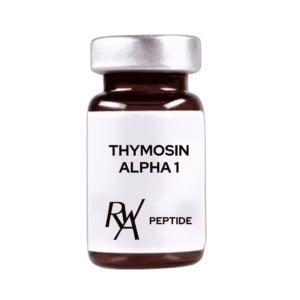
Thymosin Alpha-1 (TA1) | High-Purity Immune Bioregulator

Original price was: $120.00.$95.00Current price is: $95.00.
Thymosin Alpha-1 (TA1) is a synthetic 28-amino acid peptide that mirrors the naturally occurring hormone produced by the thymus gland. Known for its potent immunomodulatory properties, Thymosin Alpha-1 (TA1) is a cornerstone of research into the restoration of immune homeostasis. It is primarily studied for its ability to stimulate T-cell maturation and enhance the body’s innate response to pathogens without overstimulating the inflammatory cascade.
Thymosin Alpha-1 (TA1): The Master Regulator of Immune Homeostasis
The Biochemistry of Thymosin Alpha-1 (TA1)
The peptide Thymosin Alpha-1 (TA1) (brand name Thymalfasin) is derived from Prothymosin Alpha. In the human body, it is naturally secreted by the thymus to direct the differentiation of lymphoid stem cells into mature T-cells. Its structure is highly conserved, reflecting its critical role in maintaining the adaptive immune response. Research focused on Thymosin Alpha-1 (TA1) investigates its status as a “bioregulator” that can both upregulate and downregulate the immune system depending on the physiological requirement.
Mechanism of Action: Toll-Like Receptor (TLR) Signaling
In advanced immunology research, Thymosin Alpha-1 (TA1) functions through several sophisticated pathways:
-
TLR Activation: Thymosin Alpha-1 (TA1) acts as a ligand for Toll-like receptors (TLR9 and TLR3) in dendritic cells. This activation triggers the production of Type I Interferons and shifts the immune profile toward a Th1 response.
-
T-Cell Maturation: It promotes the differentiation of CD3+, CD4+, and CD8+ cells. By increasing the pool of mature T-lymphocytes, Thymosin Alpha-1 (TA1) enhances the surveillance and destruction of virally infected cells.
-
Cytokine Balancing: A key research focus of Thymosin Alpha-1 (TA1) is its ability to modulate cytokine production, increasing IL-2 and IFN-$\gamma$ while decreasing pro-inflammatory IL-4 and IL-10 when necessary.
-
Major Histocompatibility Complex (MHC) Upregulation: It increases the expression of MHC Class I molecules, improving the “visibility” of pathogens to the immune system.
Primary Research Applications of Thymosin Alpha-1 (TA1)
-
Chronic Viral Research: Studying the peptide’s efficacy in models of Hepatitis B and C, as well as general viral load reduction.
-
Immunosenescence: Analyzing how Thymosin Alpha-1 (TA1) can “reboot” a weakened immune system in aging subjects.
-
Adjuvant Studies: Investigating the use of Thymosin Alpha-1 (TA1) to enhance the efficacy of vaccines by boosting the primary antibody response.
-
Oncological Support: Researching its role in restoring immune function following chemotherapy-induced immunosuppression.
4. Technical Specifications (E-E-A-T Data)
| Feature | Scientific Specification |
| Full Chemical Name | Thymosin Alpha-1 (Acetate) |
| Peptide Sequence | Ac-Ser-Asp-Ala-Ala-Val-Asp-Thr-Ser-Ser-Glu-Ile-Thr-Thr-Lys-Asp-Leu-Lys-Glu-Lys-Lys-Glu-Val-Val-Glu-Glu-Ala-Glu-Asn |
| Molecular Formula | $C_{129}H_{215}N_{33}O_{55}$ |
| Molecular Weight | 3108.3 g/mol |
| CAS Number | 62304-98-7 |
| Purity Grade | $\geq$99% (HPLC & Mass Spec Verified) |
| Physical State | Lyophilized White Powder |
5. Product FAQ (Schema-Ready)
Q: How does Thymosin Alpha-1 (TA1) differ from Thymosin Beta-4?
A: While both are thymic peptides, they serve different functions. Thymosin Alpha-1 (TA1) is primarily an immune modulator focused on T-cell maturation. In contrast, Thymosin Beta-4 (TB-500) is a regenerative peptide focused on tissue repair, angiogenesis, and cell migration.
Q: Is Thymosin Alpha-1 (TA1) considered an immunosuppressant?
A: No. Thymosin Alpha-1 (TA1) is an immunomodulator. In research, it is seen to balance the immune system. If the system is underactive, it boosts function; if it is overactive (as in certain inflammatory conditions), it helps regulate it toward homeostasis.
Only logged in customers who have purchased this product may leave a review.
Related products

COLLAGEN & RECOVERY PEPTIDES
Type II Collagen + Boswellia Complex | Advanced Cartilage Signaling

LONGEVITY & CELLULAR REPAIR PEPTIDES

COLLAGEN & RECOVERY PEPTIDES
Pentosan Polysulphate Peptide Analogue | Advanced GAG Mimetic Research

COLLAGEN & RECOVERY PEPTIDES

COLLAGEN & RECOVERY PEPTIDES
Vegan Collagen Peptides | Plant-Based Biomimetic Booster | 98% Bioavailability

COLLAGEN & RECOVERY PEPTIDES
BPC-157 (Body Protection Compound) | 99% Purity Gastric & Tissue Repair

COLLAGEN & RECOVERY PEPTIDES

COLLAGEN & RECOVERY PEPTIDES
Collagen Peptides + Glucosamine + Chondroitin | Joint Matrix Repair

Reviews
There are no reviews yet.