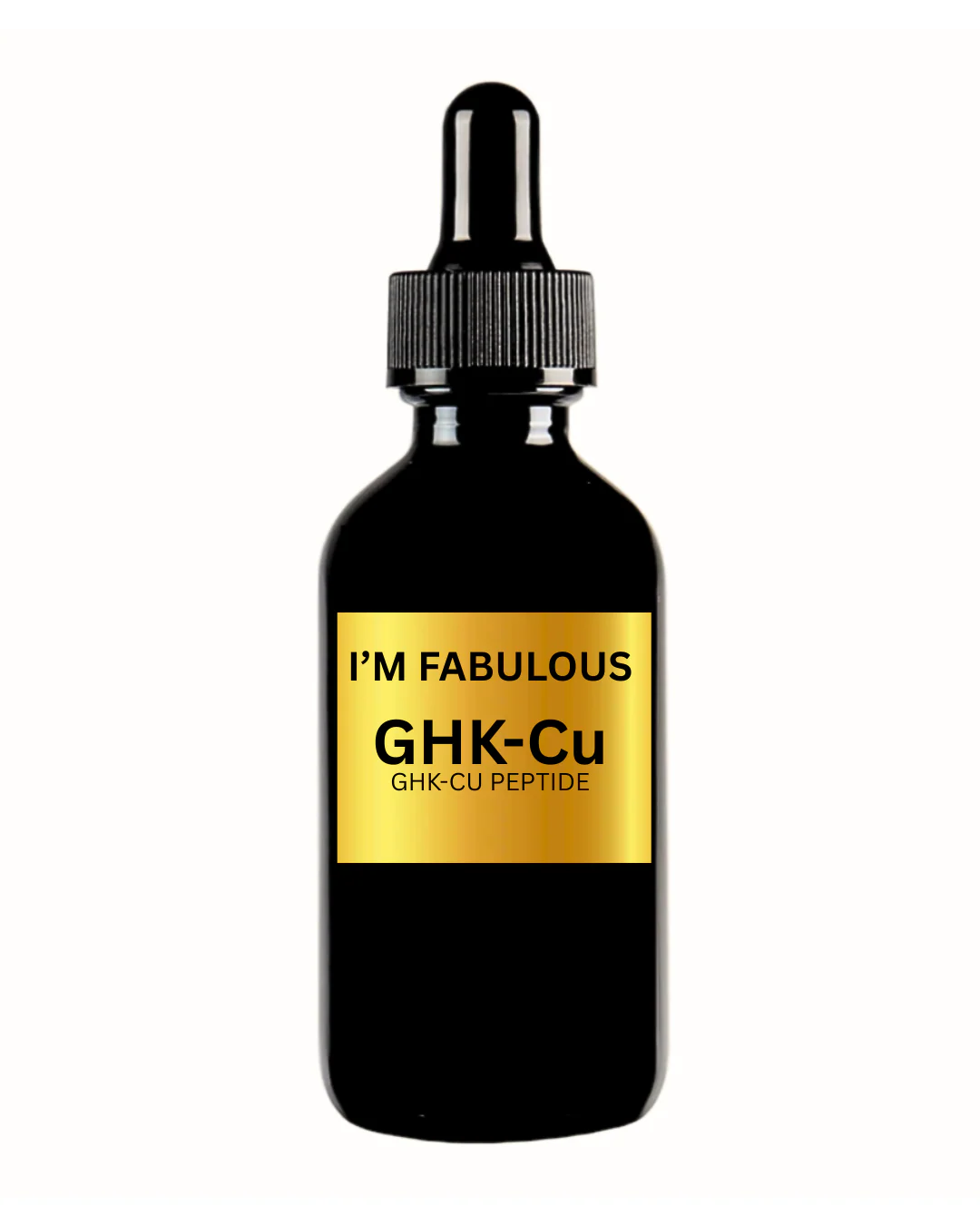
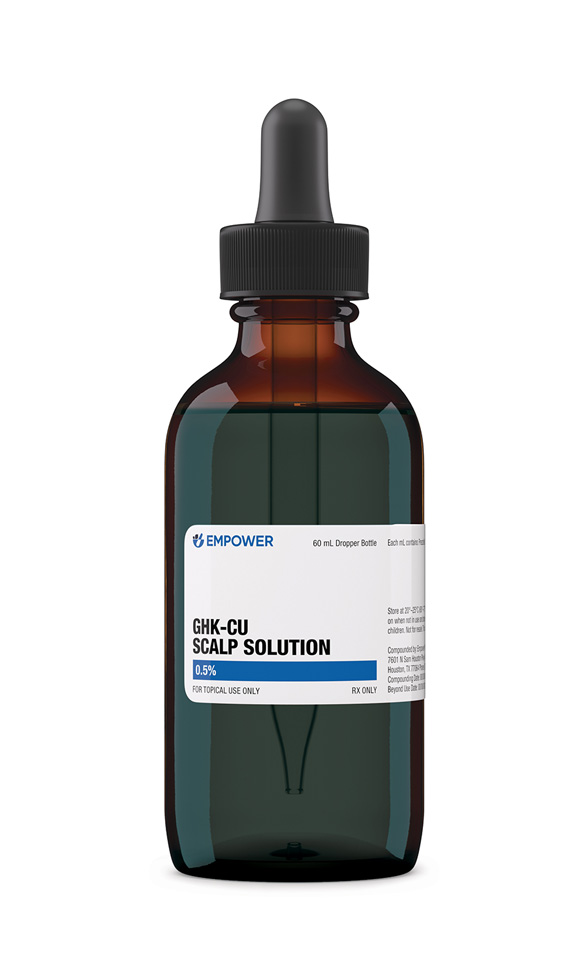


GHK-Cu Topical Serum | High-Purity Copper Peptide Complex

Original price was: $65.00.$60.50Current price is: $60.50.
GHK-Cu Topical Serum is a high-affinity copper-binding tripeptide (Glycyl-L-histidyl-L-lysine) formulated for advanced dermatological research. Originally identified in human plasma, this peptide is a master regulator of the “wound healing cascade.” In laboratory models, GHK-Cu Topical Serum is investigated for its ability to promote significant collagen synthesis, stabilize the skin barrier, and reset the gene expression of aged or damaged dermal cells to a more youthful state.
HK-Cu Topical Serum: The Science of Copper-Mediated Regeneration
The Biochemistry of GHK-Cu Topical Serum
The efficacy of GHK-Cu Topical Serum is rooted in its unique ability to chelate copper ions ($Cu^{2+}$), transporting them into the skin cells where they act as essential co-factors for enzymatic reactions. The tripeptide sequence (Gly-His-Lys) has a remarkable affinity for copper, forming a complex that is highly stable and bioavailable. Research into GHK-Cu Topical Serum focuses on its role as a “signaling peptide” that modulates the production of several key components of the extracellular matrix.
Mechanism of Action: Gene Modulation and Dermal Repair
In sophisticated skin biology research, GHK-Cu Topical Serum functions through multiple regenerative pathways:
-
Collagen and Elastin Stimulation: GHK-Cu Topical Serum is studied for its ability to increase the production of Type I collagen and elastin fibers, which provide structural support and elasticity to the skin matrix.
-
Glycosaminoglycan (GAG) Upregulation: Research shows the peptide stimulates the production of hyaluronic acid and other GAGs, significantly improving dermal hydration and volume.
-
DNA Repair and Anti-Inflammatory Action: A critical research focus for GHK-Cu Topical Serum is its ability to modulate the expression of over 4,000 human genes. It is observed to upregulate DNA repair genes while downregulating pro-inflammatory cytokines like TNF-alpha and IL-6.
-
Angiogenesis and Microcirculation: The serum is investigated for its capacity to promote the formation of new blood vessels, enhancing nutrient delivery and waste removal in the dermal layers.
Primary Research Applications of GHK-Cu Topical Serum
-
Skin Rejuvenation Studies: Analyzing the reduction of fine lines, wrinkles, and hyperpigmentation in aging skin models.
-
Scar Tissue Remodeling: Investigating the peptide’s ability to normalize collagen deposition, potentially reducing the appearance of hypertrophic scars.
-
Trichology Research: Studying the impact of GHK-Cu Topical Serum on hair follicle size and the promotion of the anagen (growth) phase of the hair cycle.
-
Post-Procedure Recovery: Observing the acceleration of skin barrier restoration following laser treatments or chemical peels.
4. Technical Specifications (E-E-A-T Data)
| Feature | Scientific Specification |
| Peptide Sequence | Glycyl-L-histidyl-L-lysine (Copper Complex) |
| Molecular Formula | $C_{14}H_{24}N_{6}O_{4}Cu$ |
| Molecular Weight | 403.9 g/mol |
| CAS Number | 89030-95-5 |
| Purity Grade | $\geq$99% (HPLC & Mass Spec Verified) |
| pH Range | 5.5 – 6.5 (Optimized for Stability) |
| Appearance | Characteristic Deep Blue Solution |
5. Product FAQ (Schema-Ready)
Q: Why is GHK-Cu Topical Serum naturally blue?
A: The deep blue color is a direct result of the copper chelation process. When the GHK tripeptide successfully binds with copper ions, it creates a blue-tinted complex. A lack of color in a GHK-Cu solution typically indicates a lack of copper saturation.
Q: Can GHK-Cu Topical Serum be used with Retinoids?
A: In research settings, these are often used in separate cycles. While GHK-Cu Topical Serum promotes repair and reduces inflammation, high-strength retinoids can be irritating. Using GHK-Cu can help stabilize the skin barrier, but researchers typically avoid mixing them in the same application to prevent the copper from oxidizing the retinoid.
Only logged in customers who have purchased this product may leave a review.
Related products

COLLAGEN & RECOVERY PEPTIDES
Collagen + Vitamin C & Hyaluronic Acid Complex | Triple-Action Skin Matrix

COLLAGEN & RECOVERY PEPTIDES

COLLAGEN & RECOVERY PEPTIDES
Larazotide Acetate (AT-1001) | Tight Junction Regulator Peptide


COLLAGEN & RECOVERY PEPTIDES
Marine Collagen Peptides (Type I) | 100% Wild-Caught | Nano-Scale Absorption

COLLAGEN & RECOVERY PEPTIDES
BPC-157 (Body Protection Compound) | 99% Purity Gastric & Tissue Repair

COLLAGEN & RECOVERY PEPTIDES

COLLAGEN & RECOVERY PEPTIDES

RESEARCH-GRADE COMPOUNDS

Reviews
There are no reviews yet.