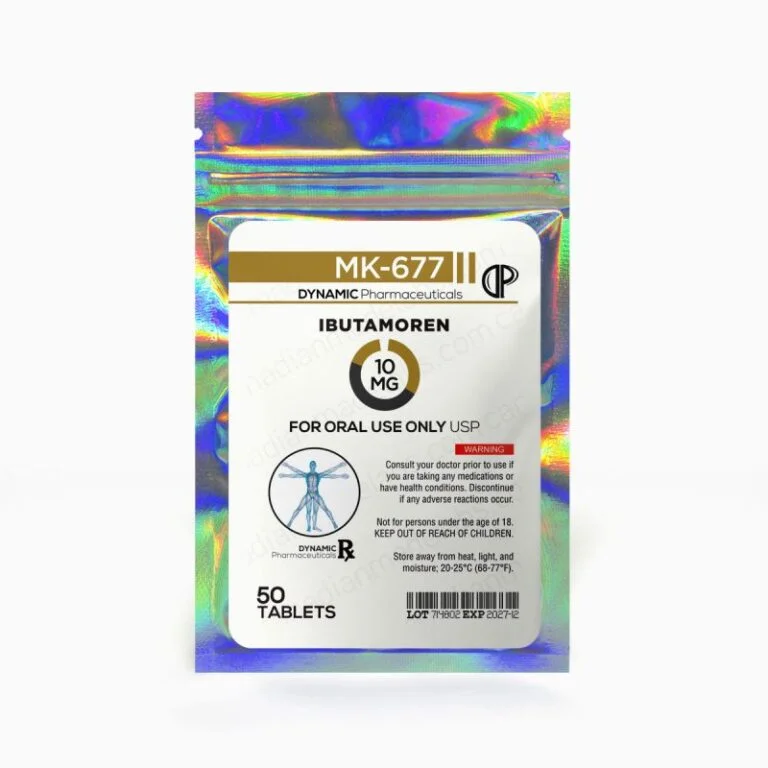
MK-677 (Ibutamoren) | Advanced Growth Hormone Secretagogue


$92.00
MK-677, also known as Ibutamoren, is a potent, non-peptide, orally active growth hormone secretagogue (GHS). Unlike exogenous growth hormone, MK-677 functions as a highly selective agonist of the ghrelin receptor (GHSR). In laboratory research, it is investigated for its ability to mimic the action of ghrelin to stimulate the pulsatile release of endogenous growth hormone from the pituitary gland, leading to a sustained increase in plasma levels of Insulin-like Growth Factor 1 (IGF-1) without significantly altering cortisol levels.
MK-677: The Science of Ghrelin Agonism and Somatotropic Signaling
The Biochemistry of MK-677
MK-677 ($C_{27}H_{36}N_{4}O_{5}S$) is a methanesulfonate salt that stands out in endocrine research due to its structural stability and high oral bioavailability. By targeting the ghrelin receptors in the hypothalamus and pituitary, it bypasses the need for intravenous administration, making it a primary subject for studying long-term somatotropic stimulation.
Mechanism of Action: Pituitary Stimulation and Energy Balance
In advanced endocrinology and metabolic research, MK-677 functions through several coordinated physiological pathways:
-
Ghrelin Receptor Agonism: The compound binds to the G-protein coupled receptor GHSR, triggering the release of Growth Hormone Releasing Hormone (GHRH) and inhibiting Somatostatin signaling.
-
Sustained IGF-1 Upregulation: Research focuses on the compound’s ability to maintain elevated systemic levels of IGF-1, which is critical for tissue repair, cell proliferation, and protein synthesis.
-
Nitrogen Retention: MK-677 is investigated for its ability to reverse nitrogen wasting in metabolic stress models, promoting a positive nitrogen balance essential for muscle preservation.
-
Sleep Architecture Modulation: Studies observe that ghrelin receptor activation may improve the quality of REM sleep and the duration of deep (Stage IV) sleep in laboratory subjects.
Primary Research Applications
-
Sarcopenia and Muscle Atrophy: Analyzing the preservation of lean body mass in aging models or subjects with protein-energy malnutrition.
-
Bone Mineral Density Research: Investigating the impact of increased GH and IGF-1 on osteoblast activity and bone turnover.
-
Metabolic Homeostasis: Studying the relationship between ghrelin agonism, appetite signaling, and total energy expenditure.
-
Cognitive and Neurotrophic Studies: Observing the potential indirect effects of elevated IGF-1 on hippocampal neurogenesis and cognitive function.
4. Technical Specifications (E-E-A-T Data)
| Feature | Scientific Specification |
| Chemical Name | 2-amino-N-[(1R)-2-[benzyl(methyl)amino]-2-oxo-1-(phenylmethoxymethyl)ethyl]-2-methylpropanamide;methanesulfonic acid |
| Molecular Formula | $C_{27}H_{36}N_{4}O_{5}S$ |
| Molecular Weight | 528.66 g/mol (base) |
| CAS Number | 159752-10-0 |
| Purity Grade | $\geq$99% (HPLC Verified) |
| Form | Research Grade Tablets (10mg Standardized) |
| Solubility | Soluble in Water, DMSO, and Ethanol |
5. Product FAQ
Q: Is MK-677 a SARM?
A: No. While MK-677 is often sold alongside SARMs, it is a Growth Hormone Secretagogue. It does not interact with the androgen receptor and does not influence testosterone levels.
Q: Does MK-677 affect cortisol or prolactin?
A: Research indicates that MK-677 is highly selective. While it significantly increases GH and IGF-1, it generally has a minimal and transient effect on cortisol and prolactin levels in laboratory models compared to other secretagogues.
Related products


GLP-1 & METABOLIC RESEARCH COMPOUNDS


RESEARCH-GRADE COMPOUNDS

RESEARCH-GRADE COMPOUNDS
GROWTH HORMONE SECRETAGOGUES
Hexarelin Peptide | High-Purity 2mg Vial | Advanced Cardioprotective Research

GLP-1 & METABOLIC RESEARCH COMPOUNDS

GLP-1 & METABOLIC RESEARCH COMPOUNDS