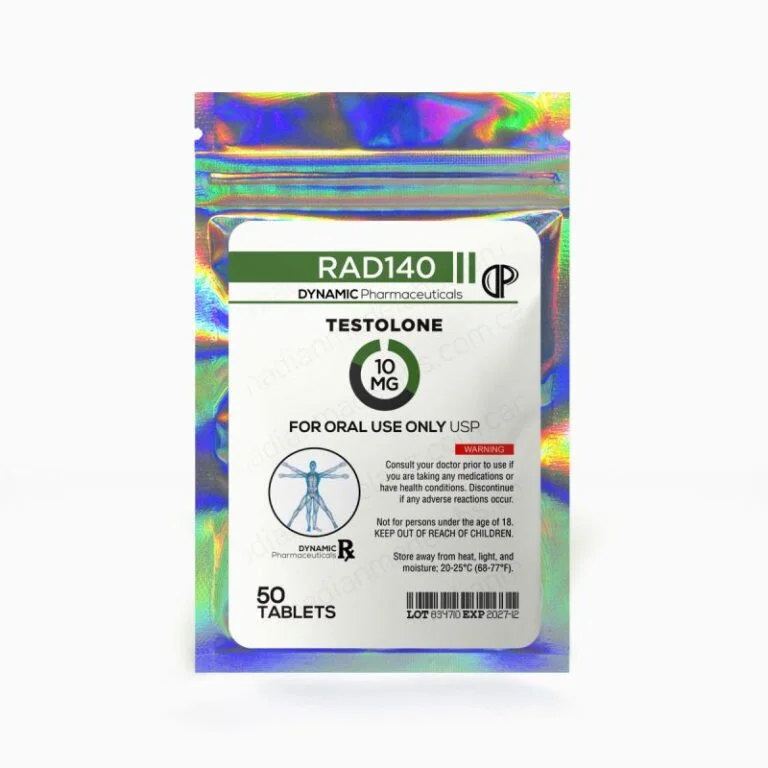
RAD140 (Testolone) | Advanced SARM & Androgen Receptor

$85.00
RAD140, also known as Testolone, is a highly potent, non-steroidal Selective Androgen Receptor Modulator (SARM). Developed to provide the anabolic benefits of traditional androgens while minimizing undesirable androgenic effects on non-target tissues, RAD140 is a primary subject in musculoskeletal research. It is investigated for its exceptional affinity for androgen receptors in skeletal muscle and bone, making it a foundational tool for studying muscle wasting mitigation and potential neuroprotective pathways.
RAD140: The Science of Selective Anabolic Signaling
The Biochemistry of RAD140
RAD140 ($C_{20}H_{16}ClN_{5}O_{2}$) is characterized by its high stability and oral bioavailability. Unlike anabolic steroids, which can interact with a wide range of receptors and lead to systemic side effects, RAD140 was engineered to be “tissue-selective.” It acts as a full agonist in skeletal muscle while functioning as a partial antagonist or showing minimal activity in tissues like the prostate and sebaceous glands.
Mechanism of Action: Targeted Androgen Receptor Affinity
In advanced pharmacology and regenerative medicine research, RAD140 functions through several coordinated physiological pathways:
-
High-Affinity AR Binding: The compound binds to androgen receptors (AR) with an affinity that exceeds that of testosterone, triggering the transcription of genes responsible for protein synthesis and nitrogen retention.
-
Skeletal Muscle Hypertrophy: Research focuses on the compound’s ability to stimulate the growth of lean tissue mass and increase physical strength in laboratory models of muscle atrophy.
-
Bone Mineral Density Enhancement: RAD140 is investigated for its capacity to stimulate osteoblastic activity, potentially strengthening bone structure and increasing mineralization.
-
Neuroprotective Signaling: Emerging studies observe that RAD140 may reduce cellular apoptosis in the brain, providing a model for researching neurodegenerative defenses against amyloid-beta proteins.
Primary Research Applications
-
Sarcopenia and Muscle Wasting: Analyzing the restoration of lean mass in subjects suffering from age-related or disease-induced muscle loss.
-
Breast Cancer Research: Investigating the potential of RAD140 as an AR agonist in AR-positive/ER-positive breast cancer models to inhibit tumor growth.
-
Osteoporosis Studies: Observing the impact of selective androgen signaling on bone turnover and fracture resistance.
-
Cognitive and Neurological Health: Researching the relationship between androgen receptor activation and the preservation of neuronal integrity.
4. Technical Specifications (E-E-A-T Data)
| Feature | Scientific Specification |
| Chemical Name | 2-chloro-4-{[(1R,2S)-1-[5-(4-cyanophenyl)-1,3,4-oxadiazol-2-yl]-2-hydroxypropyl]amino}benzonitrile |
| Molecular Formula | $C_{20}H_{16}ClN_{5}O_{2}$ |
| Molecular Weight | 393.83 g/mol |
| CAS Number | 1182367-47-0 |
| Purity Grade | $\geq$99% (HPLC Verified) |
| Form | Research Grade Tablets (10mg Standardized) |
| Solubility | Soluble in DMSO and Ethanol |
5. Product FAQ
Q: Is RAD140 a steroid?
A: No. RAD140 is a Selective Androgen Receptor Modulator (SARM). While it targets the same receptors as steroids, its chemical structure is non-steroidal, allowing it to target muscle and bone specifically while reducing impact on other organs.
Q: Why is RAD140 studied for neuroprotection?
A: Research indicates that RAD140 can cross the blood-brain barrier and activate androgen receptors in the brain. In laboratory models, this has been shown to reduce neuronal damage caused by oxidative stress and toxic proteins.
Related products




ENDURANCE & ENERGY PEPTIDES
Humanin (HN) 10mg | High-Purity Mitochondrial-Derived Peptide | $\geq$99% Purity

ENDURANCE & ENERGY PEPTIDES
Selank Peptide | 10mg High-Purity Tuftsin Analog | Neuro-Research Grade

MUSCLE GROWTH & ANABOLIC PEPTIDES
Follistatin 344 (FST-344) 1mg | High-Purity Myostatin Inhibitor | $\geq$98% Purity