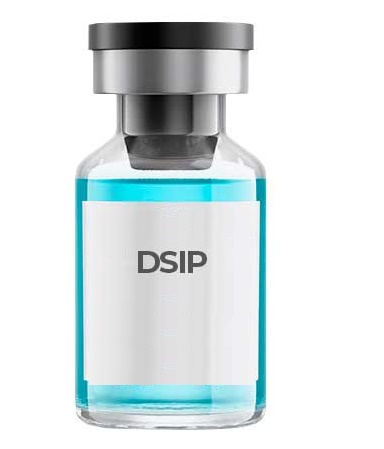
DSIP (Delta Sleep-Inducing Peptide)
Original price was: $80.00.$77.00Current price is: $77.00.
DSIP (Delta Sleep-Inducing Peptide) is a naturally occurring nonapeptide ($Trp-Ala-Gly-Gly-Asp-Ala-Ser-Gly-Glu$) first isolated from the cerebral venous blood of rabbits in a state of induced sleep. In advanced neurochemical research, DSIP is investigated for its unique ability to cross the blood-brain barrier and induce deep, “delta-wave” sleep without the sedative-hypnotic profile of traditional pharmacological agents. Beyond its sleep-promoting properties, DSIP is studied as a potent stress-limiting peptide that modulates the hypothalamic-pituitary-adrenal (HPA) axis.
DSIP: The Science of Delta-Wave Induction and Stress Resilience
The Biochemistry of DSIP
DSIP is a highly versatile regulatory peptide found in both free and bound forms within the hypothalamus, limbic system, and pituitary gland. Unlike many other neuropeptides, DSIP exhibits a unique amphiphilic structure, allowing it to penetrate the blood-brain barrier effectively. In research models, it acts as a neuromodulator that stabilizes the activity of neurons involved in the sleep-wake transition, specifically targeting the synchronization of slow-wave (delta) oscillations.
Mechanism of Action: Neuromodulation and HPA Axis Regulation
In advanced neuroscience and metabolic research, DSIP functions through several complex physiological pathways:
-
Delta-Wave Synchronization: The peptide is studied for its ability to increase the power and duration of delta waves in the EEG, promoting the most restorative stages of Non-REM sleep.
-
GABAergic and Glutamatergic Balance: DSIP is observed to modulate the balance between excitatory and inhibitory neurotransmission, preventing neuronal hyper-excitability during periods of stress.
-
HPA Axis Suppression: Research focuses on the peptide’s role in inhibiting the release of Corticotropin-Releasing Hormone (CRH) and Adrenocorticotropic Hormone (ACTH), thereby lowering systemic cortisol levels.
-
Antioxidant and Neuroprotective Effects: DSIP is investigated for its capacity to reduce oxidative stress and stabilize mitochondrial membranes, protecting neurons from metabolic exhaustion.
Primary Research Applications
-
Sleep Architecture Analysis: Observing the restoration of natural sleep cycles in models of chronic insomnia and circadian disruption.
-
Stress-Limiting Studies: Investigating the peptide’s efficacy in buffering the physiological impact of acute and chronic environmental stress.
-
Addiction and Withdrawal Research: Studying the role of DSIP in normalizing neurochemical imbalances during alcohol and opioid withdrawal protocols.
-
Pain Modulation: Analyzing the synergistic effects of DSIP with endogenous opioid systems for the attenuation of chronic pain signals.
4. Technical Specifications (E-E-A-T Data)
| Feature | Scientific Specification |
| Peptide Sequence | Trp-Ala-Gly-Gly-Asp-Ala-Ser-Gly-Glu |
| Molecular Formula | $C_{35}H_{48}N_{10}O_{15}$ |
| Molecular Weight | 848.81 g/mol |
| CAS Number | 62568-57-4 |
| Purity Grade | $\geq$99% (HPLC & Mass Spec Verified) |
| Physical State | Lyophilized White Powder |
| Solubility | Highly Soluble in Water and Saline |
5. Product FAQ
Q: Does DSIP act like a traditional sedative?
A: No. Research indicates that DSIP does not force sedation. Instead, it is studied for its “modulatory” effect—facilitating the biological conditions necessary for natural delta-wave sleep only when the subject is in a quiet environment.
Q: Why is DSIP studied for stress management?
A: DSIP is researched as a “stress-limiting” peptide because it can help normalize the body’s cortisol response. By regulating the HPA axis, it helps maintain physiological homeostasis during high-pressure events in research models.
Only logged in customers who have purchased this product may leave a review.
Related products

WEIGHT MANAGEMENT & METABOLIC WELLNESS
Semaglutide (GLP-1 Analogue) | GLP-1 Agonist for Weight Loss
SLEEP & CIRCADIAN RHYTHM PEPTIDES
SLEEP & CIRCADIAN RHYTHM PEPTIDES


NEUROPEPTIDE RESEARCH COMPOUNDS


COGNITIVE & NEUROPROTECTIVE PEPTIDES
Selank Anxiolytic Nootropic Peptide | Advanced Stress & Cognitive

LONGEVITY & CELLULAR REPAIR PEPTIDES
Epitalon (Epithalamin) 10mg | Telomerase Activator | $\geq$99% Purity
HORMONAL BALANCE & VITALITY
Reviews
There are no reviews yet.