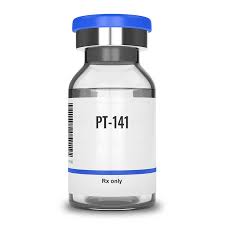
PT-141 (Bremelanotide) | Sexual Health & Melanocortin

Original price was: $120.00.$112.00Current price is: $112.00.
PT-141 (Bremelanotide) is a synthetic cyclic heptapeptide analog of alpha-melanocyte-stimulating hormone ($\alpha$-MSH) specifically investigated for its role in sexual health. Unlike traditional compounds that target the vascular system, PT-141 (Bremelanotide) functions centrally by activating melanocortin receptors in the brain. In laboratory research, it is the primary subject for studying the neurobiological triggers of sexual desire and arousal in both male and female models.
PT-141 (Bremelanotide): The Science of Central Nervous System Arousal
The Biochemistry of PT-141 (Bremelanotide)
PT-141 (Bremelanotide) is a metabolite of Melanotan II, specifically refined to remove the tanning (MC1R) properties while enhancing its affinity for the receptors involved in sexual response. Its structure (Ac-Nle-cyclo[Asp-His-D-Phe-Arg-Trp-Lys]-OH) allows it to bypass the peripheral vascular system and cross the blood-brain barrier. This central mechanism of action makes PT-141 (Bremelanotide) a unique subject for studying arousal disorders that do not respond to standard phosphodiesterase-5 (PDE5) inhibitors.
Mechanism of Action: MC3R and MC4R Agonism
In advanced neuroendocrine and sexual health research, PT-141 (Bremelanotide) functions through the activation of specific melanocortin pathways:
-
Hypothalamic Signaling: The peptide acts as a non-selective agonist of the MC3R and MC4R receptors located in the hypothalamus. This area of the brain is the primary regulator of metabolic balance and sexual motivation.
-
Dopaminergic Integration: By activating MC4R, PT-141 (Bremelanotide) triggers the release of dopamine in the medial preoptic area. This neurochemical shift is investigated for its ability to increase sexual desire and the “proceptive” behaviors associated with arousal.
-
Independence from Vasodilation: Unlike nitric-oxide-dependent compounds, the physiological response triggered by PT-141 (Bremelanotide) is entirely neurological. Research focus is often placed on how this central activation coordinates the physical components of the sexual response.
Primary Research Applications of PT-141 (Bremelanotide)
-
Hypoactive Sexual Desire Disorder (HSDD): Analyzing the peptide’s ability to restore libido in female models through central receptor modulation.
-
Erectile Dysfunction (ED) Studies: Investigating the effectiveness of central signaling in subjects who are non-responsive to peripheral vasodilators.
-
Female Sexual Arousal Disorder (FSAD): Studying the impact of melanocortin agonism on vaginal blood flow and subjective arousal markers.
-
Metabolic and Appetite Research: Due to its MC4R affinity, PT-141 (Bremelanotide) is also used to study the suppression of feeding behavior and its effects on energy expenditure.
4. Technical Specifications (E-E-A-T Data)
| Feature | Scientific Specification |
| Peptide Sequence | Ac-Nle-cyclo[Asp-His-D-Phe-Arg-Trp-Lys]-OH |
| Molecular Formula | $C_{50}H_{68}N_{14}O_{10}$ |
| Molecular Weight | 1025.16 g/mol |
| CAS Number | 189691-06-3 |
| Purity Grade | $\geq$99% (HPLC & Mass Spec Verified) |
| Physical State | Lyophilized White Powder |
| Solubility | Highly Soluble in Water and Saline |
5. Product FAQ
Q: How does PT-141 (Bremelanotide) differ from Melanotan II?
A: While both are melanocortin agonists, PT-141 (Bremelanotide) has a hydroxyl group at the C-terminus rather than an amide group. This modification significantly reduces its affinity for the MC1R (tanning) receptor while maintaining its potent effect on the MC3R and MC4R receptors responsible for sexual health.
Q: Why is PT-141 (Bremelanotide) studied for both men and women?
A: Because the melanocortin system is a foundational regulator of sexual desire across genders. Research into PT-141 (Bremelanotide) focuses on the universal hypothalamic pathways that control the behavioral and physiological aspects of arousal, making it a versatile tool for general sexual health studies.
Only logged in customers who have purchased this product may leave a review.
Related products


COGNITIVE & NEUROPROTECTIVE PEPTIDES
Selank Anxiolytic Nootropic Peptide | Advanced Stress & Cognitive


WEIGHT MANAGEMENT & METABOLIC WELLNESS

WEIGHT MANAGEMENT & METABOLIC WELLNESS
Semaglutide (GLP-1 Analogue) | GLP-1 Agonist for Weight Loss


COGNITIVE & NEUROPROTECTIVE PEPTIDES
SLEEP & CIRCADIAN RHYTHM PEPTIDES
HORMONAL BALANCE & VITALITY
Oxytocin Peptide | Neuropeptide for Emotional Wellness Research
SLEEP & CIRCADIAN RHYTHM PEPTIDES
SLEEP & CIRCADIAN RHYTHM PEPTIDES
Reviews
There are no reviews yet.