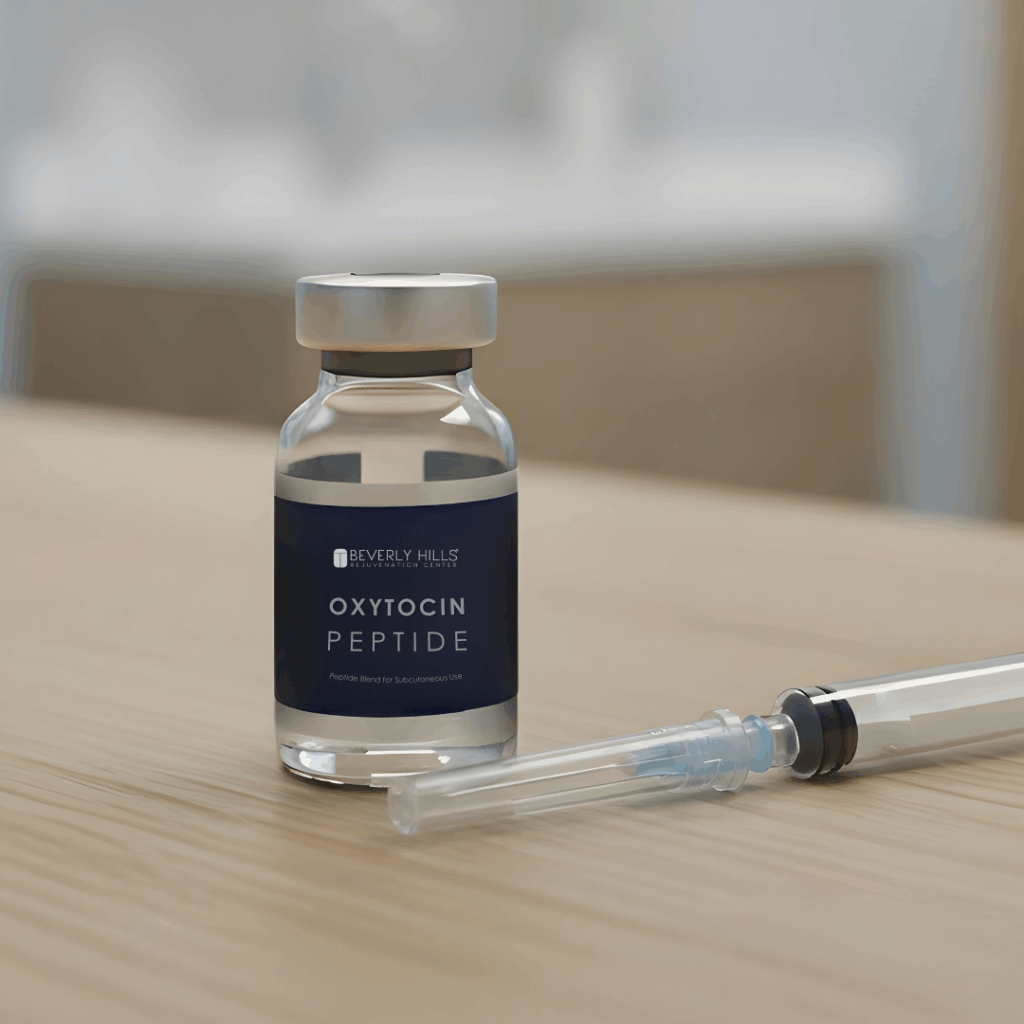
Oxytocin Peptide | Neuropeptide for Emotional Wellness Research
Original price was: $80.00.$72.00Current price is: $72.00.
Oxytocin Peptide is a powerful nine-amino acid neuropeptide and hormone synthesized in the hypothalamus and secreted by the posterior pituitary gland. Often termed the “bonding molecule,” Oxytocin Peptide serves as a central regulator of social interaction and emotional wellness. In clinical and laboratory research, it is investigated for its capacity to modulate the amygdala’s response to fear, facilitate maternal-infant attachment, and promote trust and prosocial behavior in complex social models.
Oxytocin Peptide: The Science of Social Connection and Stress Regulation
The Biochemistry of Oxytocin Peptide
The Oxytocin Peptide is a cyclic nonapeptide ($C_{43}H_{66}N_{12}O_{12}S_{2}$) characterized by a critical disulfide bridge between cysteine residues. This structural integrity is essential for its high-affinity binding to the oxytocin receptor (OXTR), a G-protein coupled receptor. While functionally similar to vasopressin, the specific amino acid configuration of Oxytocin Peptide allows it to cross-link with pathways responsible for reward, empathy, and emotional wellness.
Mechanism of Action: Modulating the Social Brain
In advanced neurobiology and psychology research, Oxytocin Peptide functions through targeted signaling in the central nervous system:
-
Amygdala Attenuation: Oxytocin Peptide is studied for its ability to reduce the activation of the amygdala in response to threatening stimuli. This anxiolytic effect is a cornerstone of research into emotional wellness and social anxiety.
-
Dopaminergic Reward Integration: The peptide interacts with the nucleus accumbens, linking social interaction with the brain’s reward system. This synergy is investigated as a mechanism for reinforcing pair-bonding and social cohesion.
-
HPA Axis Regulation: Research suggests that Oxytocin Peptide inhibits the release of cortisol, effectively buffering the hypothalamic-pituitary-adrenal (HPA) axis against chronic stress.
-
Vagus Nerve Modulation: The peptide is observed to increase vagal tone, promoting a “rest and digest” state that supports emotional wellness and cardiovascular health.
Primary Research Applications of Oxytocin Peptide
-
Social Cognition and Autism Research: Analyzing the peptide’s ability to improve eye contact, emotion recognition, and social engagement.
-
Post-Traumatic Stress (PTSD) Studies: Investigating the use of Oxytocin Peptide to facilitate therapeutic alliances and dampen hypervigilance.
-
Postpartum and Maternal Health: Studying the role of the peptide in lactation, uterine contraction, and the formation of the maternal-fetal bond.
-
Interpersonal Trust and Cooperation: Observing the impact of the neuropeptide on economic game theory models and group dynamics.
4. Technical Specifications (E-E-A-T Data)
| Feature | Scientific Specification |
| Peptide Sequence | Cys-Tyr-Ile-Gln-Asn-Cys-Pro-Leu-Gly-NH2 (Disulfide bridge: Cys1-Cys6) |
| Molecular Formula | $C_{43}H_{66}N_{12}O_{12}S_{2}$ |
| Molecular Weight | 1007.19 g/mol |
| CAS Number | 50-56-6 |
| Purity Grade | $\geq$99% (HPLC & Mass Spec Verified) |
| Physical State | Lyophilized White Powder |
| Storage | Store at -20°C (Protect from light and moisture) |
5. Product FAQ
Q: How does Oxytocin Peptide influence emotional wellness?
A: Research focuses on its ability to lower cortisol levels and dampen the fear response in the amygdala. By shifting the brain from a “fight or flight” state to one of “tend and befriend,” Oxytocin Peptide is a primary subject in studies regarding stress resilience and emotional stability.
Q: Can Oxytocin Peptide cross the blood-brain barrier?
A: Standard systemic administration has limited central penetration. Consequently, most research into the neuropeptide’s effects on social cognition and emotional wellness utilizes intranasal delivery models to bypass the blood-brain barrier via the olfactory and trigeminal nerve pathways.
Only logged in customers who have purchased this product may leave a review.
Related products


LONGEVITY & CELLULAR REPAIR PEPTIDES
SS-31 Longevity | Elamipretide Mitochondrial Rejuvenation Peptide
HORMONAL BALANCE & VITALITY
SLEEP & CIRCADIAN RHYTHM PEPTIDES
SLEEP & CIRCADIAN RHYTHM PEPTIDES

WEIGHT MANAGEMENT & METABOLIC WELLNESS
Liraglutide (GLP-1 Analogue) | GLP-1 Agonist for Weight Management

LONGEVITY & CELLULAR REPAIR PEPTIDES
HORMONAL BALANCE & VITALITY
LONGEVITY & CELLULAR REPAIR PEPTIDES
Pinealon Peptide | 10mg High-Purity Brain Bioregulator | $\geq$99% Purity

Reviews
There are no reviews yet.