
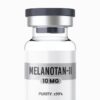
Melanotan II Melanocortin Peptide | 99% Purity

Original price was: $70.00.$57.00Current price is: $57.00.
Melanotan II Melanocortin Peptide is a synthetic cyclic heptapeptide analog of the naturally occurring alpha-melanocyte-stimulating hormone ($\alpha$-MSH). This non-selective agonist of the melanocortin receptors is primarily investigated for its ability to induce melanogenesis—the production of protective skin pigment—independent of UV exposure. In laboratory research, the Melanotan II Melanocortin Peptide is a critical tool for studying photoprotection, systemic lipid metabolism, and the regulation of appetite and sexual function through central nervous system pathways.
Melanotan II Melanocortin Peptide: The Science of Melanocortin Agonism
The Biochemistry of Melanotan II Melanocortin Peptide
The Melanotan II Melanocortin Peptide is engineered for enhanced stability and potency compared to endogenous $\alpha$-MSH. Its cyclic structure (Ac-Nle-cyclo[Asp-His-D-Phe-Arg-Trp-Lys]-NH2) protects it from rapid enzymatic degradation, allowing for a significantly longer biological half-life. By acting as a mimetic of the body’s natural signaling molecules, it binds with high affinity to various melanocortin receptors (MC1R, MC3R, MC4R, and MC5R), triggering a cascade of intracellular responses.
Mechanism of Action: Receptor-Specific Signaling
In advanced endocrinology and dermatological research, the Melanotan II Melanocortin Peptide functions through several distinct receptor-mediated pathways:
-
MC1R (Melanogenesis): Binding to the Melanocortin 1 Receptor on melanocytes stimulates the production of eumelanin (brown/black pigment) rather than pheomelanin (red/yellow pigment). This shift is studied for its role in increasing the skin’s inherent photoprotection against DNA damage.
-
MC4R (Metabolic and Sexual Regulation): Agonism of the MC4R in the hypothalamus is investigated for its role in appetite suppression and the regulation of energy expenditure. Additionally, central MC4R activation is studied for its impact on erectile function and libido.
-
MC3R (Systemic Energy Balance): The peptide’s interaction with MC3R is analyzed in models of obesity and metabolic syndrome to understand its effect on total body fat composition and glucose homeostasis.
-
Anti-Inflammatory Signaling: Research suggests that Melanotan II Melanocortin Peptide may exert systemic anti-inflammatory effects by modulating cytokine production through the melanocortin system.
Primary Research Applications of Melanotan II Melanocortin Peptide
-
Photobiology and Skin Cancer Research: Analyzing the induction of pigmentation as a barrier against UV-induced mutagenesis in fair-skinned models.
-
Metabolic Research: Investigating the peptide’s influence on weight loss, adipose tissue thermogenesis, and insulin sensitivity.
-
Neuroendocrine Studies: Studying the impact of central melanocortin activation on behavioral patterns, including feeding behavior and sexual arousal.
-
Inflammatory Disease Models: Observing the reduction of markers such as TNF-$\alpha$ and IL-6 in response to systemic melanocortin stimulation.
4. Technical Specifications (E-E-A-T Data)
| Feature | Scientific Specification |
| Peptide Sequence | Ac-Nle-cyclo[Asp-His-D-Phe-Arg-Trp-Lys]-NH2 |
| Molecular Formula | $C_{50}H_{69}N_{15}O_{9}$ |
| Molecular Weight | 1024.18 g/mol |
| CAS Number | 121062-08-6 |
| Purity Grade | $\geq$99% (HPLC & Mass Spec Verified) |
| Physical State | Lyophilized White Powder |
| Solubility | Highly Soluble in Water and Aqueous Buffers |
5. Product FAQ
Q: How does Melanotan II Melanocortin Peptide differ from Melanotan I?
A: While both stimulate pigmentation, Melanotan II Melanocortin Peptide is a cyclic heptapeptide with a smaller molecular structure and additional affinity for the MC4 receptor. This leads to additional metabolic and central nervous system effects that are not typically observed with the linear Melanotan I.
Q: Why is the purity of Melanotan II Melanocortin Peptide critical for research?
A: Due to its potent interaction with multiple receptor types, even minor impurities can lead to off-target effects or inconsistent data. Our Melanotan II Melanocortin Peptide is verified at $\geq$99% purity to ensure that all observed physiological changes are a direct result of melanocortin receptor agonism.
Only logged in customers who have purchased this product may leave a review.
Related products


LONGEVITY & CELLULAR REPAIR PEPTIDES
SS-31 Longevity | Elamipretide Mitochondrial Rejuvenation Peptide

WEIGHT MANAGEMENT & METABOLIC WELLNESS
Semaglutide (GLP-1 Analogue) | GLP-1 Agonist for Weight Loss

LONGEVITY & CELLULAR REPAIR PEPTIDES

LONGEVITY & CELLULAR REPAIR PEPTIDES
Epitalon (Epithalamin) 10mg | Telomerase Activator | $\geq$99% Purity
SLEEP & CIRCADIAN RHYTHM PEPTIDES

COGNITIVE & NEUROPROTECTIVE PEPTIDES
Semax Nootropic Neuropeptide | Advanced Neuroprotective Research
HORMONAL BALANCE & VITALITY
COGNITIVE & NEUROPROTECTIVE PEPTIDES
Reviews
There are no reviews yet.