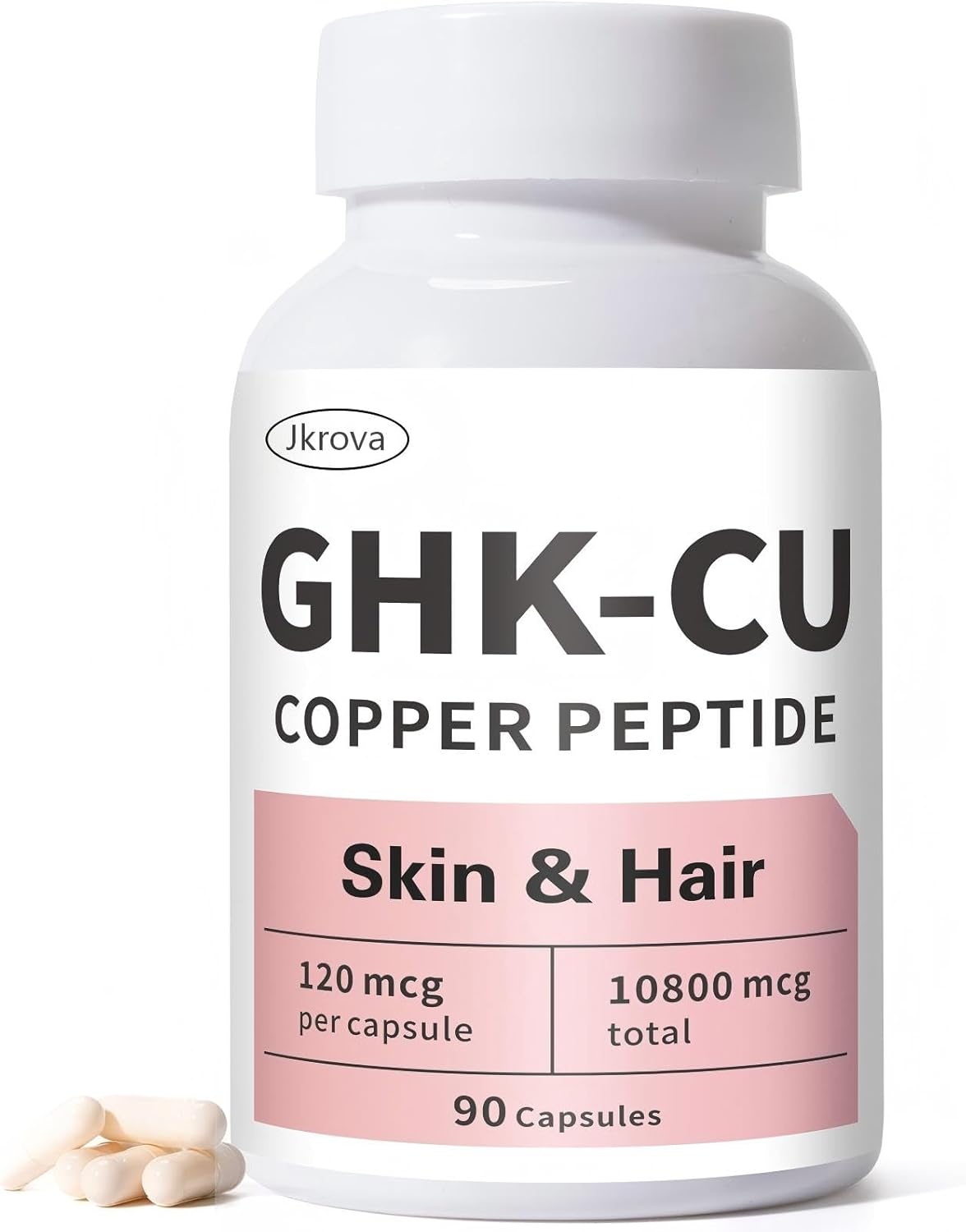
GHK-Cu (Copper Peptide) | 99% Purity Skin & Hair Research


Original price was: $80.00.$65.00Current price is: $65.00.
GHK-Cu (Copper Peptide) is a naturally occurring copper-binding tripeptide (Glycyl-L-Histidyl-L-Lysine) widely studied for its profound regenerative capabilities. Originally isolated from human plasma, GHK-Cu (Copper Peptide) functions as a master signaling molecule that coordinates the “wound healing cascade.” In research environments, it is investigated for its ability to reset gene expression to a youthful state, stimulate collagen and elastin production, and promote the health of both skin and hair follicle cells.
GHK-Cu (Copper Peptide): The Master Regulator of Tissue Remodeling
The Biochemistry of GHK-Cu (Copper Peptide)
The structure of GHK-Cu (Copper Peptide) consists of three amino acids with a high affinity for copper ($Cu^{2+}$). This complex is essential because it acts as a carrier, delivering copper into cells where it serves as a critical co-factor for enzymes such as Superoxide Dismutase (SOD) and Lysyl Oxidase. Unlike generic copper complexes, the specific sequence of GHK-Cu (Copper Peptide) allows it to modulate a vast array of biological pathways, including the regulation of over 4,000 human genes.
Mechanism of Action: DNA Repair and Extracellular Matrix Synthesis
In advanced molecular research, GHK-Cu (Copper Peptide) operates through several specialized pathways:
-
Dermal Matrix Repair: GHK-Cu (Copper Peptide) stimulates fibroblasts to increase the production of Collagen Type I, Glycosaminoglycans (GAGs), and Elastin. This restores the structural integrity of the dermal scaffold.
-
Gene Expression Reset: Research demonstrates that GHK-Cu (Copper Peptide) can shift gene expression from a pro-inflammatory/aging profile to a pro-regenerative profile, specifically influencing genes involved in DNA repair and antioxidant defense.
-
Angiogenesis: The peptide is studied for its ability to promote the formation of new blood vessels, enhancing the microcirculation required for tissue repair.
-
Hair Follicle Support: In trichology research, GHK-Cu (Copper Peptide) is observed to increase hair follicle size and stimulate the proliferation of follicular cells, potentially prolonging the anagen (growth) phase.
Primary Research Applications of GHK-Cu (Copper Peptide)
-
Anti-Aging and Cosmeceutical Research: Analyzing the reduction of wrinkles, fine lines, and age spots.
-
Wound Healing and Scar Mitigation: Investigating the acceleration of skin barrier restoration and the normalization of collagen deposition to prevent keloid formation.
-
Anti-Inflammatory Studies: Studying the peptide’s ability to lower levels of pro-inflammatory cytokines like IL-6 and TNF-alpha.
-
Stem Cell Research: Observing the effect of GHK-Cu (Copper Peptide) on the “stemness” and proliferative capacity of epidermal basal cells.
4. Technical Specifications (E-E-A-T Data)
| Feature | Scientific Specification |
| Peptide Sequence | Glycyl-L-Histidyl-L-Lysine (Copper Complex) |
| Molecular Formula | $C_{14}H_{22}CuN_{6}O_{4}$ |
| Molecular Weight | 401.91 g/mol |
| CAS Number | 89030-95-5 |
| Purity Grade | $\geq$99% (HPLC & Mass Spec Verified) |
| Appearance | Deep Blue Lyophilized Powder |
| Solubility | Highly Soluble in Water and Aqueous Buffers |
5. Product FAQ
Q: Why is the color of GHK-Cu (Copper Peptide) so important?
A: A high-quality GHK-Cu (Copper Peptide) should appear as a vibrant, characteristic blue. This color indicates that the copper ion is properly chelated (bound) to the tripeptide. If the powder is white or pale, it likely lacks the copper component necessary for biological activity.
Q: Does GHK-Cu (Copper Peptide) cross the skin barrier?
A: Due to its small molecular weight ($<$500 Daltons), GHK-Cu (Copper Peptide) has excellent potential for topical penetration in research models, especially when used in a serum or aqueous base designed for dermal delivery.
Only logged in customers who have purchased this product may leave a review.
Related products

COLLAGEN & RECOVERY PEPTIDES

COLLAGEN & RECOVERY PEPTIDES

COLLAGEN & RECOVERY PEPTIDES

COLLAGEN & RECOVERY PEPTIDES
BPC-157 (Body Protection Compound) | 99% Purity Gastric & Tissue Repair

COLLAGEN & RECOVERY PEPTIDES
Pentosan Polysulphate Peptide Analogue | Advanced GAG Mimetic Research

COLLAGEN & RECOVERY PEPTIDES
L-Glutamine Peptide Complex | High-Purity Bioavailable Nitrogen
COLLAGEN & RECOVERY PEPTIDES
TB-500 (Thymosin Beta-4) | Advanced Cellular Migration & Recovery

COLLAGEN & RECOVERY PEPTIDES
Type II Collagen + Boswellia Complex | Advanced Cartilage Signaling

Reviews
There are no reviews yet.