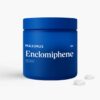
Enclomiphene | Advanced HPG Axis & SERM

$79.00
Enclomiphene is the purified trans-isomer of clomiphene citrate, categorized as a non-steroidal Selective Estrogen Receptor Modulator (SERM). Unlike its counterpart, zuclomiphene, which exhibits estrogenic activity, Enclomiphene acts as a potent estrogen receptor antagonist. In endocrine research, it is investigated for its ability to stimulate the hypothalamic-pituitary-gonadal (HPG) axis, thereby increasing the natural production of gonadotropins and endogenous testosterone without the suppressive effects associated with exogenous hormone replacement.
Enclomiphene: The Science of Estrogen Antagonism and HPG Modulation
The Biochemistry of Enclomiphene
Enclomiphene ($C_{26}H_{28}ClNO$) is the specific isomer responsible for the pro-gonadotropic effects of clomiphene. By isolating this isomer, researchers can study its antagonistic effects on estrogen receptors in the hypothalamus and pituitary gland without the long-lasting estrogenic interference of zuclomiphene. This makes it a primary subject for investigating pure estrogen blockade and its secondary effects on male reproductive hormones.
Mechanism of Action: Restoring the HPG Axis
In advanced endocrinology and reproductive research, Enclomiphene functions through several coordinated physiological pathways:
-
Hypothalamic Estrogen Blockade: The compound binds to estrogen receptors in the hypothalamus, preventing the negative feedback normally exerted by circulating estrogen.
-
Stimulation of GnRH: By “tricking” the brain into sensing a deficit of sex hormones, Enclomiphene triggers an increase in the pulsatile release of Gonadotropin-Releasing Hormone (GnRH).
-
Upregulation of LH and FSH: Increased GnRH signals the anterior pituitary to secrete Luteinizing Hormone (LH) and Follicle-Stimulating Hormone (FSH).
-
Endogenous Testosterone Synthesis: In research models, elevated LH levels stimulate the Leydig cells in the testes to produce higher levels of endogenous testosterone, while FSH supports spermatogenesis.
Primary Research Applications
-
Secondary Hypogonadism Modeling: Analyzing the restoration of testosterone levels in subjects with a functional but suppressed HPG axis.
-
Spermatogenesis Studies: Investigating the impact of increased FSH and LH on sperm count and motility in laboratory settings.
-
Metabolic Impact of Testosterone: Studying how stimulated endogenous testosterone affects lean muscle mass, bone density, and lipid metabolism.
-
Comparison to TRT: Observing the physiological differences between stimulating natural testosterone production versus providing exogenous testosterone replacement.
4. Technical Specifications (E-E-A-T Data)
| Feature | Scientific Specification |
| Chemical Name | 2-[4-(2-chloro-1,2-diphenylethenyl)phenoxy]-N,N-diethylethanamine |
| Molecular Formula | $C_{26}H_{28}ClNO$ |
| Molecular Weight | 405.96 g/mol |
| CAS Number | 15690-57-0 |
| Purity Grade | $\geq$99% (HPLC Verified) |
| Form | Research Grade Capsules (Standardized Concentration) |
| Isomeric Purity | Purified Trans-Isomer (Zero Zuclomiphene Content) |
5. Product FAQ
Q: How does Enclomiphene differ from Clomiphene Citrate (Clomid)?
A: Clomiphene is a mixture of two isomers: Enclomiphene (antagonist) and Zuclomiphene (agonist). By using only the purified Enclomiphene isomer, researchers can avoid the estrogenic side effects associated with zuclomiphene, such as mood disturbances or visual disturbances in research subjects.
Q: Does Enclomiphene suppress natural testosterone?
A: No. Unlike exogenous testosterone, which shuts down the HPG axis, Enclomiphene is researched for its ability to stimulate the HPG axis, increasing the body’s natural production of testosterone.
Related products

GROWTH HORMONE SECRETAGOGUES

ENDURANCE & ENERGY PEPTIDES
Humanin (HN) 10mg | High-Purity Mitochondrial-Derived Peptide | $\geq$99% Purity

GROWTH HORMONE SECRETAGOGUES

PERFORMANCE PEPTIDES
Kisspeptin-10 (Kiss-1) 10mg | High-Purity GPR54 Agonist | $\geq$99% Purity

MUSCLE GROWTH & ANABOLIC PEPTIDES
PEG-MGF (Pegylated MGF) 2mg | Long-Acting Muscle Recovery Peptide
GROWTH HORMONE SECRETAGOGUES
Hexarelin Peptide | High-Purity 2mg Vial | Advanced Cardioprotective Research

FAT LOSS & METABOLIC PEPTIDES
5-Amino-1MQ | Selective NNMT Inhibitor | Metabolic Research Standard

GROWTH HORMONE SECRETAGOGUES