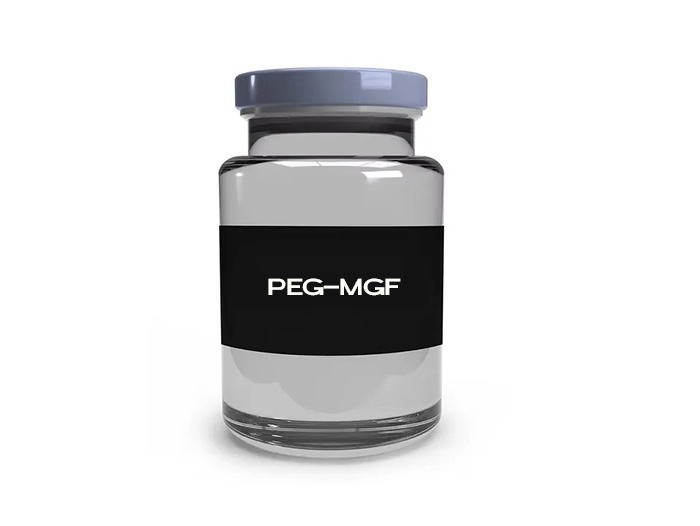
PEG-MGF (Pegylated MGF) 2mg | Long-Acting Muscle Recovery Peptide

Original price was: $90.00.$65.00Current price is: $65.00.
PEG-MGF (Pegylated Mechano Growth Factor) is a breakthrough splice variant of IGF-1, specifically the IGF-1Ec isoform, that has been pegylated to dramatically increase its systemic half-life. Unlike standard MGF, which degrades in minutes, it remains stable in the bloodstream for several days. This extended stability allows it to continuously stimulate muscle satellite cells, facilitating superior localized tissue repair and hypertrophic signaling in research models.
PEG-MGF: The Science of Extended Mechano Growth Factor Signaling
Understanding PEG-MGF and the Pegylation Process
PEG-MGF is the pegylated version of Mechano Growth Factor (MGF), a peptide naturally produced in response to muscle loading and tissue damage. In its raw state, MGF is highly unstable. By attaching a Polyethylene Glycol (PEG) molecule—a process known as pegylation—the peptide is shielded from enzymatic breakdown and rapid renal clearance. This modification transforms it from a transient signal into a long-lasting research tool that sustains elevated levels of IGF-1Ec in target tissues.
Mechanism of Action: Satellite Cell Recruitment
The primary function of PEG-MGF in biological research is the activation of muscle satellite cells (stem cells).
-
Proliferation Phase: PEG-MGF triggers the division of dormant satellite cells, increasing the pool of available nuclei for muscle fiber repair.
-
Myoblast Fusion: It promotes the fusion of these new cells with existing damaged fibers, increasing the cross-sectional area of the muscle tissue.
-
Hypertrophic Signaling: By modulating the AKT/mTOR pathway, PEG-MGF enhances protein synthesis and nitrogen retention, key markers of localized hypertrophy.
PEG-MGF vs. Standard MGF: Stability Metrics
Research indicates that standard MGF has a half-life of roughly 5–7 minutes, limiting its impact to the immediate site of a high-load event. In contrast, PEG-MGF exhibits a half-life of 48 to 72 hours. This allows it to circulate systemically while still exerting its most potent effects on receptors within damaged muscle groups, making it a far more efficient subject for longitudinal recovery studies.
4. Technical Specifications (E-E-A-T Data)
| Feature | Scientific Specification |
| Full Name | Pegylated Mechano Growth Factor (IGF-1Ec variant) |
| Molecular Weight | ~2875.5 Da (Peptide) + PEG Weight |
| Purity Grade | $\geq$99% (HPLC & MS Verified) |
| CAS Number | 120287-85-6 (MGF base) |
| Physical State | Lyophilized White Powder |
| Stability | PEG-MGF is stable for 24 months at -20°C |
5. Product FAQ (Schema-Ready)
Q: Why is PEG-MGF preferred over IGF-1 LR3?
A: While both are IGF-1 derivatives, PEG-MGF specifically focuses on the initial recruitment of satellite cells and the proliferation of new myoblasts. In many research protocols, PEG-MGF is used to “prime” the muscle for repair, while IGF-1 LR3 is studied for its ability to drive nutrient uptake and cell maturation.
Q: How does the pegylation of PEG-MGF affect its bioavailability?
A: The PEG molecule protects the peptide from proteolysis and reduces its immunogenicity. This results in a significantly higher area-under-the-curve (AUC) in pharmacokinetic studies, meaning the PEG-MGF remains bioactive in the system for a much longer duration than non-pegylated variants.
Related products

PERFORMANCE PEPTIDES
Kisspeptin-10 (Kiss-1) 10mg | High-Purity GPR54 Agonist | $\geq$99% Purity


PERFORMANCE PEPTIDES
GnRH (Gonadorelin) 2mg | High-Purity Decapeptide | HPTA Standard

FAT LOSS & METABOLIC PEPTIDES
Tesamorelin 2mg | High-Purity GHRH Analog | Visceral Fat Research

ENDURANCE & ENERGY PEPTIDES
Selank Peptide | 10mg High-Purity Tuftsin Analog | Neuro-Research Grade

ENDURANCE & ENERGY PEPTIDES
Humanin (HN) 10mg | High-Purity Mitochondrial-Derived Peptide | $\geq$99% Purity

PERFORMANCE PEPTIDES
Thymalin (Thymus Peptide) 10mg | High-Purity Immunomodulatory
GROWTH HORMONE SECRETAGOGUES
Hexarelin Peptide | High-Purity 2mg Vial | Advanced Cardioprotective Research