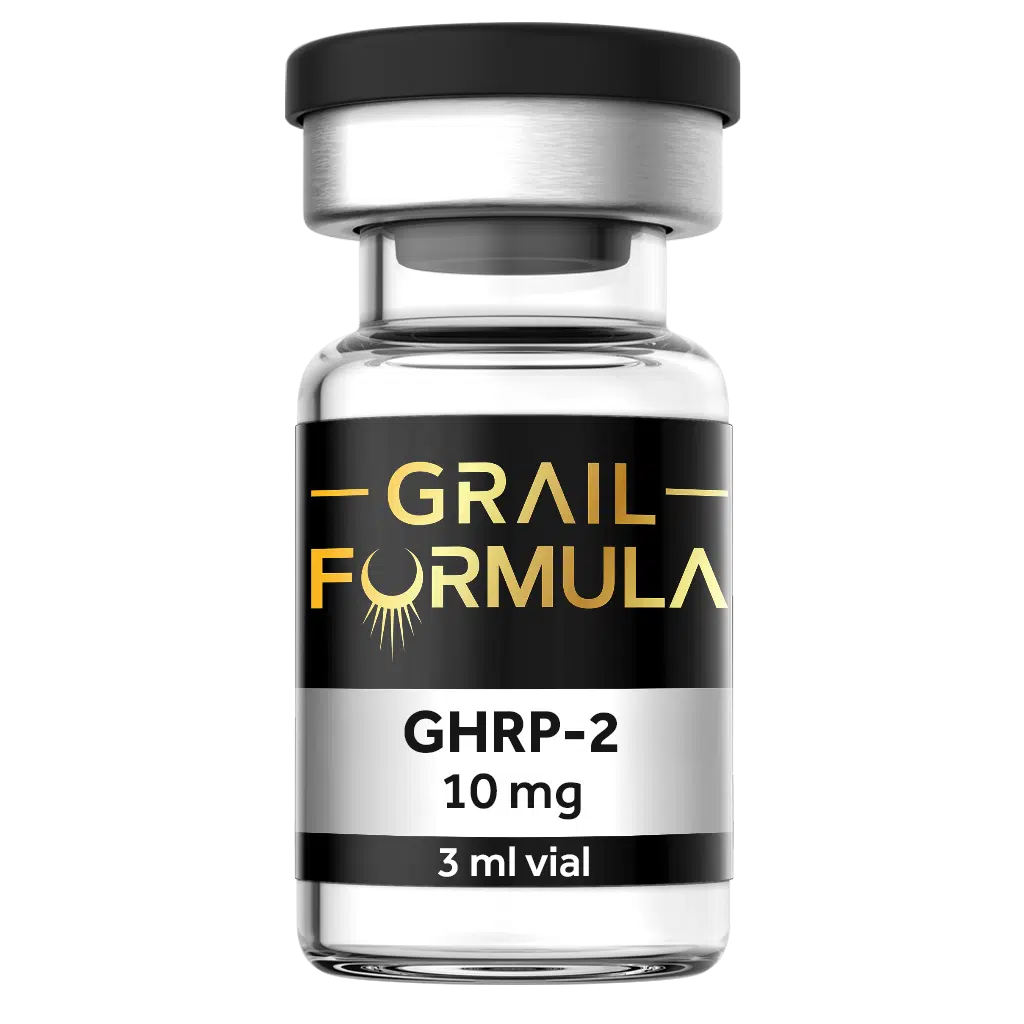


GHRP-2 | Advanced Growth Hormone Releasing Peptide Research
Original price was: $65.00.$50.00Current price is: $50.00.
GHRP-2 (Growth Hormone Releasing Peptide-2), also known as Pralmorelin, is a synthetic hexapeptide ($D-Ala-D-2-Nal-Ala-Trp-D-Phe-Lys-NH_2$) that acts as a potent, non-natural growth hormone secretagogue. In advanced endocrine research, GHRP-2 is investigated for its ability to stimulate the pituitary gland to release endogenous growth hormone (GH) via the ghrelin receptor. It is distinguished in laboratory models for its high efficacy and its moderate impact on secondary hormonal pathways, such as prolactin and cortisol, when compared to other GHRP analogs.
GHRP-2: The Science of Somatotropic Signaling and GHS-R Agonism
The Biochemistry of GHRP-2
The molecular structure of GHRP-2 is engineered for high stability and specific binding affinity to the Growth Hormone Secretagogue Receptor (GHS-R1a). As a second-generation GHRP, it serves as a critical tool for studying the pulsatile secretion of GH. Unlike exogenous growth hormone, GHRP-2 triggers the body’s own production mechanisms, allowing researchers to observe the natural feedback loops of the somatotropic axis.
Mechanism of Action: GHS-R1a Activation and Ghrelin Mimicry
In advanced endocrinology and metabolic research, GHRP-2 functions through several coordinated physiological pathways:
-
Pituitary GHS-R1a Binding: The peptide acts as a selective agonist of the ghrelin receptor in the anterior pituitary, stimulating the rapid release of stored growth hormone.
-
Hypothalamic Modulation: Research focuses on its ability to inhibit somatostatin (the “growth hormone-inhibiting hormone”) while simultaneously increasing the frequency of GH pulses.
-
Appetite and Orexigenic Signaling: GHRP-2 is studied for its role in modulating appetite through the activation of NPY neurons in the hypothalamus, mimicking the effects of the “hunger hormone” ghrelin.
-
Secondary Endocrine Impact: While highly selective for GH, research observes that GHRP-2 may cause minor, dose-dependent increases in ACTH, cortisol, and prolactin levels in certain research models.
Primary Research Applications
-
GH Deficiency Diagnosis: Analyzing the functional capacity of the pituitary gland to secrete growth hormone under stimulation.
-
Skeletal Muscle Anabolism: Investigating the indirect effects of increased GH/IGF-1 levels on muscle protein synthesis and nitrogen retention.
-
Metabolic and Lipid Research: Studying the impact of somatotropic signaling on adipose tissue lipolysis and systemic glucose metabolism.
-
Age-Related Endocrine Decline: Observing the restoration of youthful GH pulse amplitudes in aging laboratory models.
4. Technical Specifications (E-E-A-T Data)
| Feature | Scientific Specification |
| Peptide Sequence | D-Ala-D-2-Nal-Ala-Trp-D-Phe-Lys-NH2 |
| Molecular Formula | $C_{45}H_{55}N_{9}O_{6}$ |
| Molecular Weight | 817.9 g/mol |
| CAS Number | 158861-67-7 |
| Purity Grade | $\geq$99% (HPLC & Mass Spec Verified) |
| Physical State | Lyophilized White Powder |
| Solubility | Soluble in Water and Saline |
5. Product FAQ
Q: How does GHRP-2 differ from GHRP-6 in research?
A: Research indicates that GHRP-2 is typically more potent in terms of growth hormone release than GHRP-6. Additionally, GHRP-2 is often preferred in studies where intense appetite stimulation (a common side effect of GHRP-6) needs to be minimized, as its orexigenic effect is generally considered less severe.
Q: Is GHRP-2 the same as Pralmorelin?
A: Yes, Pralmorelin is the international nonproprietary name (INN) for GHRP-2. Both terms refer to the same synthetic hexapeptide used in somatotropic research.
Only logged in customers who have purchased this product may leave a review.
Related products

RESEARCH-GRADE COMPOUNDS
GROWTH HORMONE SECRETAGOGUES
Hexarelin Peptide | High-Purity 2mg Vial | Advanced Cardioprotective Research

GLP-1 & METABOLIC RESEARCH COMPOUNDS
GIP Peptide | Gastric Inhibitory Polypeptide Research Analysis

GLP-1 & METABOLIC RESEARCH COMPOUNDS

NEUROPEPTIDE RESEARCH COMPOUNDS


NEUROPEPTIDE RESEARCH COMPOUNDS


EMERGING & SPECIALIST RESEARCH PEPTIDES

GROWTH HORMONE RESEARCH PEPTIDES
Hexarelin | Advanced GHRP & Growth Hormone Research Compound

Reviews
There are no reviews yet.