MGF (Mechano Growth Factor) | 2mg High-Purity Peptide

Original price was: $100.00.$79.00Current price is: $79.00.
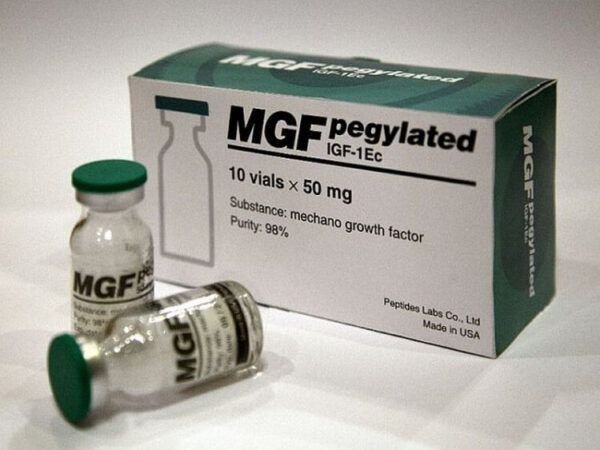
MGF (Mechano Growth Factor), scientifically classified as the IGF-1Ec splice variant, is a potent local tissue repair factor produced naturally when muscle fibers are stretched or damaged. Unlike systemic IGF-1, MGF acts as a localized “rescue” signal, triggering the proliferation of dormant satellite cells to replace damaged muscle tissue. This research-grade MGF is provided in its native, non-pegylated form for studies requiring rapid, high-intensity local signaling.
MGF (Mechano Growth Factor): The Native Catalyst for Local Myogenesis
The Biology of the IGF-1Ec Splice Variant
MGF is derived from the IGF-I gene through a process called alternative splicing. While the liver produces systemic IGF-1, skeletal muscle produces MGF in direct response to mechanical stress. This peptide contains a unique E-domain (the C-terminal end), which is responsible for its ability to activate muscle stem cells independently of the IGF-1 receptor. In its native state, MGF serves as the body’s first responder to structural micro-trauma.
Mechanism of Action: The “Repair and Regrow” Phase
In a controlled research environment, MGF operates through a distinct biological pathway to facilitate tissue restoration:
-
Satellite Cell Proliferation: MGF is the primary signal that tells satellite cells to stop resting and start dividing. This increases the total pool of myoblasts available for repair.
-
Prevention of Premature Differentiation: Crucially, MGF prevents these new cells from maturing too quickly. This ensures a larger volume of “building blocks” is created before the final fusion into muscle fibers occurs.
-
Local Upregulation: Because it is non-pegylated, MGF provides a high-intensity, short-duration signal that mimics the natural “burst” of growth factor activity following physical exertion.
MGF vs. PEG-MGF: Strategic Research Differences
Choosing between MGF and PEG-MGF depends on the desired duration of action:
-
MGF (Native): Has a half-life measured in minutes. It is preferred for studies focused on the immediate acute response to tissue damage or localized site-specific signaling.
-
PEG-MGF (Pegylated): Has a half-life of 48-72 hours. It is designed for systemic circulation and sustained signaling over several days.
-
Research Utility: Using native MGF allows researchers to observe the rapid onset of satellite cell recruitment without the prolonged metabolic elevation associated with pegylated versions.
4. Technical Specifications (E-E-A-T Data)
| Feature | Scientific Specification |
| Full Chemical Name | Mechano Growth Factor (IGF-1Ec) |
| Molecular Formula | $C_{121}H_{200}N_{42}O_{39}$ |
| Molecular Weight | 2867.2 g/mol |
| CAS Number | 120287-85-6 |
| Purity Grade | $\geq$98.5% (HPLC Verified) |
| Reconstitution | Recommended with Bacteriostatic Water or Sterile Saline |
5. Product FAQ
Q: Is MGF effective without pegylation?
A: Yes. Native MGF is highly effective for observing the immediate cellular response to mechanical load. While its half-life is shorter, its ability to trigger rapid satellite cell division is unmatched for acute phase research.
Q: How does MGF differ from IGF-1 LR3?
A: MGF primarily drives the proliferation (multiplication) of new cells, whereas IGF-1 LR3 is more involved in the differentiation and maturation of those cells. Many researchers study these two peptides sequentially to observe the full cycle of myogenesis.
Related products

PERFORMANCE PEPTIDES
Hydrolysed Collagen Peptides (Type I & III) | Grass-Fed | Multi-Tissue Support

ENDURANCE & ENERGY PEPTIDES
Humanin (HN) 10mg | High-Purity Mitochondrial-Derived Peptide | $\geq$99% Purity

MUSCLE GROWTH & ANABOLIC PEPTIDES
PEG-MGF (Pegylated MGF) 2mg | Long-Acting Muscle Recovery Peptide


PERFORMANCE PEPTIDES
GnRH (Gonadorelin) 2mg | High-Purity Decapeptide | HPTA Standard

GROWTH HORMONE SECRETAGOGUES

MUSCLE GROWTH & ANABOLIC PEPTIDES
TB-500 (Thymosin Beta-4) 5mg | High-Purity Regenerative Peptide | $\geq$99% Purity

GROWTH HORMONE SECRETAGOGUES
CJC-1295 + Ipamorelin Blend (5mg/5mg) | Synergistic GHS Research