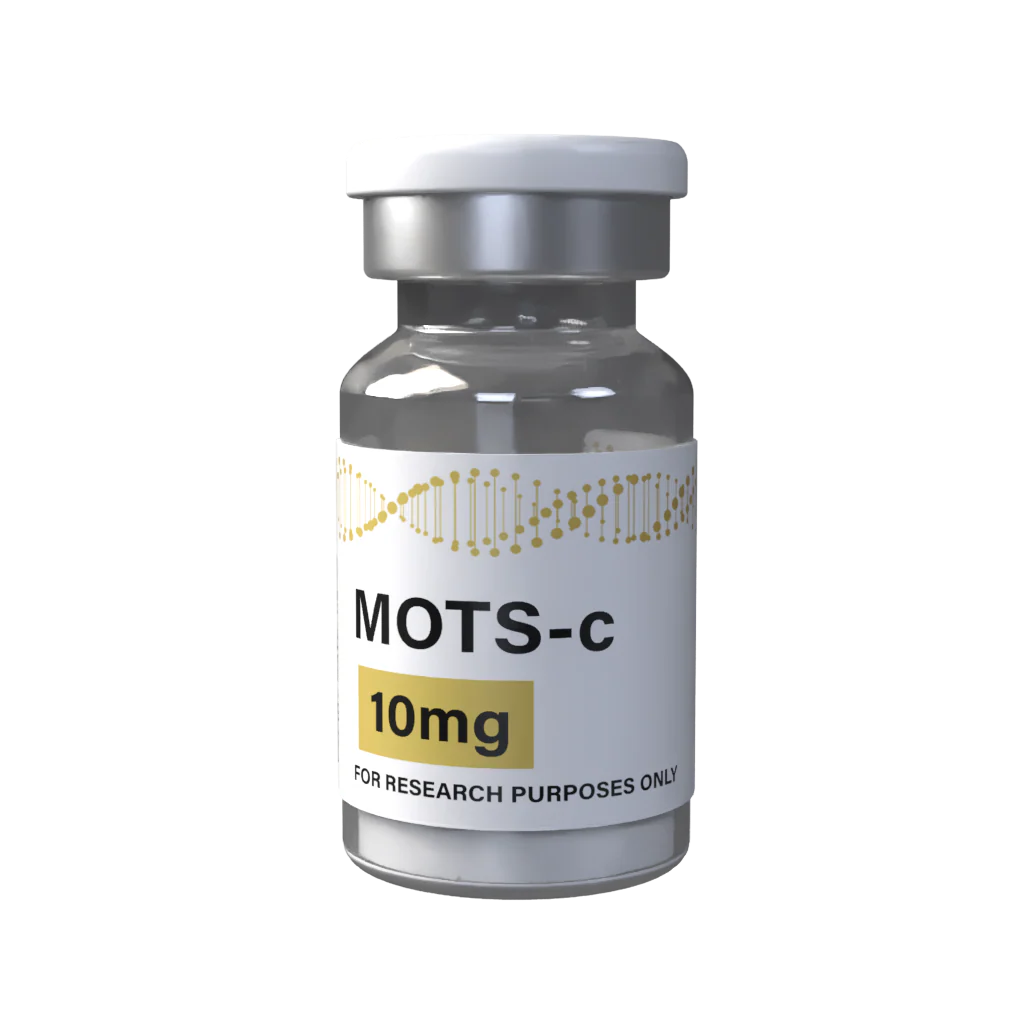
MOTS-c | Mitochondrial-Derived Peptide & Metabolic Research


Original price was: $160.00.$149.00Current price is: $149.00.
MOTS-c (Mitochondrial Open Reading Frame of the 12S rRNA-c) is a unique, naturally occurring 16-amino acid peptide encoded by the mitochondrial genome. Unlike most peptides encoded in the nucleus, MOTS-c is a mitochondrial-derived peptide (MDP) that functions as a potent metabolic signaling molecule. In laboratory research, it is primarily investigated for its ability to regulate systemic energy homeostasis, acting as an “exercise mimetic” that enhances metabolic flexibility and promotes healthy aging.
MOTS-c: The Science of Mitochondrial Signaling and Metabolic Flexibility
The Biochemistry of MOTS-c
MOTS-c represents a paradigm shift in molecular biology, demonstrating that the mitochondrial genome possesses its own signaling capacity to communicate with the nucleus. This 16-amino acid peptide ($Met-Arg-Trp-Gln-Glu-Met-Gly-Tyr-Ile-Phe-Ala-Leu-Lys-Pro-Arg-Trp$) translocates to the nucleus in response to metabolic stress, where it regulates nuclear gene expression. Its primary role is the protection of metabolic health by sensing and responding to the energetic state of the cell.
Mechanism of Action: AMPK Activation and AICAR Induction
In advanced metabolic and longevity research, MOTS-c functions through several coordinated physiological pathways:
-
AMPK Pathway Activation: The peptide is studied for its ability to activate AMP-activated protein kinase (AMPK), the master regulator of energy metabolism, which enhances glucose uptake and fatty acid oxidation.
-
Folate Cycle Regulation: Research focuses on the peptide’s capacity to inhibit the folate cycle, leading to the accumulation of 5-aminoimidazole-4-carboxamide ribonucleotide (AICAR), a natural activator of AMPK.
-
Insulin Sensitivity Enhancement: MOTS-c is investigated for its role in improving skeletal muscle insulin sensitivity, making it a focal point for studies involving metabolic dysfunction and obesity.
-
Exercise Mimicry: Research models suggest that MOTS-c levels increase during exercise, and exogenous administration can mimic many of the physiological benefits of physical activity, including improved physical performance and heat tolerance.
Primary Research Applications
-
Metabolic Syndrome Modeling: Analyzing the reduction of weight gain and the stabilization of blood glucose levels in high-fat diet models.
-
Longevity and Anti-Aging Research: Investigating the peptide’s role in preventing age-related metabolic decline and maintaining muscle mass.
-
Skeletal Muscle Homeostasis: Studying the impact of mitochondrial signaling on myoblast differentiation and glucose metabolism.
-
Osteoporosis Research: Observing the impact of MOTS-c on osteoblast function and its potential to prevent bone loss in estrogen-deficient models.
4. Technical Specifications (E-E-A-T Data)
| Feature | Scientific Specification |
| Peptide Type | Mitochondrial-Derived Peptide (MDP) |
| Amino Acid Count | 16 Amino Acids |
| Molecular Formula | $C_{101}H_{152}N_{28}O_{22}S_{2}$ |
| Molecular Weight | 2174.6 g/mol |
| Purity Grade | $\geq$99% (HPLC & Mass Spec Verified) |
| Physical State | Lyophilized White Powder |
| Solubility | Soluble in Water and Saline |
5. Product FAQ
Q: Why is MOTS-c called a “Mitochondrial-Derived Peptide”?
A: It is called a mitochondrial-derived peptide because it is encoded by the mitochondrial DNA (specifically the 12S rRNA gene) rather than the nuclear DNA. This makes it part of a rare class of peptides that facilitate “retrograde signaling” between mitochondria and the rest of the cell.
Q: How does MOTS-c function as an “exercise mimetic”?
A: Research indicates that MOTS-c activates the same metabolic pathways triggered by physical exertion—specifically the AMPK pathway. In laboratory studies, it has been shown to increase physical capacity and improve metabolic efficiency, effectively mimicking the cellular signals generated during intense exercise.
Only logged in customers who have purchased this product may leave a review.
Related products

NEUROPEPTIDE RESEARCH COMPOUNDS

NEUROPEPTIDE RESEARCH COMPOUNDS


RESEARCH-GRADE COMPOUNDS
BPC-157 | Advanced Tissue Repair & Gastric Research Compound

RESEARCH-GRADE COMPOUNDS

GLP-1 & METABOLIC RESEARCH COMPOUNDS
GROWTH HORMONE RESEARCH PEPTIDES

FAT LOSS & METABOLIC PEPTIDES
MOTS-c Peptide 10mg | Mitochondrial Exercise Mimetic | $\geq$99% Purity

Reviews
There are no reviews yet.