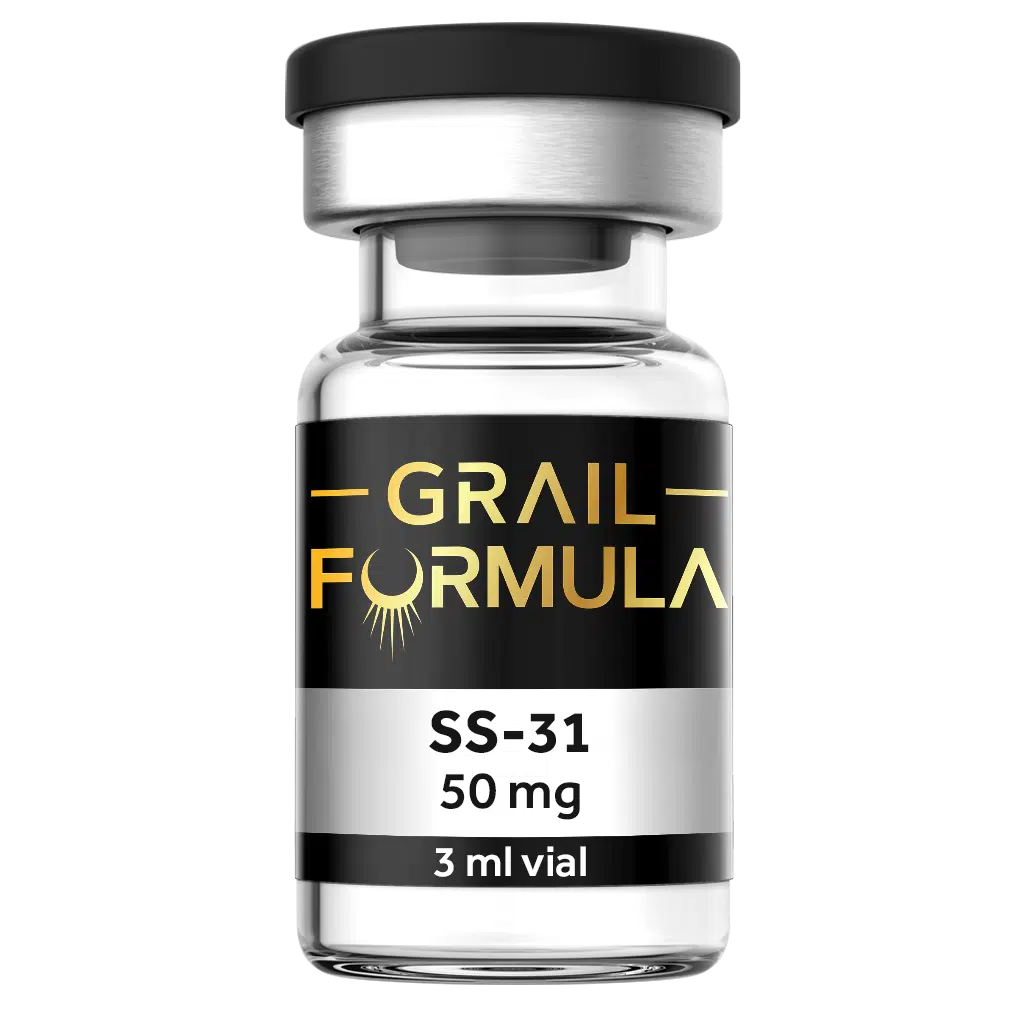



SS-31 Longevity | Elamipretide Mitochondrial Rejuvenation Peptide

Original price was: $180.00.$169.00Current price is: $169.00.
SS-31 Longevity research represents a breakthrough in the Mitochondrial Theory of Aging. As a cell-permeable tetrapeptide, SS-31 (also known as Elamipretide) selectively targets the inner mitochondrial membrane. By stabilizing cardiolipin, SS-31 Longevity protocols focus on repairing the structural foundation of cellular energy production. In aging models, this peptide is studied for its ability to reset mitochondrial efficiency and drastically reduce the oxidative stress that drives systemic decline.
SS-31 Longevity: Reversing Mitochondrial Decay at the Source
The Role of Cardiolipin in SS-31 Longevity
The primary mechanism behind SS-31 Longevity involves the protection of cardiolipin, a phospholipid essential for mitochondrial cristae structure. Aging causes cardiolipin to oxidize, leading to “leaky” mitochondria and cellular death signals. SS-31 Longevity research demonstrates that by binding to cardiolipin, the peptide prevents this degradation, effectively maintaining a youthful metabolic state within the cell.
Strategic Benefits of SS-31 Longevity Research
-
Optimization of the Electron Transport Chain: SS-31 Longevity is defined by its ability to enhance the flow of electrons through Complexes I-IV, ensuring maximum ATP production with minimal free radical byproduct.
-
Mitigation of Inflammaging: By reducing mitochondrial reactive oxygen species (ROS), SS-31 Longevity protocols study the downregulation of the NLRP3 inflammasome, a major driver of age-related systemic inflammation.
-
Cellular Senescence Delay: Maintaining mitochondrial membrane potential ($Δψm$) via SS-31 Longevity is a key strategy for preventing cells from entering a senescent, non-dividing state.
4. Technical Specifications (E-E-A-T Data)
| Feature | Scientific Specification |
| Full Chemical Name | D-Arg-2′,6′-dimethyltyrosyl-Lys-Phe-NH2 |
| Peptide Sequence | D-Arg-Dmt-Lys-Phe-NH2 |
| Molecular Formula | $C_{32}H_{49}N_{9}O_{5}$ |
| Molecular Weight | 639.8 g/mol |
| CAS Number | 736992-21-5 |
| Purity Grade | $\geq$99% (HPLC & Mass Spec Verified) |
| Physical State | Lyophilized White Powder |
5. Product FAQ
Q: Why is SS-31 Longevity a focal point for anti-aging researchers?
A: Unlike standard antioxidants, SS-31 Longevity is achieved through mitochondrial-targeted action. It concentrates within the inner mitochondrial membrane to fix the “engine” of the cell rather than just cleaning up the “exhaust.”
Q: Does SS-31 Longevity research include neuroprotection?
A: Yes. Because it crosses the blood-brain barrier, SS-31 Longevity is a primary subject in studies involving age-related cognitive decline and neuronal energy restoration.
Only logged in customers who have purchased this product may leave a review.
Related products

COGNITIVE & NEUROPROTECTIVE PEPTIDES
Semax Nootropic Neuropeptide | Advanced Neuroprotective Research

LONGEVITY & CELLULAR REPAIR PEPTIDES
Epitalon (Epithalamin) 10mg | Telomerase Activator | $\geq$99% Purity
SLEEP & CIRCADIAN RHYTHM PEPTIDES
SLEEP & CIRCADIAN RHYTHM PEPTIDES
HORMONAL BALANCE & VITALITY


COGNITIVE & NEUROPROTECTIVE PEPTIDES

LONGEVITY & CELLULAR REPAIR PEPTIDES
SLEEP & CIRCADIAN RHYTHM PEPTIDES
Reviews
There are no reviews yet.